
For years, the familiar blue bottle of Parachute coconut oil has been a constant in Ankita Bansal’s Delhi home, just as it is in millions of households across India.
Every two months, like clockwork, she would pick up her regular 500ml pack. For her, it’s just an unassuming purchase, a ritual. But for Marico, these blue bottles drive about 35% of its domestic revenue.
To make this oil, the fast-moving consumer goods (FMCG) major needs copra, the dried coconut kernel. Through 2025–26, its price roughly doubled. As a result, Marico had to raise Parachute oil prices by a steep 60%, a harsh blow for a basic household staple.

1 November 2026
Get the latest issue of Outlook Business

For everyday shoppers like Bansal, this meant adjusting tight monthly budgets and swapping their large bottles for smaller, more affordable packs. Consequently, though Parachute’s revenue jumped, actual volume slipped.
When coconut prices finally eased this year, Marico passed on a 10% price cut to its larger packs, and shoppers rushed back. In the April–June quarter, Parachute clocked a 10% volume growth, marking its strongest performance in 20 quarters.
However, Marico cautioned against reading too much into it. Pawan Agrawal, group chief financial officer and chief executive, international business, called the surge an aberration during the August earnings call. “We don’t really expect ourselves to keep delivering high single-digit or 10% volume growth for the year.”
That matters because the company is chasing an ambitious target to expand its ₹13,611cr revenue in 2025–26 to a ₹20,000cr by 2029–30.
However, its legacy cash engines, Parachute and Saffola, are at the mercy of volatile commodity markets they cannot control. Also, both brands are highly penetrated.
Parachute already commands nearly 60% of the coconut oil market by volume. “When your core categories are highly penetrated, the headroom for growth is in the high single digits even if you do well,” says Saugata Gupta, managing director and chief executive, Marico. “As an organisation, we aspire to double our business every five years, which means delivering a mid-teen compounded annual growth rate,” he adds.
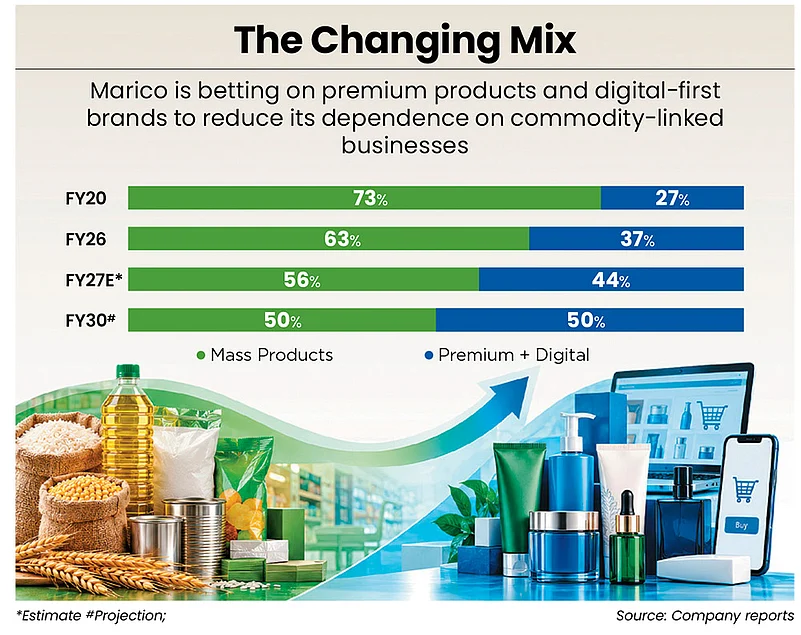
To reach that target, Marico wants premium products and digital-first brands to account for more of its revenue as they earn better profit on each sale. As their share grows, the commodity-linked part of the business, mainly coconut and edible oils, would fall to 50% by 2029–30.
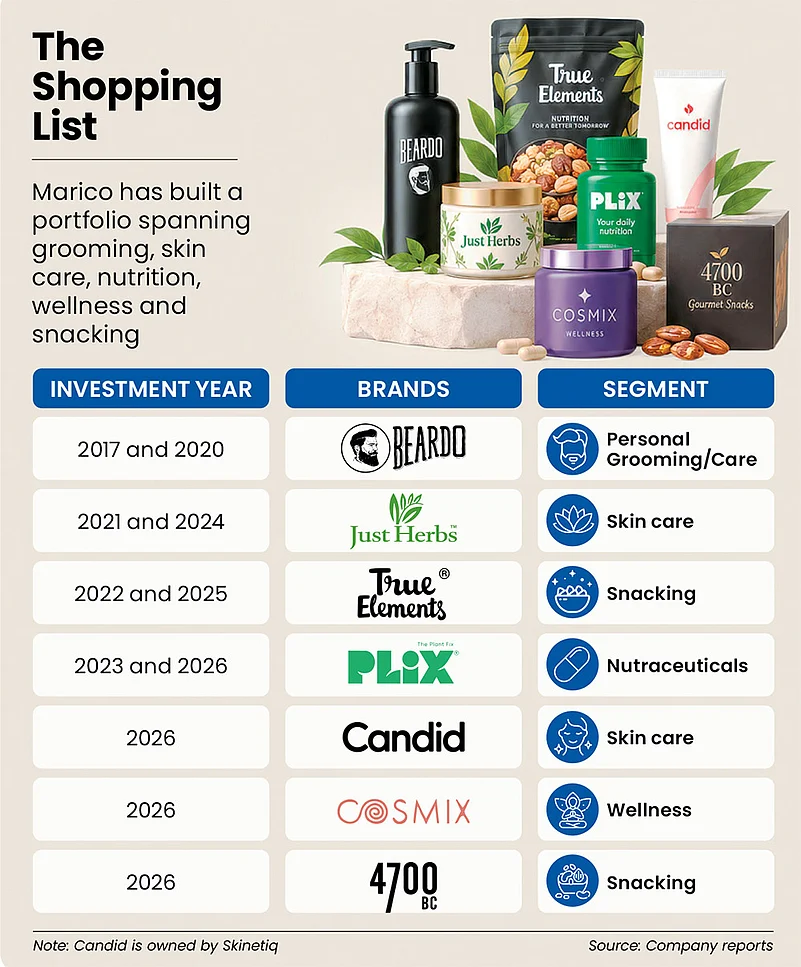
Setting this plan into motion, Marico is pouring capital into acquiring agile and young labels like the men’s grooming brand Beardo and the wellness label Plix. However, the question is whether Marico can nurture these digital bets into profitable businesses as rivals like HUL, ITC and Emami are sprinting down the same path.

Retail Therapy
Devesh Sharma, 40, followed a predictable routine for years. On the first weekend of every month, he would walk down to his local shop to stock up on detergent, hair oil and shampoo refills.
Then the pandemic arrived, and his smartphone became his primary marketplace. Today, while he still occasionally visits physical stores, the vast majority of his daily purchases—from a bottle of Coca-Cola to hair cream and cooking oil—are delivered in minutes via quick-commerce apps.
Millions of Indian households have mirrored this shift, leaving behind the traditional stores where Marico had spent decades perfecting its dominance.
Marico knew how to sell in brick-and-mortar shops: release a memorable TV commercial, coordinate with a vast network of distributors, and secure prime shelf space.
In the online universe, a shopper discovers a product through a seconds-long influencer video or while scrolling through a quick-commerce app. For a long time, the brands capturing these digital-first consumers were agile start-ups led by founders who could spot a micro-trend and launch a product in weeks.
Marico foresaw this shift, having acquired a 45% stake in Beardo back in 2017. However, the post-pandemic boom of online shopping drastically accelerated the timeline, says Gupta.
The company realised that it had to move in two distinct directions: foods and digital-native brands. While expanding into food felt familiar, building agile online brands from scratch was a capability Marico simply did not possess internally.
Instead of building, it chose to buy. Since 2020, Marico has absorbed or taken control of seven digital-native brands, including Beardo, Plix, organic beauty products platform Just Herbs and health-food brand True Elements. So far this year, the FMCG major has committed around ₹1,700cr to buy premium snacking brand 4700BC, Vietnamese skin-care label Skinetiq, health-supplement start-up Cosmix, and to raise its stake in Plix.
Gupta says every acquisition is filtered through two fundamental consumer desires: the aspiration to look good and the urge to stay well. This naturally steered Marico towards beauty and wellness, while keeping it away from trendy sectors like pet care.
Marico isn’t alone in this digital pursuit. Roughly two-thirds of all FMCG acquisitions over the preceding five financial years were concentrated in direct-to-consumer brands, with rivals like HUL, ITC and Emami hunting for the same targets, revealed a report by Crisil Ratings in September 2025. However, what is distinctive about Marico, says Sunny Agrawal, head, fundamental equity research at brokerage SBI Securities, is “how it combines acquisitions with founder continuity”.
For the first three years after buying stake, Marico lets founders run the start-ups independently while the FMCG major studies the nuances of the digital ecosystem.
Although Marico maintains absolute oversight over capital allocation, regulatory compliance and quality control. “These are non-negotiable,” says Gupta.
Meanwhile, these young brands gain access to Marico’s resources. For instance, True Elements, now fully owned, uses Marico’s procurement and gets “things at a far lucrative rate”. They share media buying and logistics. “These are some of the unique advantages of being part of Marico’s house of brands,” points out Gupta. The founders keep a stake until Marico buys them out after a few years.
As the portfolio matures, Marico has stated that it will exclusively buy digital-native brands that have already scaled to ₹100cr or more, not those in the ₹20–30cr bracket.
New brands should fit one of its two buckets, beauty and personal care, or food.
Small Bets, Big Business
Back in 2017, Beardo was a small Ahmedabad start-up trying to sell products most Indian men had never even considered buying: beard oil, beard wash, styling wax. Its playground was almost entirely online, supplemented by a few salons.
That same year, Marico stepped in with a minority stake, kicking off a three-year partnership where the original founders continued to steer the ship alongside the FMCG major.
By 2020, Marico absorbed the rest of the company, the founders moved on, and a profitable entity emerged, boasting a healthy, double-digit earnings before interest, taxes, depreciation and amortisation (Ebitda) margin. What started as a small bet with Beardo has now become the corporate template Marico needs to replicate.
The FMCG major has set its sights on an ambitious milestone: propelling its digital-first brands to a ₹4,000cr revenue mark by 2029–30, which would account for a fifth of its broader ₹20,000cr target.
“The progress of our existing digital-first portfolio gives us confidence in this approach. The portfolio exited 2025–26 with an annualised revenue run rate of more than ₹1,100cr,” says Gupta. “We expect the overall digital-first portfolio to achieve teens Ebitda margins by 2029–30.”
However, for the Marico boss, growth also has to be sustainable and profitable. The FMCG major could grow faster by moving into large categories like staples and spices, but margins there are thin. The same restraint applies to digital. “If I increase the pace of investment, I can grow at 40%, but that growth is not sustainable,” points out Gupta.
As these newer segments scale, their contribution to the bottom line is non-negotiable. Diversified businesses currently make up about 24% of Marico’s portfolio, with a target to hit 30% by 2029–30. “If 30% of the business is diversified, it has to move into a significant level of profitability,” he says.
While Beardo is leading the pack, others are at varying stages of maturity. Plix makes a high single-digit Ebitda margin, and recent buys such as Cosmix and Skinetiq are already profitable. True Elements and Just Herbs, says Gupta, should turn a profit within 18 months.
Market observers see the wisdom in this approach. Vinit Bolinjkar, head of research at brokerage Ventura Securities, says buying at this stage makes sense because these brands have already shown the product works, which saves Marico cost of building from scratch.
He calls the ₹4,000cr target “demanding but structurally achievable”.
The difficulty, experts say, is the cost of growing online.
A new brand finds its first buyers cheaply. As it grows, it pays more, in advertisements, deeper discounts and placement, to win more customers, while quick-commerce apps keep a cut of every sale.
Bolinjkar’s answer is to sell in more places. Brands like Plix and Beardo will eventually need to pull 40% to 50% of their sales from modern retail, pharmacy counters and beauty stores, and look overseas. Marico will likely need one or two more deals, in functional foods or skin care, to help close the distance to ₹4,000cr.
Market experts see another risk. When post-acquisition earn-out periods end, founders may leave, and the brands could lose their speed and creative edge.
Recognising that it cannot rely solely on acquisitions, Marico is also strengthening its legacy brands by launching premium variants under its core brand. “We are doing a lot of work on digital variants within our core,” says Gupta.
Upgraded offerings like Saffola cold-pressed oil and the premium Parachute Advansed hair-oil range are being pushed aggressively onto quick-commerce apps.
Gupta says while the company will continue to acquire smaller digital brands to plug specific portfolio gaps, its in-house launches are going to become bolder. “We are taking bigger bets there,” he adds, pointing to shampoo, cold-pressed oils and muesli.
A prime example of this strategy arrived in May 2026, when Marico introduced Parachute Advansed Protein Shampoo, a major category extension in a market worth over ₹10,000cr a year.
Gupta is extremely confident of reaching ₹100cr in just one year, a milestone that a digital-native brand would take years to reach.
The test, says SBI Securities’ Agrawal, is whether Marico can “turn a collection of promising brands into a few large franchises” that contribute materially to growth while keeping the core healthy.
The Last Mile
For Marico, navigating the Indian retail landscape is a balancing act between online marketplaces and local kirana stores. Today, more than 20% of Marico’s domestic sales flow through digital channels like quick-commerce apps. Still, nearly 80% of its business remains firmly rooted in local kirana shops and supermarkets.
The reason is partly geography. While online shopping, especially quick commerce, thrives in metro cities or big towns, most Indians still rely on their local kirana stores.
“India is always an ‘and’ market,” says Gupta. An incumbent company that skips digital sees its growth stunted, but mass distribution is still a moat for large companies, he adds.
The challenge lies in the fact that every retail channel attracts a different kind of shopper. A consumer browsing a quick-commerce app wants a bottle of shampoo immediately and is rarely deterred by a higher price tag.
A supermarket shopper is hunting for bulk value, while the local store relies on small, low-priced single-use packs. Dumping the exact same inventory across all three channels, and relying on discounts to move it, simply shifts a single sale from one door to another.
Gupta warns against this “steroid-based growth”, noting that it inevitably catches up with a company within a couple of years.
But packaging is only one part of the job. Marico has to run a tighter ship on the ground, especially in smaller towns and rural markets, where physical stores are key. That means bolstering the distribution network. “While entry barriers at the premium end of organised trade have reduced, building distribution at scale continues to require substantial capability and investment,” he says.
Currently, Marico directly supplies to about a million stores, relying on a web of wholesalers and super stockists to patch together the rest.
To bridge this gap, Marico launched Project SETU in 2024. The initiative aims to scale direct retail reach to 1.5mn outlets by migrating small rural shops away from middlemen, while simultaneously carving out new direct supply lines for its emerging brands in urban centres.
The early results are good, says Gupta. “One of the reasons for our incremental growth has been SETU.” Marico says its distributors now carry some of the leanest inventory levels in the FMCG sector.
With less stock sitting in the system, a price cut now reaches shoppers faster. Previously, it took eight to ten weeks to reflect in the market.
Under SETU, the price adjustment hit the market almost instantly, triggering a rapid volume recovery for Marico’s flagship Parachute coconut oil large packs. However, Marico still has a lot of ground to cover. Tata Consumer, which began rebuilding its own network in 2020, now serves over 1.8mn shops directly. ITC reaches about seven million shops, directly serving about 40% of them.
Halfway There
Today, Marico stands at a pivotal crossroads. By Gupta’s count, the company is already “more than halfway there” in becoming a legacy company that is also a digital powerhouse. “We are one of the very few businesses that has been able to take an incumbent business and turn it digital,” he says. Now, the company is already eyeing international markets to replicate this exact blueprint.
That global expansion, however, brings its own set of vulnerabilities. The international business accounts for a quarter of Marico’s total sales, exposing it to currency swings, volatile geopolitics and macroeconomics.
Meanwhile, the domestic turf is growing increasingly crowded. Marico’s recent foray into shampoo drops it squarely into one of the most competitive categories in FMCG.
In plant protein and apple cider vinegar markets, where Plix and Cosmix play, there are now deep-pocketed challengers like HUL’s OZiva, Tata 1mg and private labels from online pharmacies. Still, Gupta views the crowded field as a net positive.
As he noted in a recent earnings call, having two or three major players building out a niche category helps “convert a fad into a habit” for the mass market.
Succeeding in these premium, high-margin categories allows Marico to break its heavy reliance on commodity-linked copra and edible oil cycles.
Pulling this off requires execution of three key imperatives, says Bolinjkar. First, the digital brands must stabilise their margins at a healthy 10–12%. Second, the Saffola food portfolio needs to diversify into new product categories while reaching more urban grocers and modern trade outlets.
Finally, Marico must resist overpaying for trendy lifestyle and skin care acquisitions as valuations in the wellness space climb.
Loyal consumers like Bansal will still reach for that blue Parachute oil bottle. But the test for Marico will be whether it can convince that very same shopper to add a box of True Elements oats or a bottle of Plix supplements to her cart.