In the barren salt desert of Kutch in Gujarat, where temperatures can soar above 45°C and strong winds whip across the landscape, thousands of workers and engineers are building what is set to become one of the world’s largest renewable energy parks.
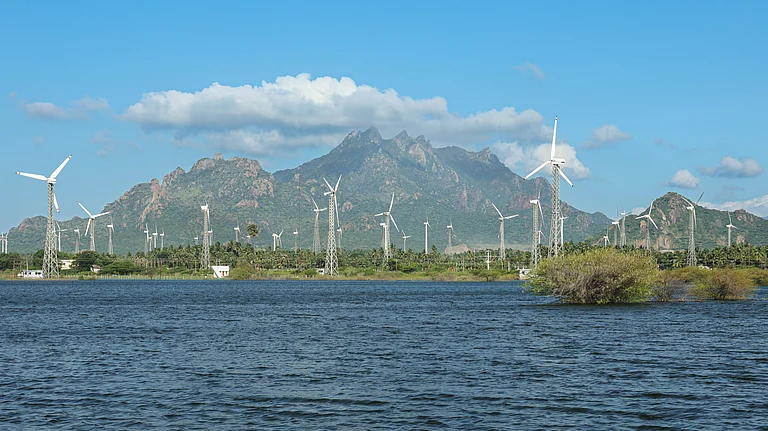
At Khavda, the scale is difficult to comprehend: solar panels stretch across the horizon, while wind turbines rise in the distance. What was once an inhospitable wasteland is being transformed into a massive clean-energy hub.
Behind these towering energy projects are the same corporate giants that have battled for dominance across India’s economy—from telecom and ports to steel, retail and oil—for decades.

1 September 2026
Get the latest issue of Outlook Business

Now, the arena has shifted to new energy. What’s striking is how completely the space is being dominated by big names like the Ambanis, the Adanis and the Tatas.
At an industry event early this year, Gautam Adani laid bare his group’s aggressive path forward: “Our total commitment towards the energy transition stands at $100bn, making us one of the largest clean-energy investors anywhere in the world.”
Not to be outdone, Reliance Industries (RIL) is carving out its own empire in Kutch on a scale rarely witnessed in corporate history. Sprawling across roughly 5.5 lakh acres, RIL’s mega-hub is designed to merge massive solar generation with gigawatt-scale battery storage, ensuring clean power flows even when the sun goes down.
At the recent annual general meeting, RIL’s executive director Anant Ambani underscored the project’s potential: “Once fully developed, this hub is expected to generate more than 40bn units of green electricity a year—enough to meet roughly 3% of India’s total electricity demand.”
Advantages are aplenty for these conglomerates in the new energy space. Beyond the hefty entry price, the nascent nature of the new-energy industry requires something small players simply cannot provide: the ability to build an entire infrastructure ecosystem from scratch.
With their deep pockets, diverse business cross-linkages and industrial muscle, these large groups are uniquely positioned to turn a barren desert into the powerhouse of the nation’s future.


Growing Appetite
As the world’s third-largest electricity consumer, India is experiencing an energy demand explosion, surging at a relentless 6–7% annually. The Central Electricity Authority (CEA) projects that the nation’s peak power demand could tower at 366GW by 2030—a rapid climb from the record-breaking 270.8GW hit just this past May.
While a rapidly expanding economy naturally requires more energy, India’s power grid is being squeezed. Changing climate is one such contributor with soaring temperatures pushing daytime cooling demands to new highs.
Simultaneously, rising household incomes are turning air conditioners and power-hungry appliances into household fixtures.
Electric vehicles (EVs) are also adding to the demand load as they hit Indian roads in droves, powered by progressive state policies. Meanwhile, the digital landscape, fuelled by artificial intelligence (AI) and data centres, is consuming immense amounts of power.
Traditional factories are replacing old fossil-fuel boilers and furnaces with electrical alternatives while scrambling to scrub their environmental records clean.
“Together, these forces are driving a monumental shift toward electricity,” points out Vibhuti Garg, South Asia director at the Institute for Energy Economics and Financial Analysis (IEEFA). “And it is creating a playground of massive opportunities for large conglomerates.”
But the sheer size of the investments required in this energy push is what gives deep-pocketed large conglomerates an edge over smaller players. According to NITI Aayog, India will require a staggering $22.7trn—roughly $500bn every single year—to finance its ultimate net-zero goal by 2070.

Assured Demand
The race for India’s green future has turned into a high-stakes rush to build industrial ecosystem. Here, the largest private conglomerates have the biggest advantage: a captive consumer base.
By funnelling green energy into their own empires spanning steel, aluminium, telecom and massive data centres, they have turned clean power into a vital strategic input.
As Duttatreya Das, an energy analyst at the think tank Ember, points out, “there is little reason for these titans to build renewables at such a staggering scale unless it directly fuels their own expansion, creating massive economies of scale”.
Each conglomerate is charting the path ahead with its own unique signature. RIL has a more self-sustaining approach towards the green transition. Its strategy is ecosystem-oriented: it manufactures the clean tech, builds the renewable capacity and then consumes that very energy across its own digital and industrial empire.
The sheer scale of this synergy became clear at the AI Impact Summit, where RIL chairman Mukesh Ambani announced a monumental ₹10-lakh-crore blueprint to build India’s foundational AI infrastructure.
To power these energy-hungry AI data centres and Jio’s telecom network, Reliance will leverage a 10GW green-power surplus flowing from its massive solar fields in Kutch and Andhra Pradesh.
This strategy is anchored by heavy hardware investments. RIL is pumping over $10bn into the Dhirubhai Ambani Green Energy Giga Complex in Jamnagar, Gujarat, making it a manufacturing hub for solar panels, large-scale battery storage and green hydrogen.
Adani’s strategy is fundamentally supply-side. It wants to become one of India’s biggest producers of renewable electricity and use its transmission and other infrastructure to deliver that power at scale
India’s nuclear energy sector represents the final frontier of the country’s new-energy industry puzzle
In a recent report, global brokerage firm Bernstein Research pointed out that RIL has an advantage in cost of capital and manufacturing, particularly in solar and batteries, while Adani is better positioned in transmission connectivity and renewable power generation.
Adani has already hooked 10GW of its planned 30GW renewable capacity from its Khavda project to the national grid, with full completion targeted for 2029–30.
This also feeds into Adani’s green hydrogen dreams, which feature a 5MW pilot plant in Kutch and a massive downstream hydrogen and green-ammonia hub in Mundra. To support this, Adani Solar operates an 800-acre facility in Mundra, which manufactures solar cells, modules and silicon wafers.
Crucially, Adani has secured its revenue lines. The Khavda project is backed by long-term power purchase agreements (PPAs), including a 5GW, 25-year deal with Maharashtra and allocations to state-run Solar Energy Corporation of India. Adani has also partnered with Google to supply clean energy from Khavda, directly powering the US tech giant’s carbon-free cloud operations in India.
Meanwhile, JSW Energy is pursuing a generation-and-storage-led strategy by building a flexible power portfolio backed by batteries and pumped-hydro storage to counter the erratic nature of wind and solar.
Also, its green hydrogen strategy is linked directly to JSW Steel, ensuring that its clean energy transition is instantly absorbed by its own heavy industrial operations.
As for the Tatas, they possess an advantage the others are working hard to build: a direct, established line to the end consumer through their massive distribution business.
Tata Power is seamlessly connecting the entire value chain—moving upstream with a 10GW wafer- and ingot-manufacturing facility in Odisha, expanding its renewable generation and delivering directly to the consumer’s doorstep.
Power Position
India’s nuclear sector has been traditionally closed off to private players for decades. Yet, it represents the final frontier of the new-energy puzzle.
Conglomerates have come to realise that renewables—dependent on the whims of the weather—alone lack the round-the-clock reliability. To bridge the gap, they are turning their sights toward nuclear energy, which is protected by one of the deepest moats in business due to its highly sensitive technology.
Leading the charge is Tata Power, which aims to become India’s first private nuclear power producer by 2032–33. It is placing its bets on small modular reactor, drawing up plans to deploy two 220MW units, potentially across Madhya Pradesh, Gujarat or Odisha. In a strategic alliance, it has roped in state-run Nuclear Power Corporation of India to evaluate proven, indigenous reactor designs.
But a heavyweight lineup of rivals, including RIL, Adani Power, Hindalco Industries (part of the Aditya Birla Group), Jindal Steel and Power and JSW Energy, are not far behind. They are aggressively exploring their own opportunities around small and captive nuclear reactors.
However, the path forward remains uncharted. As industry expert Garg cautions: “Nuclear power can play a role in the transition, but its high costs, long development timelines and complex supply-chain requirements pose significant challenges.”
Then there is the very visible public-private debate. For decades, companies like NTPC, Power Grid, Indian Oil and ONGC ran India’s energy show. These public-sector units (PSUs) built the very grid that powered the country’s modernisation.
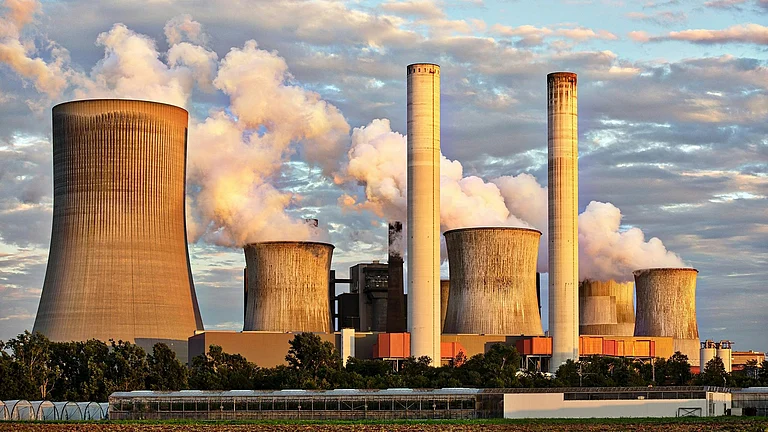
But the power dynamics are being reconfigured. While PSUs remain dominant in traditional energy space, they have been largely sidelined in the clean-energy boom, accounting for a mere 12% of India’s 288.58GW overall renewable capacity as of June.
Subhash Kumar, former chairman of ONGC, says PSUs are bound by a core mandate: ensuring that India’s skyrocketing, day-to-day energy needs are unconditionally met. “This unique responsibility and their commercial character, forces PSUs to anchor their operations in the tried-and-tested safety nets of fossil fuels,” adds Kumar.
While private players are making rapid investment decisions and deploying capital with flexibility, PSUs are still navigating government priorities. They are constantly balancing commercial survival against public accountability and their massive legacy investments in coal, oil and gas. This structural divide has given private conglomerates a commanding head start.
The Next Chapter
The next act of the energy transition needs to be more than capacity expansion; India must effectively build the infrastructure needed to absorb and use that power.
The spotlight is shifting towards energy storage, cross-country transmission grids, firm round-the-clock power, domestic manufacturing and frontier technologies like green hydrogen and nuclear energy.
For conglomerates, the future demands creation of energy ecosystems, where renewable generation is tied directly to batteries, manufacturing facilities, data centres and energy-intensive industries.
For policymakers, the challenge will be ensuring a holistic explosion of national capacity rather than concentrating the market among a handful of large players.
Experts say that success will hinge on faster transmission build-out, predictable regulations, easier access to financing and stronger domestic supply chains. “India will need both its private conglomerates and public-sector companies to scale up investment,” emphasises Kumar.
The race for energy security has only just begun. The true test now is whether India can turn this sprint into an energy system that is cleaner, reliable, affordable and resilient to power its next phase of growth.