World Bank launches Water Forward to expand global water access significantly.
Initiative targets 1bn people amid worsening global water scarcity risks.
Climate change, mismanagement intensify water stress, especially across South Asia region.
What Is World Bank’s ‘Water Forward’ Programme and Why It Matters Now
Global lenders launch Water Forward to tackle rising water scarcity crisis

Man carries water in a water-stressed region
Summary
Advertisement
The World Bank and other top development lenders launched a new global initiative dubbed Water Forward on April 15, aimed at improving secure water access for a billion people within the next four years.
The programme seeks to boost investment in water management while encouraging governments to treat water as a strategic economic resource rather than a low-cost public utility. It will focus on mobilising private capital and philanthropic money alongside public funding, reported Reuters.

Projected Beneficiary Reach
The World Bank said it estimated that 4bn people experience water scarcity due to a mix of unclear government policies, weak regulations and financially unsustainable utilities.
The World Bank aims to deliver water security to 400mn people by 2030. While “additional partner commitments” would take the Water Forward programme’s total reach to more than 1bn people.
Advertisement
Global Water Crisis Explained
Global water scarcity, exacerbated by climate change, is a major concern because it could cost some regions up to 6% of their GDP, spur migration and spark conflict, according to a report titled ‘High and Dry: Climate Change, Water and the Economy’ published by World Bank in 2016.
The report further added that the combined effects of growing populations, rising incomes and expanding cities will see demand for water rising exponentially, while supply becomes more erratic and uncertain. The World Bank report also warned that water will become scarce in regions where it is currently abundant, such as the Middle East and the Sahel in Africa. These regions could see their growth rates decline by as much as 6% of GDP by 2050 due to water-related impacts on agriculture, health and incomes.
The report also warns that reduced freshwater availability and competition from other uses - such as energy and agriculture – could reduce water availability in cities by as much as two thirds by 2050, compared to 2015 levels.
Advertisement
Water insecurity could multiply the risk of conflict, the report adds. Food price spikes caused by droughts can inflame latent conflicts and drive migration. Where economic growth is impacted by rainfall, episodes of droughts and floods have generated waves of migration and spikes in violence within countries, it says.
Water Scarcity in South Asia
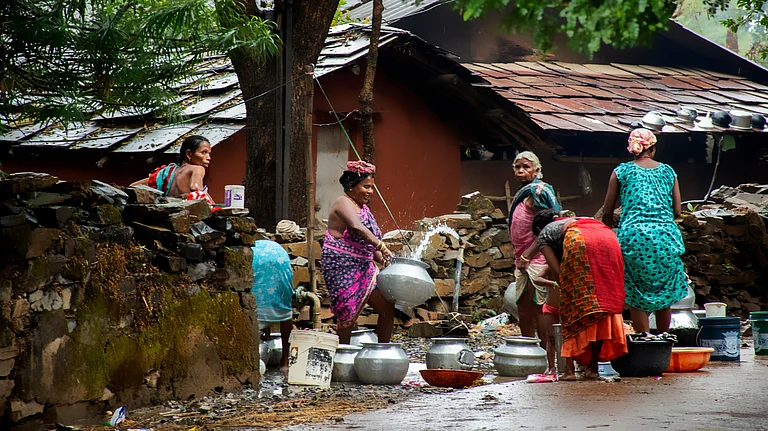
According to a 2023 UNICEF report, a staggering 347mn children under 18 are exposed to high or extremely high water scarcity in South Asia, the highest number among all regions in the world.
Water scarcity affects children’s well-being and growth, causes food insecurity, malnutrition and other diseases, such as diarrhoea. Financial hardships faced by farming families can impact children’s education and force them into work. It is also a threat to agriculture, industry and economic growth.
“Safe water is a basic human right, yet millions of children in South Asia don’t have enough to drink in a region plagued by floods, droughts and other extreme weather events, triggered increasingly by climate change,” Sanjay Wijesekera, UNICEF Regional Director for South Asia stated in the news release published by UNICEF.
Advertisement
In addition, the report underscored that poor water quality, lack of water and mismanagement are reasons for water scarcity in South Asia. Although South Asia is home to more than one quarter of the world’s children, the region has only 4% of the world’s renewable water. Droughts are becoming more frequent and more severe, lasting longer in many South Asian countries because of climate change and increased water demand.
Another factor leading to unpredictable water availability is climate change. According to the UNICEF report mentioned above, climate change also adds additional stress as it exacerbates conditions caused by the over-extraction of groundwater. Around 70mn children live in drought-prone areas where aquifers are severely overused, with the Indo Gangetic Basin covering Pakistan, India, Bangladesh, and Nepal among the most heavily exploited in the world.
Groundwater salinity and drying reservoirs are other problems. Climate warming further decreases the amount of water charging the aquifers. Soil quality and strong rainfall also affect the capacity of groundwater to recharge.
Advertisement
As water stress around the world grows, multilateral organisations like the World Bank have stressed the need for coordinated investment and policy changes to treat water as a limited economic resource. The United Nations says that if current trends continue, water demand will be 40% higher than supply by 2030. This makes initiatives like Water Forward even more important. The success of the program will depend on how well countries use the money to build strong infrastructure, improve governance and make sure everyone has equal access.