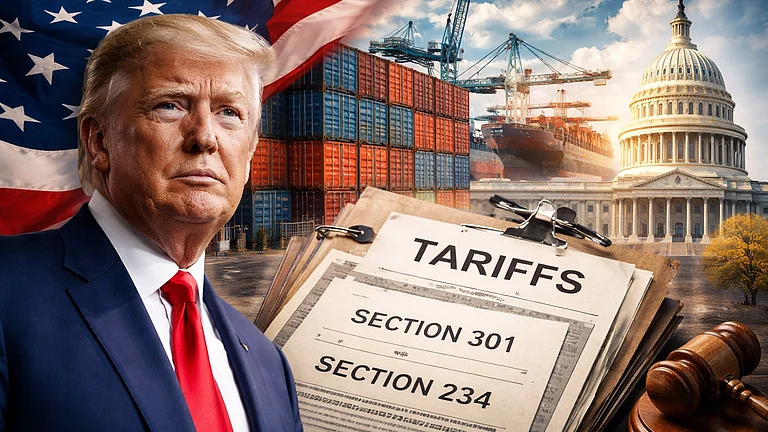
US Treasury Secretary Scott Bessent said Trump’s reciprocal tariffs could return by early July through Section 301 investigations after the Supreme Court setback.
The Trump administration has launched Section 301 probes into 16 economies, including India and China, examining alleged unfair trade practices.
A temporary 10% blanket tariff remains in place until July 24 as Washington explores alternative legal routes to revive higher duties.
Tariffs Comeback? Trump Eyes July Reset Using Section 301 Trade Tool; Here's What It Means
Treasury Secretary Scott Bessent signals tariff reset as Trump administration explores alternative legal route after court setback

US Treasury Secretary Scott Bessent X
Summary
Advertisement
US President Donald Trump’s reciprocal tariffs could soon be restored, likely by July, to levels seen prior to the US Supreme Court’s ruling, US Treasury Secretary Scott Bessent said. “We had a setback at the Supreme Court in terms of tariff policy, but we will be implementing or conducting Section 301 studies, so the tariffs could be back in place at the previous level by the beginning of July,” Bessent said on Tuesday, according to a Wall Street Journal report.
Bessent said that since Section 301 tariff authority has already been tested in courts, business leaders can begin planning and making decisions around capital expenditure. According to reports, Trump is seeking to revamp his tariff strategy through alternative legal pathways after a US court in February ruled that his use of emergency powers to impose tariffs was unconstitutional.
What is Section 301?
Following the court’s decision to strike down Trump’s “Liberation Day” tariffs, the administration introduced a temporary blanket tariff of 10% for a period of 150 days. This levy is set to expire on July 24. In the weeks since, the Trump administration has initiated probes into 16 major economies, including India and China, under Section 301.
Advertisement
Section 301 of the US Trade Act of 1974 allows the US to impose retaliatory tariffs if it determines that the trade policies of other countries unfairly harm American industry. In effect, Section 301 is Washington’s primary legal tool for responding to what it considers unfair trade practices. According to reports, public comments for the current investigation will be accepted until April 15, with a hearing expected around May 5.
Iran war impact on US economy
Speaking about the ongoing conflict with Iran and the impact of elevated crude oil prices on the US economy, Bessent said it was difficult to estimate when the economic consequences of the war would “catch up” with the US economy, reiterating that it remains in “strong shape.”
“I do think that growth could easily exceed three, three-and-a-half this year,” he said. Bessent added that core inflation, which excludes food and volatile fuel prices, continues to decline. “I think the Fed has been wrong on inflation, and core inflation is coming down,” he said. “I understand if they want to wait until the data is clearer, but that will mean that interest rates should come down a lot more.”
Advertisement