Hormuz tensions are disrupting LPG supplies, squeezing India’s restaurants
Around 60–65% of restaurant cooking depends on LPG, making the sector highly vulnerable
Supply prioritisation for households may create ripple effects for other industries, including pharma
Strait of Hormuz Tensions Begin to Hit Indian Kitchens | The Geopolitics of LPG Explained
Rising tensions in West Asia are beginning to ripple through India’s restaurant industry as disruptions around the Strait of Hormuz tighten LPG supplies. Restaurants, which rely heavily on 19 kg LPG cylinders and typically maintain only a few days of buffer stock, are already trimming menus

Strait of Hormuz Tensions Begin to Hit Indian Kitchens | The Geopolitics of LPG Explained
Summary
Advertisement
At 8.30 am, the staff at ‘Tadka Rani’ in Delhi realised their kitchen was running on borrowed time. The LPG cycliners that power every burner to prepare meals were almost finished. And suppliers have also stopped answering calls. With just one cylinder left, nearly 90% of the menu at the restaurant’s outlet in Vasant Kunj had to be shut.
“It feels very similar to the uncertainty we experienced during the Covid-19 pandemic,” says Gagandeep Singh Sapra, co-founder of Tadka Rani. Such scenes have started playing out across the culinary landscape in India due to the LPG cylinder shortage caused by the West Asia conflict.
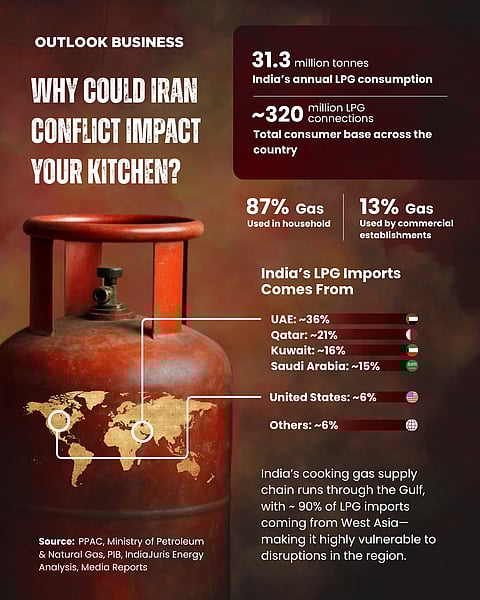
At present, India imports about 60% of its LPG consumption, and out of these imports, about 90% come through the Strait of Hormuz, which has been impacted due to the conflict between Israel-US and Iran.
The current situation has disrupted commercial LPG supplies across several major cities, including Mumbai and Bengaluru, affecting restaurants, hotels, and food courts. Some eateries have even warned of temporary closures if supplies remain constrained.
Advertisement
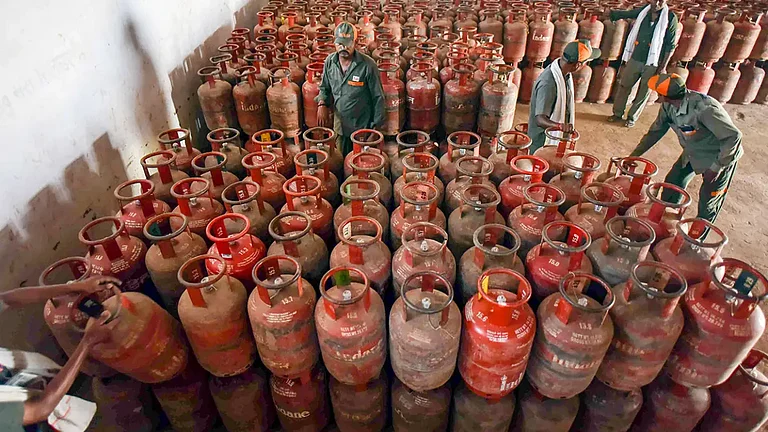
For an industry that depends heavily on LPG to run daily operations, even short disruptions can create immediate operational stress. Unlike large industries that maintain significant fuel reserves, most commercial kitchens operate with only a few days’ worth of LPG stock, which makes them highly vulnerable to supply hiccups.
“Most commercial kitchens typically maintain only a few days’ worth of LPG buffer stock,” says Harshabad Deep Singh, AVP Sales at EazyDiner. Storage constraints and the expectation of regular distributor deliveries mean even brief disruptions quickly become visible at the operational level.
The current situation is exposing a deeper structural vulnerability in India’s food service ecosystem — an over-dependence on a single cooking fuel whose supply chain is increasingly tied to volatile global energy markets.
Why LPG Matters So Much
LPG has become the dominant cooking fuel in India. According to industry estimates, India consumes about 31.3 million tonnes of LPG annually. Of this, approximately 87% is used in homes, while hotels and restaurants consume the rest.
Advertisement
The demand is projected to increase further. According to the International Energy Agency data, the LPG demand will expand at an average of 2.5% per year between 2024 and 2030, reaching roughly 1.2 million barrels per day, or about 37.7 million tonnes.
But the rapid growth has also increased the country’s reliance on imports. The current scenario is even worse for restaurants and hotels because commercial LPG users are typically rationed first. After all, the government prioritises household cooking gas supply.
“Dispatch of non-domestic cylinders has been temporarily halted in some regions to protect household supply. Restaurants and food vendors rely almost entirely on 19kg commercial LPG cylinders for cooking,” said JM Financial in a recent report.
The National Restaurant Association of India (NRAI) has warned that sustained disruptions could lead to “catastrophic closure” of restaurants across the country, highlighting the sector’s dependence on uninterrupted LPG supply.
As demand grows, the supply chain becomes increasingly sensitive to global disruptions. When supply tightens even slightly, the effects quickly cascade through the domestic market.
Advertisement
How Are Restaurants Feeling the Heat
Industry data shows the dependency of India’s food service sector on LPG cylinders. According to a JM Financial report on the quick-service restaurant (QSR) sector, about 60-65% of cooking across major restaurant chains relies on LPG.
It says most operators maintain only one to two weeks of fuel buffer, meaning supply disruptions can quickly translate into operational challenges. The brokerage also hinted at the possible decline in revenue due to the ongoing geopolitical situation.
“Assuming restaurants dependent on LPG cylinders shut down for five days amid LPG supply disruption, we estimate revenue decline of 6% per store for the quarter and a higher decline of 14–20% on restaurant-level EBITDA versus the normalised level of operations,” the report added.
The financial pressure is already beginning to show up in fuel costs. Commercial LPG prices have risen roughly 8% month-on-month in March 2026 amid supply disruptions. Higher fuel costs add another layer of strain for restaurant businesses that already operate on thin margins.
Advertisement
For operators, the situation is not just about higher expenses—it is about maintaining continuity of service. “Even a small drop in supply can create panic because everyone tries to secure cylinders at the same time,” says Niraj Bora, co-founder and CEO of Cheesiano Pizza.
He says his outlets are still receiving LPG, but prices have risen sharply, with cylinders that typically cost around ₹1,700 now selling for as much as ₹2,100-₹2,300 per cylinder.
“Even if supply drops by just 20%, prices shoot up sharply. Everyone starts trying to secure cylinders at the same time,” says Bora.
The disruption is also uneven across cities. Bora notes that his outlets in Pune and Hyderabad are facing fewer difficulties than those in Delhi, where supply interruptions and higher prices have been more pronounced.
Some restaurants have already begun trimming menus or reducing operating hours to stretch their fuel supplies. Others have had to shut temporarily.

Ripple Effects Beyond Restaurants
While restaurants are among the first to feel the immediate heat of the LPG crisis, the disruption can begin to send shockwaves through other parts of the economy as well. Policymakers’ efforts to divert more feedstock toward cooking gas production may ease pressure on household supply, but they could also tighten availability for industries that rely on the same inputs.
One such concern has emerged from the pharmaceutical sector. Dr. Jaijit Bhattacharya, president of the Centre for Domestic Economy Policy Research, says the shift in supply priorities could affect the availability of isopropyl alcohol (IPA), a key ingredient used in manufacturing several essential medicines and disinfectants.
“Isopropyl alcohol is manufactured using propylene. However, as per recent government orders, all propylene is to be diverted for LPG production, thereby leaving nothing for essential medicine production,” he says.
Bhattacharya says that the steps taken by the government are precautionary in nature, but the concern is the impact of these steps on pharma security, especially for essential medicines listed under the CDSCO’s National List of Essential Medicines (NLEM) 2020.
The ripple effects are also being felt across food supply chains linked to the restaurant industry. Higher energy costs and transport disruptions are already pushing up the price of key inputs such as packaging materials and fresh produce. For many operators, these secondary impacts could prove as challenging as the fuel shortage itself.
Industry executives say the current disruption is a reminder of how deeply energy supply chains are embedded in everyday economic activity. “The recent disruptions in LPG supply have revealed one structural vulnerability in India’s foodservice ecosystem, an overreliance on a single fuel source to fire millions of commercial kitchens,” says Bansi Kotecha, founder of Kytchens.
He believes the situation should prompt a broader rethink of energy resilience in commercial kitchens. “Alternatives like PNG, induction and electric cooking infrastructure are not only efficiency improvements but part of a longer-term risk mitigation strategy,” Kotecha says. “Hybrid energy models can provide flexibility and continuity when supply chains face disruptions”.

Is the LPG Crunch Real?
Policymakers maintain that India is not facing a structural LPG shortage. The government has moved to stabilise the market through a mix of administrative and supply-side measures, including invoking the Essential Commodities Act to prevent hoarding and directing oil marketing companies to prioritise household consumption.
Economist Mitali Nikore, founder of Nikore Associates, says the current turbulence reflects more of a market imbalance than a nationwide supply collapse.
“If you look at the situation today, supply itself is not the issue. The government has also issued a statement saying there is no supply gap right now,” she says. “But in situations like this, hoarders see an opportunity. When there is panic in the market, they try to buy in bulk and sell at double or triple the price.”
To counter this, authorities have stepped up monitoring and enforcement under the Essential Commodities Act, which gives the government powers to curb hoarding and regulate distribution during scarcity. At the same time, efforts are underway to increase domestic supply.
According to Nikore, refiners such as the Jamnagar complex have already ramped up LPG output, while policymakers are exploring additional sourcing options to stabilise the supply chain.
Yet the challenge is not just about total supply but how it is distributed. This disconnect between macro assurances and ground-level availability is fuelling uncertainty in the hospitality sector. Beyond boosting supply, policymakers may need to focus more closely on distribution planning.
The focus currently is on increasing supply, sourcing LPG from places like Russia and ramping up domestic production, says Nikore. In the near term, the key variable will be the duration of the ongoing geopolitical conflict and the extent of disruption to LPG shipping routes, particularly through the Strait of Hormuz.
If disruptions persist, restaurants and QSR operators may need to shift toward alternative cooking fuels and centralised kitchen infrastructure.