US imposes 125.9% provisional duty on Indian solar exports.
Duty may double landed costs, hurting exporter competitiveness severely.
Probe examined subsidies, Chinese inputs and firm cooperation gaps.
US Solar Duty of 125.9% Could Make Indian Exports Unviable, Says Report
GTRI flags severe impact of US countervailing duty on Indian solar exports

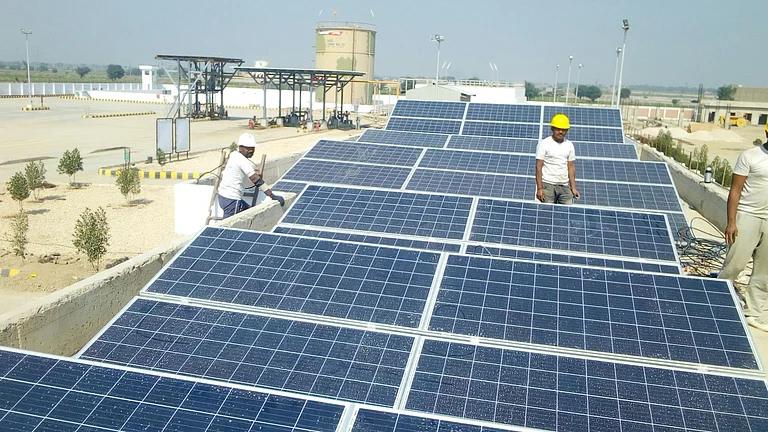
Solar panels lined up
Summary
Advertisement
India’s solar exporters are experiencing the ripples of the US commerce department’s proposed countervailing duties of 125.9% on crystalline silicon photovoltaic cells from India. The preliminary finding covers shipments to the US, which absorbs more than 95% of India’s solar cell and module exports.
The duty is likely to wipe out the cost advantage Indian suppliers enjoyed over US-made modules, which themselves rely on imported cells. Final duty rates are expected in July 2026. Until then, trade flows may remain volatile.
Trade research body Global Trade Research Initiative (GTRI) said that India exported solar panels worth $1.2bn to the US, an 18% decline from $1.5 billion in CY2024. “At this level, the duty could more than double the landed cost of Indian panels. A module priced at $100 could cost roughly $226 after the duty, making many contracts commercially unviable,” the GTRI report added. Currently, Vietnam, Thailand, Malaysia and Cambodia already face heavy countervailing duties.
Advertisement
Investigation Timeline & Scope
The US International Trade Commission found preliminary evidence of harm to domestic manufacturers following a petition filed on July 17, 2025, which paved the way for the Commerce Department's investigation, according to GTRI. Formally, the investigation began on August 6, 2025, and on February 20, 2026, a preliminary determination was reached. In accordance with a concurrent anti-dumping review, the final decision is anticipated in July. The final firm-specific rates are subject to change, and the current 125.9% rate is a provisional "all-others" duty that requires cash deposits at the border.
Two Adani Group companies, Mundra Solar Energy Ltd and Mundra Solar PV Ltd, were the subject of the investigation as mandatory respondents for the review period of April 2024 to March 2025. US authorities used the strict Adverse Facts Available (AFA) methodology, which usually yields the highest subsidy margins and may include retroactive duties, after both companies withdrew from the investigation due to incomplete responses.
Advertisement
Along with purported transnational subsidies linked to Chinese inputs like wafers and polysilicon, export-related programs like Advance Authorisation, RoDTEP and EPCG were examined.
According to GTRI report, the enforcement net was greatly expanded beyond direct domestic subsidies due to non-cooperation and the complexity of cross-border supply chains.