India must add 50 GW annually to meet 500 GW target.
Financing gaps, grid constraints and storage shortages threaten renewable energy expansion plans.
Policy reforms, market design and funding innovation needed to sustain growth.
Scaling Renewable Energy: How to Smoothen the Climb to Mount 500 GW
India’s renewable energy push faces financing, grid and storage hurdles ahead

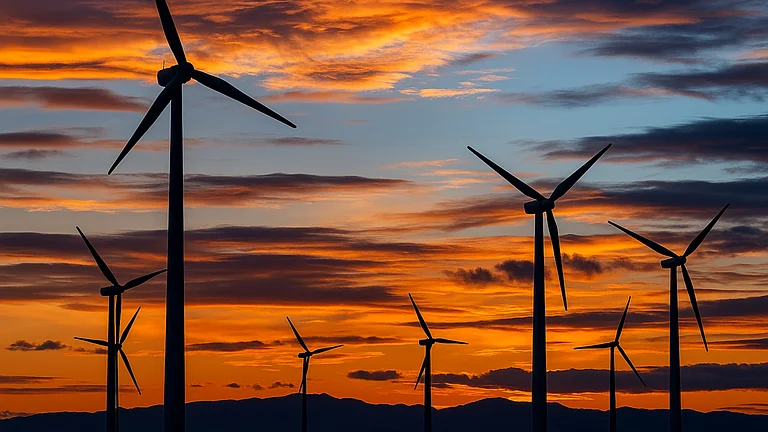
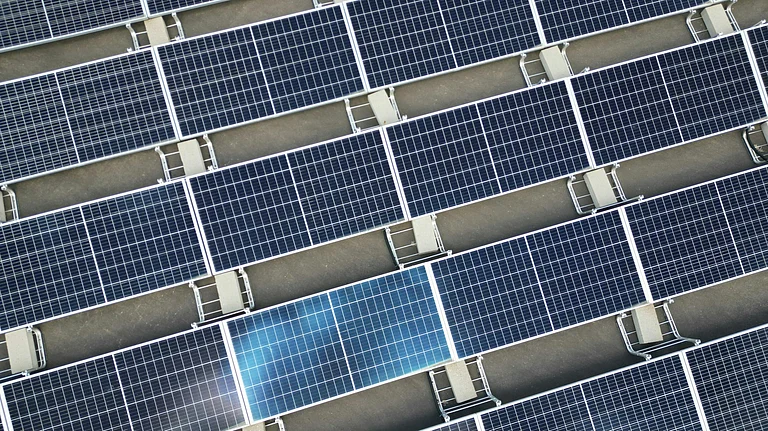
Solar panels and wind turbines installed across a renewable energy park
Summary
Advertisement
India has made remarkable strides in renewable energy over the last decade, emerging as one of the fastest-growing clean energy markets globally. Installed capacity has risen from 76 GW in 2014 to 243 GW in 2025, with nearly 170 GW already in the pipeline.
However, the ascent to the target of 500GW by 2030 will be challenging. The challenge is shifting from proving ambition to delivering firm, financeable and grid-integrated renewable power within a rapidly evolving energy system.
The Last Decade
The renewable energy story of the decade has been shaped by several innovations, such as using Solar Energy Corporation of India (SECI) as an intermediary between power generators and electricity distribution companies, which are typically loss-making and face liquidity issues.
Other measures, such as the solar park model, ensured land availability and built evacuation networks linking resource-rich regions with demand centres. Both solar and wind energy require significant capital but have low operating costs, with 25-year power purchase agreements.
Advertisement
Distributed generation has also gathered momentum. Schemes like PM Surya Ghar Yojana have already enabled 17 lakh rooftop installations (5.3 GW) and aim to reach one crore (~30 GW) by 2027. Meanwhile, PM-KUSUM is reshaping agricultural consumption by creating new business models. Together, they have built a thriving ecosystem of developers and service providers, backed by state incentives.
Yet, even as achievements stand out, scaling to the 2030 target of 500 GW brings formidable challenges.
Challenges Ahead
Achieving the 2030 targets will require adding around 50 GW annually, surpassing the higher-than-expected 43 GW additions in 2025. These additions are likely to be the highest compared to the usual 20 to 25 GW yearly increases and were driven by the ending of interstate transmission waivers in July 2025. Financing such a scale remains a significant potential obstacle, as only a few banks and non-banks are actively lending to renewable energy.
The tender landscape is also evolving. In FY25, nearly 70% of bids were for hybrid projects—solar or wind bundled with storage. While these provide firmer power, they also create excess electricity that must be sold on exchanges, adding uncertainty to cash flows.
Advertisement
Grid constraints compound the problem, while storage capacity lags far behind the need. The CEA estimates that India will require 236 GWh of battery storage by FY32, compared with just 0.5 GWh today. Without timely expansion, developers risk curtailments, as witnessed in 2025, a risk that will grow as RE penetration deepens. Additionally, as the share of distributed electricity sources rises, matching supply and demand for electrons will require sophisticated management, including through the rapid development and deepening of electricity markets.
In this context, with complex tenders, evolving storage models and huge financing requirements, India needs a comprehensive approach. The expansion of RE cannot continue without addressing concerns about dependence on Chinese equipment. To this end, a globally competitive supply chain needs to be built.

Easing the Climb
Guarantee structures for debt recycling: To match the risk-return profile and gestation-period needs of RE projects, the country must find ways to channel long-term domestic savings into power sector decarbonisation—essential infrastructure development. Regulations should be adjusted and reforms pursued to enable domestic savings from banks and non-banks to fund short-term needs, with insurance and pension sectors covering long-term requirements. Given Indian pension and insurance investments mainly in high-rated sovereign securities (about 80%), guarantee mechanisms and financial engineering are needed to recycle banking debt and attract institutional capital to asset-backed securities. Structures like Investment Trusts (InvITs) mainly recycle equity, as much debt stays with banks or non-banks even after refinancing. Institutions like NABFID could facilitate credit recycling.
Advertisement
Two-part tariff for hybrid RE: On the policy front, India could consider conventional two-part tariffs, like those for coal power, for hybrid RE capacities to cover the dispatchable component, i.e., batteries installed under the same conditions. Such a step could help reduce the variability of cash flows under hybrid tenders, thereby simplifying the process.
Power market reforms: India’s power markets must better recognise the value of flexibility. Batteries, pumped storage and spinning reserves provide essential services—frequency regulation, ramping capability and peak shaving—but current mechanisms do not fully compensate them. Developing liquid ancillary markets, with clear rules for revenue stacking and performance requirements, will be central to unlocking the storage ecosystem and reassuring lenders.
Fund-of-funds approach: A national fund of funds can bridge financing gaps that banks and NBFCs cannot address—early-stage storage, distributed energy business models, supply chain scaling and climate-tech innovation. SIDBI’s fund-of-funds for start-ups offers a successful template: partnering with AIFs to mobilise private capital while building operational track records. Extending this model to climate infrastructure can catalyse manufacturing and strengthen MSMEs across the renewable value chain.
Advertisement
(Vaibhav Pratap Singh is the Executive Director of Climate and Sustainability Initiative (CSI) and Dr. Rajiv Lall is a Professorial Research Fellow of Singapore Green Finance Centre of the Singapore Management University. The views expressed are personal.)