India may attract $350bn renewable investments over five years.
Additional 41 GW storage planned to support grid reliability.
NITI Aayog estimates $22trn needed for net-zero by 2070.
India Eyes $350 Bn Clean Energy Investment to Achieve 500 GW Target
India projects $350bn renewable investment to meet 500 GW target

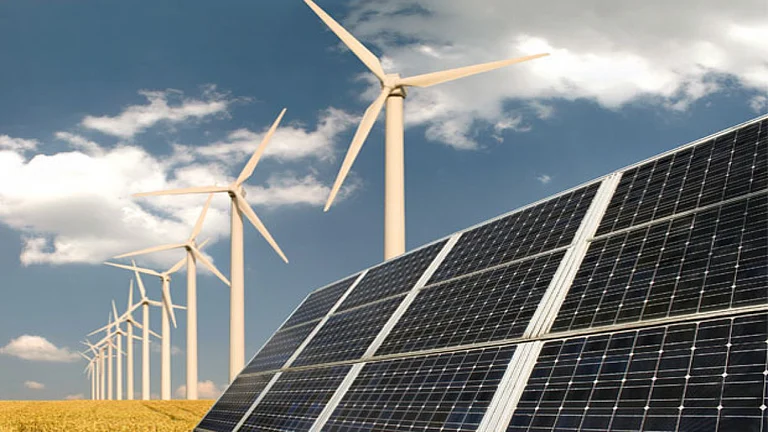
Solar panels symbolising India’s renewable expansion plans
Summary
Advertisement
Renewable energy sector in India could attract $350bn investments over five years, with expansion plans in domestic module manufacturing capacity and additional 41 gigawatt (GW) of energy storage capacity to achieve the 500 GW clean energy target by 2030, New and Renewable Energy Minister Pralhad Joshi told Business Standard.
Joshi further mentioned that the NITI Aayog projected an investment requirement of $22trn for the achievement of India’s net zero target by 2070. He acknowledged that India has invested more than $150bn in the last ten years and the country will require around $350bn to reach 500 GW of non-fossil capacity by 2030.
He said India has set the renewable energy context for the entire world, becoming the only country among the G20 nations that has achieved non-fossil fuel-based installed power capacity of more than 50%, five years in advance of the national target, reported Business Standard.
Advertisement
Economic Multiplier Effects
According to the International Energy Agency, 85% of the increase in global electricity demand over the next three years will come from emerging and developing economies. India is expected to account for the largest growth in global energy demand driven by sustained economic growth. Consequently, India's share in global primary energy consumption is projected to double by 2035.
Over the past decade, India’s power sector has seen robust expansion driven by rising demand, infrastructure development, and strong policy support for both conventional and renewable energy sources. Electricity generation has increased from 1,168 billion units (BU) in 2015–16 to an estimated 1,824 BU in 2024–25. Similarly, total installed capacity has grown from 305 gigawatts (GW) in 2015–16 to a projected 475 GW in 2024–25.
A projected $350bn investment into the renewable energy sector could also support the expansion of domestic solar module manufacturing, reduce import dependence and strengthen supply chains under initiatives such as the Production-Linked Incentive (PLI) scheme. So far, the government has allocated more than ₹24,000 crore for the production-linked incentive (PLI) scheme for High Efficiency Solar PV Modules.
Advertisement
The growth of renewable energy produces more jobs per unit of electricity than fossil fuels, according to the International Renewable Energy Agency. In India, expanding solar, wind, and storage infrastructure could hasten the creation of jobs in engineering, manufacturing and grid modernisation. In addition to improving grid reliability, increased storage capacity—an extra 41 GW as indicated—would allow for greater penetration of renewable energy sources while lowering curtailment losses.
Energy Security And Climate Goals
India’s 500 GW non-fossil capacity target by 2030 forms part of its updated Nationally Determined Contributions under the United Nations Framework Convention on Climate Change. Expanding renewable capacity at scale could lower fossil fuel imports, which currently account for a significant share of India’s energy basket, thereby improving trade balances and shielding the economy from volatile global fuel prices.
According to reports released by NITI Aayog in February 2026 titled ‘Scenarios Towards Viksit Bharat and Net Zero’, sustained and massive capital mobilisation is essential to align short-term capacity expansion with India’s 2070 net-zero trajectory, including a projected financing gap of $6.5trn and identifies the need for domestic financial reforms and stronger global capital integration.
Advertisement
The success of this investment cycle will determine whether India meets its 2030 clean energy target as well as shape its credibility in global climate leadership and sustainable development pathways.