On his very first day as managing director and chief executive of L&T Finance, Sudipta Roy did something almost unheard of. On January 24, 2024, he walked into a quarterly earnings call and announced that his non-banking financial company (NBFC) had already achieved its 2026 targets.
The plans, drawn up in 2022, were aimed at making Larsen & Toubro’s financial arm less dependent on infrastructure and business loans and transforming it into a retail lender. By the time Roy took over, wholesale loans had shrunk to under 10% of the book. Consumer lending was growing faster than planned. Defaults were falling, while return on assets (RoA), a measure of how much profit a lender generates from its loans, had reached the company’s target.
Roy was thrilled. At the very next earnings call, he raised the bar for the NBFC’s ‘Lakshya 2026’ plan.

1 September 2026
Get the latest issue of Outlook Business

Then things turned sour. A crisis in India’s microfinance sector eroded years of the gains L&T Finance had worked hard to build. A significant chunk of its lending is concentrated in rural India and in the form of smaller-ticket sizes. By late 2025, the microfinance industry was dealing with a growing problem: borrowers were taking loans from multiple lenders at the same time, pushing their repayment capacity to the limit and raising defaults.
When that model began to unravel, the impact quickly showed up in L&T Finance’s numbers. Its RoA fell for three consecutive quarters, and the company ended 2025–26 at 2.40%, slightly below the target it had set for itself in 2024.
The setback, however, didn’t dampen L&T Finance’s ambitions. If anything, the company has now set an even bigger goal under its new ‘Lakshya 2031’ plan, announced in July 2026.
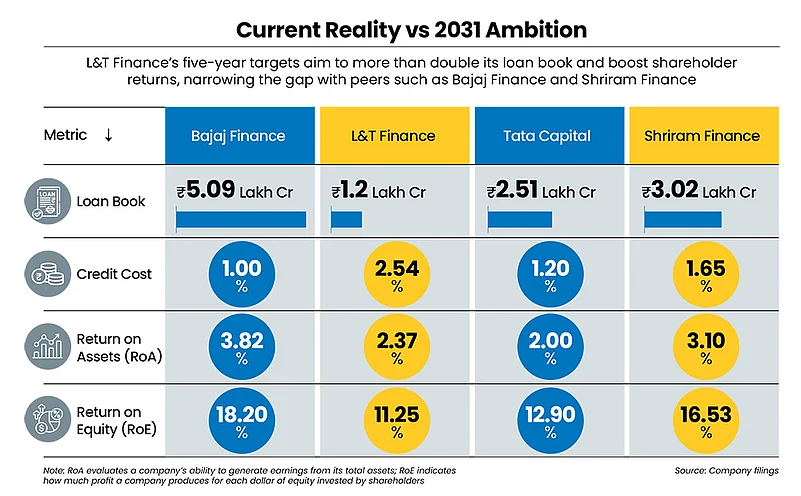
The Mumbai-based NBFC wants to more than double its loan book in the next five years, from around ₹1.3 lakh crore currently.
That would put it in a league currently occupied by only Bajaj Finance and Shriram Finance among private-sector NBFCs.
In terms of assets under management (AUM), L&T Finance currently ranks below nine other private NBFCs. Its share of loan defaults is also higher than that of Bajaj Finance, Shriram Finance, Cholamandalam and Tata Capital.
Lakshya 2031, therefore, is not simply about getting bigger. It is also about making that growth more profitable and less risky. The company wants to bring credit costs, the money it loses when borrowers don’t repay their loans, below 2%. At the same time, it wants to make more money for its shareholders by improving RoA and return on equity RoE (profit per rupee shareholders have invested).
Shashank Udupa, founder of Bengaluru-based financial advisory and investment firm Vayu Capital, believes L&T Finance’s biggest challenge will be achieving all of these targets simultaneously.
“Sustaining over 20% growth on over ₹1.3 lakh crore book will naturally get harder,” says Udupa. “Credit costs must fall to below 2%, even as L&T Finance continues to grow in relatively riskier segments like MFI [microfinance institution], personal loans and two-wheelers. That creates a genuine tension; faster growth usually comes with higher risk,” he says.
Competing against legacy players while simultaneously expanding its loan book will require the company to grow without compromising on credit quality or profitability.
That is what makes Lakshya 2031 fundamentally different from the target Roy inherited.
The 2026 plan was largely about reducing its dependence on wholesale lending and building a retail-focused franchise.
This time, the challenge is more complicated. The company has to grow at scale, lower credit costs, improve returns and compete with entrenched players.
“If Lakshya 2026 was an era of transformation, Lakshya 2031 is an era of execution and delivery,” says Roy.

Winds of Change
L&T Finance’s three-decade journey has not been smooth. For years, the lender struggled to find its footing, weighed down by wholesale lending and the fallout from the 2018 NBFC crisis. By early 2022, about half of its ₹80,000cr loan book was still tied to infrastructure, real estate and other large projects. The company, at that point, had lent as much as ₹1,300–1,400cr to a single borrower—something NBFCs rarely do.
Since large projects tend to get delayed due to execution problems, such large concentration of loans to a few borrowers risked large defaults.
Larsen & Toubro, the parent company, had had enough. Its chairman emeritus AM Naik publicly called out the financial arm at a press conference on February 28, 2022.
It was a wake-up call. L&T Finance embarked on a transformation journey. It began an accelerated sell-down of L&T Finance’s wholesale book, selling its infrastructure and real estate loans.
By the end of 2025–26, the exposure to wholesale loans had fallen to just 2% of L&T Finance’s overall assets under management, or around ₹2,000cr.
The lender also simplified its complex corporate structure, merging nine separate entities in 2021–22 into one by the end of 2023–24. This restructuring was one of many pivots the NBFC had taken since the early 2000s, including abandoning its plan to become a bank and reducing the number of products it used to offer to its customers.
L&T Finance is banking on making its diversified portfolio its identity
According to analysts at brokerage HDFC Securities, the end of frequent strategic pivots is likely to gradually translate into a relatively steady earnings trajectory.
At the end of 2025–26, analysts covering the sector breathed a sigh of relief as L&T Finance finally narrowed its organisational identity to that of a focused retail lender.
“Retailisation was the defining decision of L&T Finance’s past five years and it is the reason the company is being discussed as a serious retail franchise today rather than as a wholesale lender working through legacy exposures,” says Sonam Srivastava, founder, Wright Research, a portfolio-mangement firm.
Now, to keep growing among its retail peers, the company has framed the Lakshya 2031 plan. For this, the company is banking on two key levers: maintaining a balanced presence across rural and urban India and using AI to sharpen operations.

Carving its Own Identity
Walk into an electronics retail outlet to buy a laptop on EMI, and chances are Bajaj Finance will be among the first financiers that is recommended to you. A trucker looking to finance his next vehicle would most likely turn to Shriram Finance or Cholamandalam Investment and Finance Company. A family with gold to pledge may walk into a Muthoot Finance branch, while a farmer looking to finance a tractor may think of Mahindra Finance.
India’s bigger NBFCs have built their franchises around distinct customer segments, products and lending needs.
However, L&T Finance is banking on making its diversified portfolio its identity. Its loan book has around 49.1% exposure to urban areas, followed by rural and farmer segments together accounting for nearly 39% of AUM. Small and medium enterprises (SMEs) lending accounts for 6.9% and gold loans 3% of the total lending.
Roy says that being equally present in both rural and urban markets allowed the company to spread risk. Similarly, simultaneously growing microfinance, agri-equipment finance, SME, two-wheeler finance, home loans, personal loans and now gold loans gives it enough space to capture opportunities in each of these segments.
For Roy, L&T Finance’s diversification is a strategic choice. “Today, in microfinance, we are No. 1. In tractor finance, we are No. 2 or 3, depending on the market. In two-wheelers, we are also among the top two or three players,” he says.
According to Srivastava, this approach has helped the company during the microfinance stress of 2025. At the time, L&T Finance’s rural-business finance took a hit, but urban finance and SME kept growing, and the consolidated book still expanded by over 25% year on year. A single-segment lender in microfinance did not have that cushion.
Further, Roy also points out an edge that L&T Finance has over its peers. It has “deliberately built businesses that are very difficult to operate and even harder to make money” like agri finance. The segment depends heavily on unpredictable factors such as weather, crop prices and harvests, making it harder for lenders to assess risk.
“But if you perfect the process, it can generate very attractive returns,” says Roy, pointing to the company’s ₹17,514cr loan book linked to farmer and farm equipment.
For the next leg of growth, the company acquired diversified currency player Paul Merchants’ gold-loan business in 2025. Gold loans offer an alternative to its existing portfolio of unsecured loans in microfinance and consumer lending. It has a return on equity (RoE) of around 18–19% and relatively low loss rates, points out Roy.
At the time of acquisition Paul Merchants had around 130 branches and a ₹1,000cr book. It has since expanded its network to over 500. The target is to have 800–850 branches by the end of 2026–27.
The segment gives L&T Finance a secured, high-return product, where the company earlier had negligible presence, and something it can cross-sell to its existing customers.
“The question is whether a diversified lender can achieve the same underwriting depth across eight products that a specialist achieves in one,” asks Srivastava.
This is where the technology investments become relevant for L&T Finance.
AI to Race Ahead
Till 2025, 88 out of every 100 customers looking for two-wheeler loans from L&T Finance showed signs of trouble repaying their debt under their risk assessment.
The challenge is that borrowers do not always fit neatly into a standard credit score, particularly in businesses such as rural and farm lending, where reliable financial information can be hard to obtain.
Roy and his team decided to change that with the launch of their own AI-powered credit underwriting engine, Project Cyclops. It used a customer’s credit-bureau data, account details and other alternative signals to assess their default risk.
Within a month of employing Cyclops for two-wheeler loan underwriting, the percentage of customers showing signs of default risk declined from 88% to 38%. It has since declined to just 11% in the two-wheeler loan segment.
“Today, the only way to be relevant, improve operating efficiency and take market share is to do the same job better than others,” Roy says, explaining why the use of AI has become essential for the company.
The lender’s 85% of pre-delinquency management calls are now handled by generative AI bots. AI is also being used for collection calls, routine inbound customer-service calls, settlement negotiations and repetitive operational processes
One of the key changes Roy brought to the organisation in 2023 as chief operating officer was his push for new tech adoption, building on his previous experience at ICICI Bank.
It has also developed Project Nostradamus, an AI-driven, real-time portfolio-management system that uses traditional and alternative data for early-warning signals and proactive risk management. It tracks loans after they’re given out. It spots early warning signs of trouble in small, local pockets of the market before loans turn bad.
The company’s 85% of pre-delinquency management calls are now handled by generative AI bots. AI is also being used for collection calls, routine inbound customer-service calls, settlement negotiations and repetitive operational processes.
“The numbers will have to prove whether AI can translate into structurally better risk selection and lower credit costs,” says Vayu Capital’s Udupa. “AI could become an important part of the story, but it is too early to call it a moat.”
But the competition is not sitting idle. Bajaj Finance, for instance, has deployed 27 AI agents and plans to increase that number to more than 600 by 2026–27. It claims that AI has helped it generate ₹517cr of additional loan disbursements in the first quarter of 2026–27.
Tata Capital has used AI to cut the time needed to prepare an SME credit assessment from around two days to just 20 minutes, while improving underwriting productivity by 30%. Muthoot Finance, meanwhile, is using AI to automate routine tasks, detect fraud, predict customer behaviour and improve lending and collections decisions.
The Five-Year Test
Roy is a passionate wildlife photographer. The hobby has taught him to focus on what he wants and wait for the right opportunity, Roy revealed in a recent podcast with EY India, a consultancy.
This focus would come in handy for the NBFC as it works to reach its five-year goal in an uncertain economic environment.
The NBFC is entering its next phase of growth amid a highly regulated financial sector and a global economic environment that remains volatile.
Roy is aware of these risks. “When you start a five-year journey, you don’t know what pitfalls or economic disruptions may come along the way. No one knew that the Covid pandemic would shut down the world,” he says.
But he is still confident of delivering on his 2031 targets.
Analysts propose a straightforward test of whether the 2031 targets can be achieved. “If credit cost compresses to the guided 2–2.2% by the fourth quarter of 2026–27 and continues towards sub-2% in 2027–28 while the book grows above 20%, the AI thesis will have been validated with numbers,” says Srivastava.
At current valuations, she points out, L&T Finance investors are already paying for much of the improvement it has promised. That means what the company delivers over the next four quarters will matter more than the headline targets for 2031.
But the gap with the market’s top-rated NBFCs remains.
L&T Finance trades at a lower price-to-earnings ratio than Bajaj Finance (32) and Tata Capital (29). Closing that gap will require more than an ambitious 2031 target.
Today’s L&T Finance is a very different company from the complex entity it was in 2022.
The company has trimmed flab and put in place systems. But will those measures be enough to enter the big league?