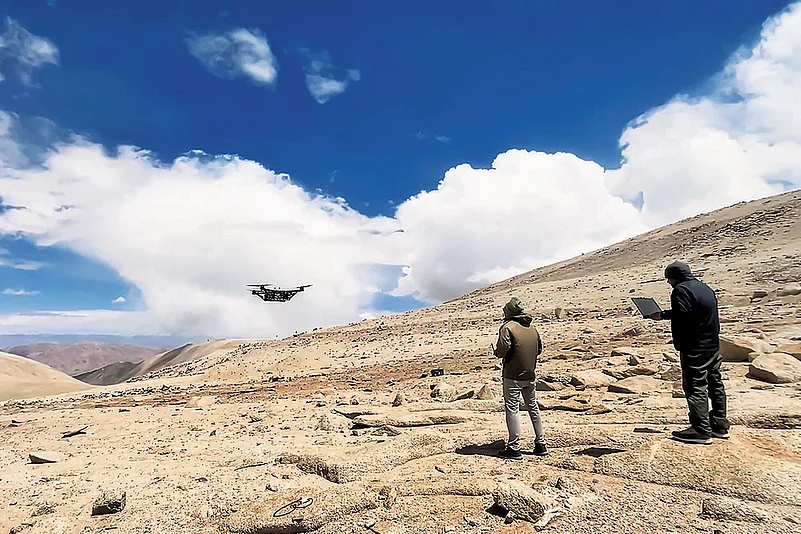
There are more than 144 funded drone start-ups in India, but BonV Aero has made its mark in an area that was challenging to say the least. This heavy-lift drone start-up set out to address a critical logistical challenge faced by soldiers stationed in remote hilly and inaccessible regions, where conventional vehicles are often unable to operate.
What also sets this start-up apart is that unlike most deep-tech peers concentrated in metro cities, BonV Aero chose to build its operations in Bhubaneswar, Odisha. This has given the start-up a strategic advantage through lower infrastructure and operational costs, enabling it to scale more efficiently while maintaining a strong focus on innovation.
And it’s this focus that has led to products like Air Orca, an autonomous logistics aerial vehicle capable of carrying payloads of up to 20kg at altitudes as high as 18,000ft. This marks a significant leap in India's drone-logistics capability.

1 October 2026
Get the latest issue of Outlook Business

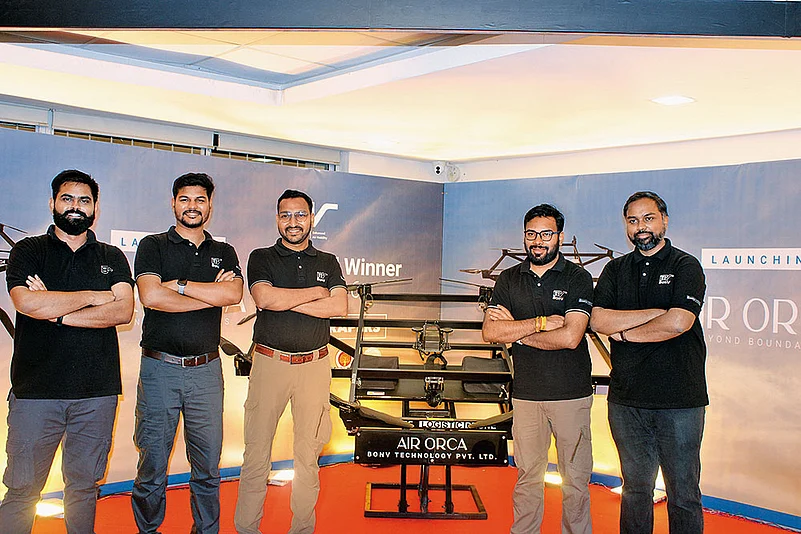
Behind BonV Aero's advancements are the start-up's co-founders Gaurav Achha and Satyabrata Satapathy.
The duo held close to a vision that they shared in the corridors of SRM University, Chennai, as undergraduates way back in 2008. They were united by a deep fascination for robotics, unmanned aerial systems and space technology.
However, it wasn’t until March 2021 that Achha and Satapathy along with other founders Abinash Sahoo, Sultan Alam Khan, Rahul Kumar and Umang Kumar Rathi formally launched BonV Aero.
The vision: to use drones to solve logistics challenges in some of India’s toughest terrains, particularly for defence and critical supply operations.

Experience to Enterprise
Achha and Satapathy's trip to Ladakh in 2015 was a turning point. The duo witnessed the everyday struggles of soldiers stationed in extreme, high-altitude conditions. Roads are almost non-existent. Helicopters, too, often struggle to operate effectively above 14,000ft due to low air density.
“Even today, vast parts of India's border villages, Himalayan regions and high-altitude zones remain incredibly difficult to access. In many of these areas, supplies are still transported using mules,” says co-founder and co-CEO Achha.
This trip led to the birth of the idea of transport class aerial platforms or heavy-lift drones. Today, BonV serves the Indian Army, several paramilitary forces and state disaster forces.
BonV Aero's lean cost structure and operations from a Tier- II city are behind the rising investor interest
BonV Aero has also placed a strong emphasis on indigenisation. One of its core focus is to develop India-made components and tie-up with domestic firms across its supply chain. According to Achha, this focus sets it apart from many competitors. “While several drone companies in India largely assemble imported systems locally, BonV Aero claims to build significant portions of its technology stack in-house, including its software systems and key elements of the hardware architecture,” he adds.
The company also operates under the indigenously designed, developed and manufactured framework, a key requirement for several defence procurement programmes that mandate a substantial share of components to be sourced from within India.
“We are strategically positioning ourselves to tap into the ₹6,000cr defence procurement opportunity currently emerging in the market, a space we believe closely aligns with our strengths and indianisation capabilities,” says Achha.
BonV is also looking at global opportunities. In fact, it has been selected by a UK defence ministry's initiative that allows collaboration between global innovators and suppliers. This would also give it a platform to engage with Nato countries in the unmanned aerial solutions space.
Cost Edge
BonV Aero's lean cost structure and operations from a Tier-II city are behind the rising investor interest.
According to Tracxn, it has so far raised $6.43mn from investors, including Silicon Valley venture-capitalist Tim Draper along with Headstart Angels Network, Unicorn India Ventures and Inflection Point Ventures. “We compared them with similar start-ups in Bengaluru and found their costs were nearly 3x lower,” says Ankur Mittal, co-founder of Inflection Point Ventures.
However, capital requirements are still too high for this early-stage start-up to realise the ambition of a larger-scale urban air mobility and human-transportation systems.
For now, BonV has adopted a phased approach beginning with drones capable of carrying 10kg payloads and now advancing to 20kg capacity with Air Orca. The aim is to scale this capability beyond 100kg and eventually develop human-carrying aerial systems.
Driven by rising demand for its heavy-lift drone solutions, Satapathy says a robust 2.3x revenue growth was logged in the last financial year.
The start-up's long-term vision is a flying transportation system for both cargo and eventually humans. “We imagined a future where people could move quickly through air-mobility platforms, particularly across congested urban centres and remote terrains,” he adds.