
Sankarsh Chanda, a young space-tech start-up founder, traces his fascination with rockets and satellites back to childhood afternoons spent reading books and watching space documentaries. His curiosity led him to set up the spaceexploration company Stardour. But what makes him a standout among his space-tech sector peers in India is his sustainable orbital transfer vehicle (OTV), often described as ‘space taxi’.
Chanda and his team have innovated OTVs to run on water—cheaper and environmentally sustainable. In fact, the liquid oxygen-liquid hydrogen-powered OTV was test-fired at the Indian Institute of Science, Bengaluru, last year. But his innovation is vulnerable to being copied, commercialised or exported without his consent as he has no patent protection. Why?
The patent process is a costly and time-consuming affair, says the Stardour founder. “As we are still bootstrapping, whatever funds I have is focused on building and upgrading the technology,” he adds.

1 October 2026
Get the latest issue of Outlook Business

This story is a familiar one for many deep-tech founders. Caught between a rock and a hard place, either they compromise on quality and product development timelines by filing patent applications or leave their technology unprotected.
Patenting is a legal process through which governments grant exclusive rights to the owner or developer of a technology. This prevents others from copying, using, selling or importing for a specific period.
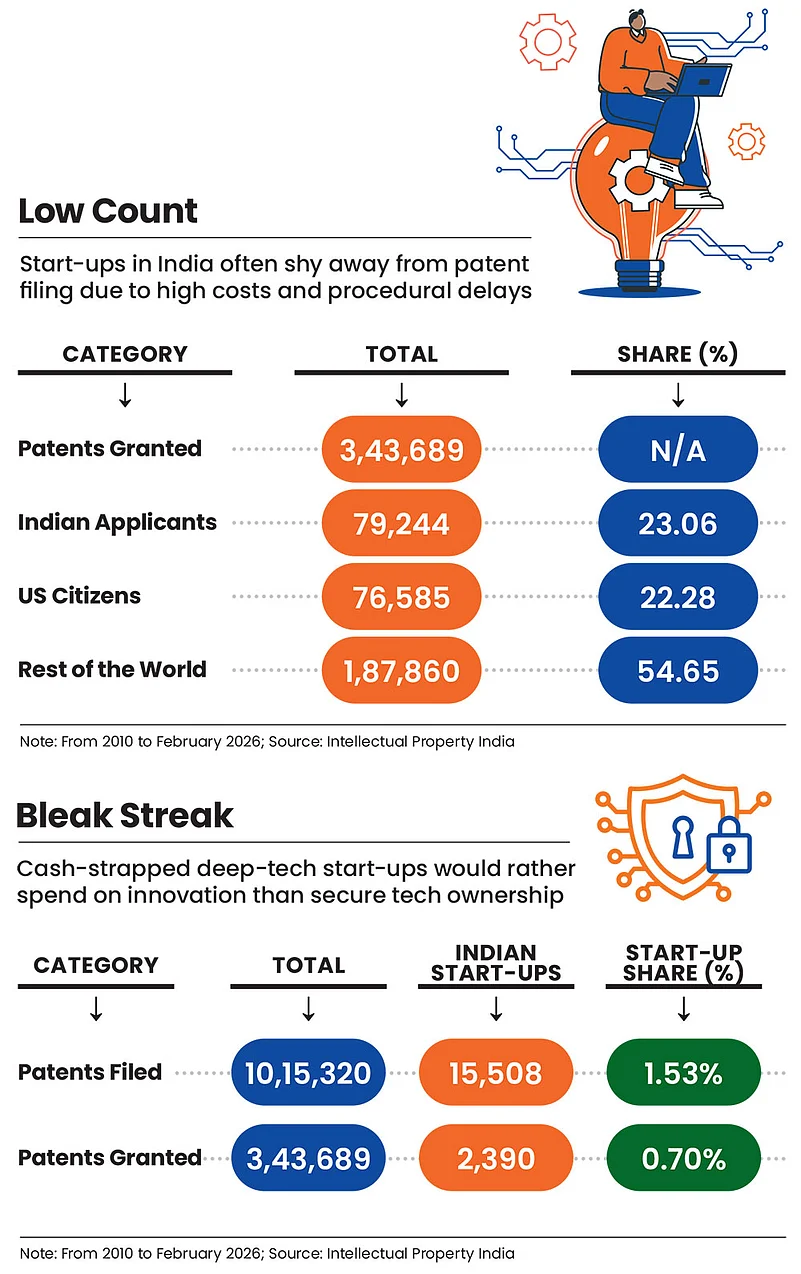
According to patent-data platform Intellectual Property India, start-ups have filed 15,508 patent applications from 2010 to February this year—a mere 1.53% of the total 10,15,320. And of the patents granted, only 2,390 were awarded to start-ups, a paltry 0.70% of the total 3,43,689. So, if start-ups are innovating, why aren’t there enough patent applications? Either they are not innovating, or they are, but there is no ownership.
Costs and Delays
SRS Prabaharan, founder and chief executive of Inventus Battery Energy Technologies, a battery-tech start-up, says that securing a patent can take up to three years, which often discourages young deep-tech founders from filing.
There are two main stages in the patent process. First, a provisional patent application can be filed by the start-ups with an idea and initial results to establish priority. Complete specifications with full technical details must be submitted within one year.
At the second stage, an international search is conducted to check for similar inventions. If overlaps are found, one must explain how the invention is novel or improved.
In short, the patenting process could take years until approval is granted. And may set you back by up to ₹6 lakh.
While registration fees may be modest, the cost of hiring patent attorneys varies widely and can be a significant financial burden, adds Prabhakaran.
Deep-tech start-ups invest heavily in innovation and continuous technological upgrades, which require substantial funding and long development cycles. Heavy patenting costs only make it difficult for them to remain competitive globally.
Salman Waris, founder of corporate and tech law firm TechLegis, points out that while official data shows progress, pendency remains high. Cost and delays persist due to backlog, shortage of examiners and complex cases.
“In reality, many applicants must wait for up to six years due to the workload on examiners [there are only 500 examiners against the required 1,000]. This financial year 2025–26 saw just 9,600 examinations being conducted, a slowdown harming the ‘IP momentum’. There is a claimed 149% grant rate, but this statistic ignores pre-exam waits,” adds Waris.
Policy Hurdles
The roadblocks also extend to the country’s patent policies.
At a time when artificial intelligence (AI) is driving innovation, existing patent frameworks often struggle to keep pace with rapid technological change.
The Patent Act’s Section 3(k), which prohibits patenting mathematical methods, business methods, computer programs and algorithms, effectively blocks most software patents.
Originally designed for physical industries, the patent system has not evolved with the digital and AI economy. As a result, it lags successive industrial revolutions.
Meghna Bal, director at tech-policy think tank Esya Centre, says that examiners often reject applications under Section 3(k), leading to appeals and prolonged court cases. Also, there are concerns about the low quality of patents and the inadequate training of those handling applications.
“Law schools do not sufficiently teach the technical and business aspects of patent law. Many start-ups see patents as cost centres rather than value creators. This is understandable because enforcement is weak, filing is expensive and strategic guidance is lacking,” she adds.
Though these factors eventually discourage founders and researchers from filing, patents are crucial for stronger capital backing.

Investor Interest
Saraniya Periaswamy, an engineer at space-tech start-up Agnikul, says that today’s investors increasingly expect strong patent portfolios before committing their funds, making IP a key part of their growth story.
Periaswamy, who is also the vehicle director of Agnibaan SOrTeD (sub-orbital technology demonstrator), explains that IP is not an option but a necessity for deep-tech start-ups. “Patents are not just legal tools; they are proof of technical credibility and global ambition,” she adds.
Also, filing patents only in the home country is no longer sufficient. To truly compete with global technologies and maximise their commercial potential, deep-tech start-ups must secure patent protection at the international level. This helps them generate greater economic value.
In this context, India can learn from countries like the US that adopt a more proactive approach to patent filing and have much faster processes. The importance of patents in these countries is well ingrained among their citizens, including the Indian-origin ones, who actively file applications.
Data available on government website IP India illustrates this point. From June 2014 to March 2025, of the total 3,43,689 patents granted, 23.06% were to Indian applicants, while 22.28% were awarded to the US citizens.
But what if every stage of the patenting process is akin to a battle in India for deep-tech start-ups?
Take Mukund Srinivas, an Indian-origin US citizen, as an example. He filed a patent in India because he wanted his innovation to originate, be examined and ultimately be protected in his country of origin. But what he found instead was the lack of responsiveness from the IP office.
“E-mails often go unanswered and follow-ups are slow. In the US, it is far more proactive with clearer communication, defined processes and predictability in engagement,” he adds.

Great Expectations
Economist Mariana Mazzucato’s theory of the “entrepreneurial state” states that the government should not function merely as a regulator. Instead, it should act as the brain and backbone of innovation, supporting every stage from fundamental research to long-term growth and commercialisation.
The government is pushing innovation through different programmes such as the IndiaAI Mission and the Research, Development & Innovation (RDI) Fund for deep-tech start-ups.
However, there are still no clear plans or programmes to help niche start-ups secure ownership of their technologies.
And most deep-tech founders are unaware of the real value of patents and how they can help commercialise their businesses.
Bal of Esya Centre says that unless the state clearly articulates the return on investment and actively supports innovators through public-private partnerships, patents will continue to remain mere statistics rather than becoming strategic tools for long-term innovation and economic growth.
She points out that the governments in countries like Singapore and Malaysia co-invest with venture-capital firms, leveraging private sector expertise in evaluating innovation.
While state intervention is important, it is equally important for the organisations to be proactive.
Unnat Pandit, controller general of patents, designs and trade marks, Department for Promotion of Industry and Internal Trade, points out that good practices are not the responsibility of the IP office alone, the entire ecosystem must work together.
One of the main reasons for delays is the late response from the organisations to the first examination report, which is issued by the patent office after examining an application, says Pandit.
“In many cases, organisations feel their applications are pending. However, responses from them are often not received on time. When replies are delayed, the applications re-enter the examination queue, which increases processing time,” he adds.
However difficult the path, what remains true is that to achieve true technological sovereignty, the focus on innovation alone is not enough. Deep-tech start-ups need consistent and meaningful support from authorities to be able to propel India’s dream of Viksit Bharat by 2047. The coming together of governments and the private sector to sustain and nurture vital technologies is not a new concept. The internet began in the US as a government-funded project and the world wide web was developed at CERN, the European organisation for nuclear research. While private companies later scaled these technologies, governments played a crucial role in nurturing and safeguarding them until they were ready for global adoption.
So, innovations like Chanda’s green OTVs need to be protected and owned both domestically and globally. And if India hopes to lead in deep tech, it must follow a similar path backing its innovators; not just with funding and infrastructure, but also with a strong IP support. Only then can lab-born ideas truly help shape the country’s future in cutting-edge technologies.