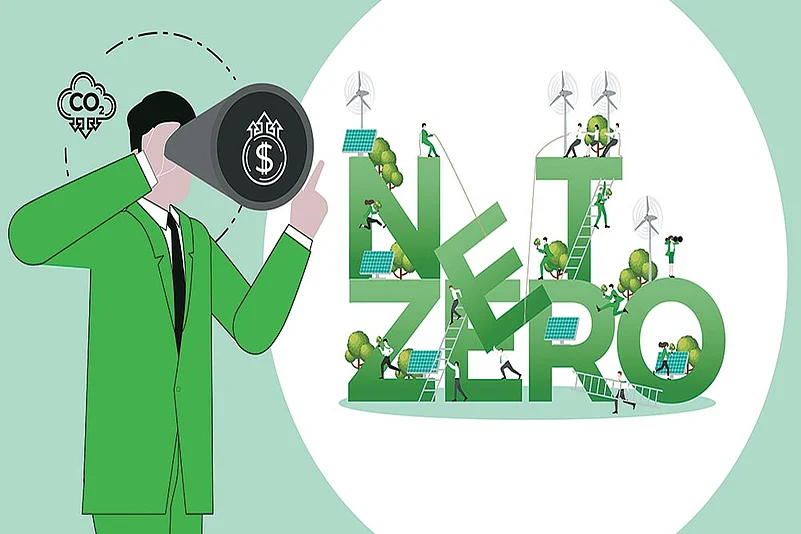

Countries that grow fast consume more energy. That much is obvious. What is less discussed is how this growth reshapes the kind of energy they use. Even as governments speak of climate targets, rapid expansion often pulls energy systems in the opposite direction.
A recent paper by economist Dhyani Mehta, published in Asia-Pacific Journal of Regional Science, looks closely at that tension across Brazil, Russia, India, China and South Africa (BRICS) economies. Titled “Energy transition dynamics in Brazil, Russia, India, China and South Africa: a nonlinear prey-predator-protectors approach using an extended Lotka-Volterra model”, the study asks a fundamental but important question. What happens to renewable energy when economies prioritise speed and scale, along with industrial growth?
The focus on BRICS is deliberate here. The grouping accounts for a large share of global energy demand and future emissions. They are urbanising quickly and expanding infrastructure at a historic pace. At the same time, they are expected to lead the energy transition in the developing world. The gap between these expectations and reality is where the paper is most useful.

1 October 2026
Get the latest issue of Outlook Business

Instead of treating the energy transition as a smooth shift from fossil fuels to renewables, the paper treats it as a system under constant pressure. Economic growth raises energy demand immediately. Cities concentrate that demand in dense spaces. Manufacturing locks it into long-term patterns. Renewable energy grows more slowly and depends heavily on policy support, technology and trade. The balance between these forces determines how the energy mix actually evolves.
The study draws on data spanning more than two decades, covering periods of both rapid expansion and global slowdown. It separates short-term disruptions from longer-term structural changes. While the modelling framework is complex, the takeaway is rather simple. Growth shapes energy choices far more aggressively than policy statements often admit.
Growth vs Renewables
The paper’s central finding is very clear. As economic growth increases in BRICS countries, the share of renewable energy in total energy use tends to decline. Urbanisation and manufacturing show similar effects. New cities, transport corridors, housing projects and industrial zones raise energy demand quickly, and fossil fuels still meet most of that demand.
One cannot simply assume it to be a failure of climate intent. It reflects how energy systems function under pressure. Fossil fuels are easier to deploy in the short run. They fit existing grids, supply chains and industrial processes. Clean energy, despite falling costs, faces constraints related to storage, transmission capacity, etc.
As economic growth increases in emerging nations, the share of renewable energy in total energy use tends to decline. Urbanisation and manufacturing show similar effects
The paper also highlights an important imbalance. When growth accelerates, renewable energy loses ground quickly. When growth slows, recovery is weaker and more gradual. Over time, this asymmetry steadily pushes renewables to the margins, even in countries that are investing heavily in clean energy.
Urbanisation deepens the problem. As more people move into cities, energy systems prioritise uninterrupted supply. Stability becomes more important than experimentation. Grid operators and policymakers tend to fall back on familiar sources that can deliver power on demand, making it harder for renewables to expand beyond a certain point. Manufacturing reinforces this dependence. Heavy industry, in particular, requires constant energy flows that remain difficult to provide using clean sources alone. Steel, cement and chemicals continue to rely on fossil fuels, creating long-term lock-in effects that outlast short-term policy shifts.
The paper finds that these pressures are strongest in the short run. In the years immediately following growth spurts, renewable adoption slows sharply. Over longer periods, some adjustments occur, but the structural bias remains.
Limits of Innovation
This paper does not dismiss the role of innovation. Investment in renewable technologies and trade in low-carbon equipment improve the energy mix over time. Countries that import clean technologies or develop local capabilities tend to see a gradual rise in clean energy use.
However, these gains are consistently smaller than the losses caused by rapid growth and industrial expansion. Innovation moves slowly. It requires time and infrastructure, along with institutional support. Growth creates immediate energy needs and fossil fuels are still better placed to meet them.
There is also a timing problem. The benefits of innovation appear mainly in the long run. The damage caused by growth shows up almost immediately. This mismatch makes it difficult to sustain clean energy momentum during boom periods, when political pressure to deliver jobs and output is strongest.
The paper also shows that growth weakens the impact of innovation itself. Clean energy may increase in absolute terms, but total energy demand grows faster. As a result, the renewable share shrinks even when clean energy capacity expands.
Differences across BRICS countries reinforce the argument. Brazil’s reliance on hydropower and bioenergy offers some insulation from fossil fuel dependence. India and China face intense pressure from urban growth, industrial scale and rising electricity demand. Russia’s economy remains deeply tied to fossil fuel extraction and exports, creating strong resistance to change. South Africa struggles with ageing infrastructure and limited fiscal space.
Call for Action
The paper’s broader message is as clear as its findings. Technology and markets alone cannot drive the energy transition in fast-growing economies. Without deliberate and early policy intervention, growth will continue to crowd out clean energy. Governments need to act during growth phases, not after. Short-term measures matter more than distant targets. Strengthening grids, investing in storage, correcting fossil fuel prices and protecting renewable investments from growth shocks are essential.
Clean energy struggles because growth, as it is currently structured, leaves little room for it to thrive. For BRICS, the challenge, therefore, is not of a choice between growth and sustainability, like many think. Growth itself will have to be redesigned so that clean energy is not pushed aside every time the economy accelerates.