Dear Reader,
The Inference | Google, ChatGPT and the AI Anxiety of Small Businesses
Artificial intelligence is no longer just about breakthroughs in labs or pumping billions of dollars into data centres — it's in our hospitals, courtrooms, classrooms, and on the battlefield. At Outlook Business, we believe that India needs a sharp, nuanced and people-first lens on this transformation.

Advertisement
Artificial intelligence is no longer just about breakthroughs in labs or pumping billions of dollars into data centres — it's in our hospitals, courtrooms, classrooms, and on the battlefield. At Outlook Business, we believe that India needs a sharp, nuanced and people-first lens on this transformation.
The Inference is our attempt to make sense of a world being rewritten by AI. In this newsletter, we bring you frontline narratives, boardroom insights and data you can trust. Whether you're an investor, founder, policymaker or just curious — this is where the signal cuts through the noise.
In this edition of the newsletter:
The AI Threat to Small Businesses
Change Afoot for AI Chips
AI's Growing Thirst
Guard the Moat of Data
Humans in the Loop
The AI Threat to Small Businesses
On a sweltering May afternoon, Mohammad Amir's phone rings: "Got your number online, my AC is not cooling properly." He asks for the address and dispatches two technicians to inspect the unit.
Advertisement
Amir started off as a technician himself 15 years ago, but has since gone on to become a business owner with 10 people working for him. When he set up his business, his first customers came from the hundreds of homes he had visited as a technician over the years.
But a few years ago, he discovered a new stream of customers: the ones calling him directly through his Google listing. Today, Amir estimates that roughly one in three enquiry calls comes through his Google listing, making it one of his biggest sources of new customers.
Every generation has changed how small businesses get discovered. It began with word of mouth, moved to wall paintings and neighbourhood billboards, and then to Google listings. Now, another change is around the corner, thanks to the rapid adoption of AI chatbots like ChatGPT and Gemini. The widespread use of AI chatbots for queries ranging from the complex to the mundane is changing how customers discover local businesses like Amir's. The discovery model is shifting from reviews and proximity to a richer digital footprint. When processing a query about an AC repair service, an AI chatbot gathers a wider digital context before recommending a business. It draws from Google listings, Facebook pages, Justdial, websites and other information available across the web.
Advertisement
The digital presence of most small businesses and service providers is limited to a simple Google listing. "We don't have a website. We only have a Google profile where customers leave reviews," says Amir. What attracted small businesses with localised operations to Google was the simplicity of getting started. Just add the details, and Google would send a code by post; enter the code, verify your address, and you are done. The model scaled rapidly. Google said in 2024 that more than 35 million Indian businesses were present across Search and Maps, facilitating over 900 million customer connections every month. For millions of neighbourhood businesses, a Google listing became their first meaningful digital storefront.
Even AI chatbots take Google listings into account, but they increasingly combine them with websites, social media pages, directories and other online signals before recommending a business. "It (AI search) rewards structured data that the system can understand and parse. It also rewards authority, but authority over media spend is not enough. You need a complementary AI strategy," says Kirthiga Reddy, CEO of OptimizeGEO, a software firm that helps enterprises fine-tune their generative engine optimisation (GEO) strategies.
Advertisement
While traditional search still dominates, AI search is growing rapidly and increasingly becoming the first stop for recommendations and research. Various estimates peg Google's search volumes at roughly 14 billion searches every day, while ChatGPT alone now processes around 2.5 billion prompts daily. The transition, however, is unlikely to affect everyone equally.
Businesses that understand the importance of a wider digital footprint are likely to adapt much faster than those relying only on Google listings and word of mouth. Reddy says even her own company saw this shift first-hand. "Our own search volumes on the enterprise business dropped before the GEO transition," she says. For many small businesses, however, adapting to this shift is a challenge. Most focus on day-to-day operations rather than dedicated digital or AI strategies.
Knowledge-based businesses are already beginning to benefit, often without planning for AI at all. Vinay Singh, who runs Lucknow-based Pinnacle Realty, says two or three customers recently told him they had discovered the firm through ChatGPT. "We have been online for a long time. We started around 2013 and got a proper website made because we wanted customers to feel we were genuine," he says. Over the years, the firm also built locality-specific pages, a Facebook presence, a Google Business profile and listings on property portals.
Advertisement
However, like with every transition, this one too has generated its own share of anxiety around investment and know-how, particularly among small business owners.
Sonu, who runs an eatery called Murli Khaste in Lucknow's Gomti Nagar, says large restaurant chains already have dedicated marketing teams, websites and active social media pages. "Small businesses don't have all that. We are busy running the shop every day. If AI starts recommending only some restaurants, then we will also have to improve our online presence, otherwise new customers may not even know we exist," he says.
Google taught millions of small businesses how to get online. Just as many were beginning to understand that playbook, the rules of digital discovery are changing again.
From the Trenches
Change afoot for AI chips
The AI boom has millions of users expecting answers to complex questions in seconds. Most are, however, oblivious to a GPU shortage festering in the background, fuelled by the seamless integration of AI tools into daily lives.
The industry's biggest constraint is no longer training models, but serving them. Training is more of a one-off exercise. Inference — the process of generating an answer every time a user submits a prompt — runs continuously. As AI moves from experimentation to production, inference is becoming the dominant compute workload.
That transition is reshaping the competitive landscape. "There's a lot happening on the software side, but equally there's a lot happening on the hardware side," says Ankur Edkie, co-founder and CEO of Murf AI, a synthetic-voice technology firm. Chipmakers such as Nvidia are increasingly designing processors optimised for inference, while AI developers are rewriting model architectures to deliver more output from the same hardware. The race is shifting from adding GPUs to extracting more performance from each one.
Murf, which develops and serves its own real-time voice foundation models for enterprises, illustrates the shift. Its push for efficiency was driven less by chip shortages than by changing user expectations. A few years ago, customers tolerated 20- or 30-second response times in exchange for higher-quality output. Today, that delay is untenable.
"Everything has become conversational," Edkie says. Whether it's customer support, AI voice agents or enterprise workflows, users now expect responses in milliseconds. That has turned inference latency into one of the industry's toughest engineering problems.
The trend also reflects the evolution of India's AI ecosystem. Rather than training frontier models from scratch, most Indian startups are building applications on top of APIs and open-source models, focusing on domain-specific use cases. India's competitive edge, Edkie argues, lies less in creating the largest models than in shaping demand for cheaper inference, stronger Indic-language capabilities and products tailored to local markets.
The first wave of AI rewarded companies that built bigger models. The next is likely to favour those that can make them faster, cheaper and scalable.
Numbers Speak
AI's Growing Thirst
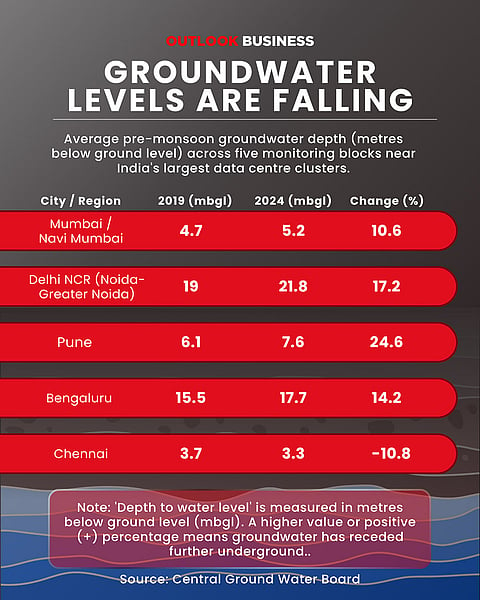
Groundwater is receding across several of India's largest data-centre hubs, underscoring a less visible constraint on the country's AI ambitions: water.
In Noida and Greater Noida, the average pre-monsoon groundwater depth increased 17% over the past five years, from 18.6 metres below ground level in 2019 to 21.8 metres in 2024, indicating a falling water table, according to an analysis of Central Ground Water Board data across five monitoring blocks. Similar deterioration is evident in Bengaluru, Mumbai and Pune. Among the other cities analysed, groundwater depth increased 24.6% in Pune, 14.2% in Bengaluru and 10.6% across Mumbai and Navi Mumbai. Chennai bucked the trend, with groundwater improving from 3.7 metres to 3.3 metres below ground level.
The overlap is striking. More than 90% of India's operational data-centre capacity is concentrated in Mumbai, Chennai, Delhi-NCR, Bengaluru and Pune — the same regions examined for groundwater trends. According to the Council on Energy, Environment and Water, a typical 100-megawatt (MW) hyperscale data centre can consume about 2 million litres of water a day for cooling, although usage varies by technology and site conditions.
The pressure is set to intensify. India is in the midst of one of its largest data-centre buildouts, fuelled by demand for AI computing. Operational capacity exceeded 1,530 MW by the end of 2025, according to CBRE, while investment commitments are projected to rise 45% in 2026, potentially surpassing $180 billion. Much of that expansion is being driven by hyperscalers such as Google, Microsoft and Amazon.
Groundwater depletion is shaped by a range of factors, including population growth, urbanisation, agriculture and industrial activity. Although the data does not singularly attribute falling water tables to data centres, it does, however, point to a growing challenge.
As India scales its AI infrastructure, electricity has become the industry's most visible resource constraint. Water may prove to be the next one — and an increasingly important factor that decides where future data centres can be built.
Words of Caution
Guard the moat
In a recent nine-point manifesto on AI sovereignty, Palantir, the US software company known for its defence, intelligence and enterprise AI platforms, warned against casually transferring proprietary data to external AI systems. "Data retention is your treasure. Transfer it at your own peril," the company said, arguing that years of institutional knowledge, customer insights and operational data are often a company's biggest competitive advantage.
The broader note argues that AI sovereignty will determine an organisation's future, because control over models and data ultimately determines control over future choices. Other principles focus on maintaining ownership of AI infrastructure, avoiding dependency on external providers and building long-term technological resilience.
As AI becomes an everyday productivity tool, its convenience should not come at the cost of giving away your biggest competitive asset.
Best of our AI coverage
Why India Doesn’t Have AI Start-ups in Growth Stage (Read)
Narayana Murthy's Message to India's Youth: Don't Settle for Being the World's Back Office (Read)
Bhavish Aggarwal's Speed is Breaking India's Only AI Unicorn (Read)
India’s Healthcare AI Start-ups Grapple with a Broken Data Ecosystem (Read)
AI Start-Ups Ride a Wave of ‘Curiosity Revenue’, VCs Rethink What It’s Worth (Read)
What Exactly Is an ‘AI Start-Up’ — and Does India Have 5,000 of Them? (Read)