Union Minister Jayant Chaudhary on Monday chaired the first general body meeting of NCVET to review the status of reforms being undertaken to integrate the country's skilling ecosystem with education.
Minister Reviews Reforms to Integrate Skilling With Education
The division will function as a think tank to undertake research on labour market trends, qualification relevance, system performance, and policy innovation

Minister for Skill Development and Entrepreneurship Jayant Chaudhary
Advertisement
In the meeting chaired by Chaudhary, the Minister for Skill Development and Entrepreneurship and Minister of State for Education, forward-looking frameworks aimed at expanding the scope of skilling were also discussed.
These include integrating the sports ecosystem within the national skilling architecture, establishing equivalency pathways for languages, such as English, Japanese, and German, to enhance international workforce mobility and developing a national strategy to build a skilled workforce for India's rapidly growing elderly population.
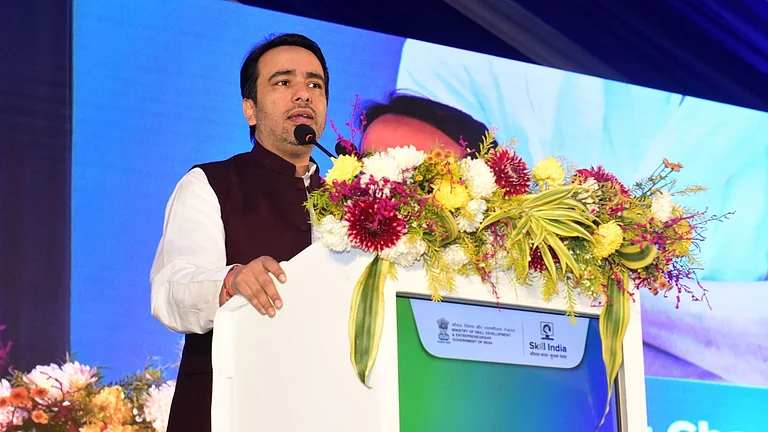
In a significant move, the general body approved the proposal to establish a dedicated research division within NCVET (National Council for Vocational Education and Training).
The division will function as a think tank to undertake research on labour market trends, qualification relevance, system performance, and policy innovation.
"India's skilling ecosystem is undergoing a paradigm shift-from fragmented systems to a unified, outcome-oriented framework aligned with education, industry, and future technologies. NCVET is playing a significant role in making this transformation credible, transparent, and learner-centric," Chaudhary said.
Advertisement

He emphasised that the integration of skilling with mainstream schooling and higher education, enabled through the National Credit Framework and other initiatives of NCVET, is making skilling aspirational and ensuring seamless horizontal and vertical mobility for learners across the education ecosystem.
A key highlight of the meeting was the review of the Revised Guidelines for Recognition and Regulation of Awarding Bodies and Assessment Agencies (2025).
The guidelines are aligned with NEP 2020, the National Credit Framework (NCrF), and the revised NSQF 2023, with a strong focus on learning outcomes, technology-enabled assessments, and evidence-based monitoring.
The minister lauded the launch of KaushalVerse, NCVET's unified Digital Enterprise Portal, which automates core regulatory functions, including recognition, qualification management, monitoring, and grievance redressal.
KaushalVerse is envisioned as the digital backbone of India's skilling regulatory ecosystem, enhancing transparency, efficiency, and ease of compliance.
Advertisement
The general body deliberated on SOAR (Skilling for AI Readiness), an initiative aimed at democratising AI learning; Project Punah Sthapan, an innovative programme facilitating the transition of Defence personnel to the civil workforce; and the semiconductor Workforce Strategy to support India's ambition to emerge as a global electronics manufacturing hub.
The body ratified the recognition of Persons with Disabilities (PwD) as a separate sector in the National Qualification Register (NQR). To date, over 221 PwD-specific qualifications have been approved.
It was apprised of the institutional progress made by NCVET since its operationalisation on 1 August 2020.
As the apex national regulator for skilling, NCVET has subsumed the functions of the erstwhile National Skill Development Agency (NSDA) and National Council for Vocational Training (NCVT), consolidating India's previously fragmented skilling regulatory architecture.
At present, NCVET regulates 161 Awarding Bodies and 68 assessment agencies across the country.
Advertisement