India reaches 50% non-fossil installed capacity ahead of schedule.
Next phase demands skilled workforce to sustain renewable scale.
Workforce development becomes decisive factor in achieving 500 GW target.
How India’s Renewable Energy Transition Entered the Cappuccino Phase
From capacity targets to capability systems, India’s clean energy shift deepens

A large-scale solar and wind energy installation
Summary
Advertisement
In The Undercover Economist, Tim Harford explains the hidden economic forces in daily life, using real world and simple everyday examples like coffee. He explains that value is created not by one heroic ingredient, but by a series of synchronised capabilities: farmers, supply chain, processing, machinery, retail and the small, repeatable skills that make quality consistent. It is quite an impressive example because it explains how present-day economies scale – not through one big bang step, but through systems that can reproduce outcomes at speed, safely and profitably.
From Ambition to Execution
India’s renewable-energy transition has entered its cappuccino phase. What began as a mission driven by ambitious targets has matured into one of the world’s most consequential energy transitions. Recently at the Bharat Climate Forum, Selwin Hart, the UN Assistant Secretary-General and Special Adviser to the UN Secretary-General on Climate Action and Just Transition, acknowledged that India is uniquely positioned to lead the global energy transition.
Advertisement
India has achieved a landmark in this journey by reaching 50% of its installed electricity capacity from non-fossil fuel sources (~250 GW)—five years ahead of the target set under its Nationally Determined Contributions (NDCs) to the Paris Agreement.
The recently announced Union Budget focusses on improving the renewable energy industry integration, grid scale energy storage and ₹20,000 Crores over five years to scale up Carbon Capture, Utilisation and Storage (CCUS) technologies. In addition, Union Minister Piyush Goyal has reiterated that India is firmly on track to achieve its 500 GW renewable energy target by 2030, positioning clean energy not merely as a climate obligation, but as a growth engine for the Indian economy.

Building the Most Consequential Input
With large-scale deployment underway, manufacturing ecosystems and supply chains taking shape, the next challenge is no longer whether India can scale renewable energy — but how sustainably and intelligently it can do so. The most critical part now is building an industrial system that can deliver outcomes—project after project—and in that system, skills shall become the most consequential input.
Advertisement
While capital flows and policy frameworks dominate headlines, the renewable energy sector faces a less visible but far more pervasive challenge: a shortage of skilled and job-ready talent across the value chain.
Estimates suggest that India’s clean energy sector will require close to 2 million industry relevant skilled workers by the latter half of this decade. This includes technicians, engineers, project managers, safety specialists, manufacturing experts, grid operators, data analysts and sustainability finance professionals. And the focus will also be on women contributing to the sector.

Leveraging Successful Models
We can draw on effective models from both global and domestic experience to support India’s renewable energy workforce transition. Countries such as Germany, Denmark and Singapore demonstrate strong practices in workforce planning, integrating green skills into vocational systems, and fostering deep industry–training partnerships. Recent initiatives—including the India‑EU trade discussions and the Government of India’s recent skill‑development collaboration with France—offer opportunities to adapt and contextualise these approaches for Indian needs.
Advertisement
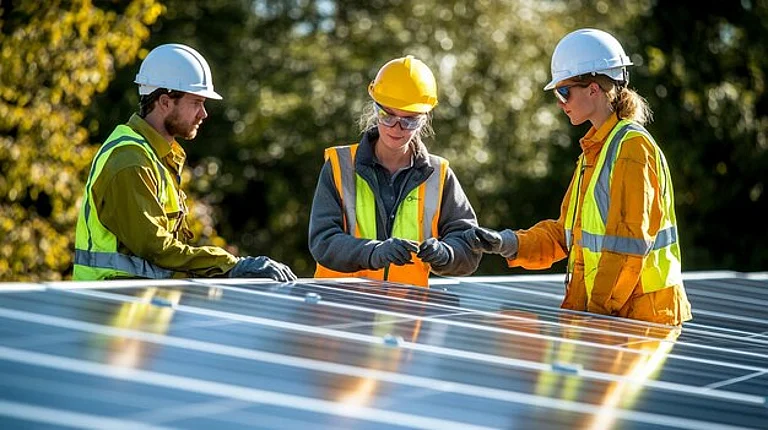
Even India has already taken meaningful steps through dedicated green‑skills courses and industry-linked programmes such as Suryamitra, Varunmitra, Jal‑Urjamitra and Vayumitra. Institutions like the Skill Council for Green Jobs and the Green Skill Development Programme have trained nearly one million individuals to date—an important foundation. However, meeting the FY2030 targets will require a significant scale‑up, especially given that renewable energy systems may demand three to ten times more workers per MW. Moving forward, a stronger alignment between training programmes and emerging industry requirements will be essential. This includes capabilities in manufacturing, energy storage, project management, large‑scale infrastructure safety, maintenance optimisation, digital energy systems, AI‑enabled forecasting, grid‑flow management and climate finance. The recently launched PM SETU scheme, with its focus on upgrading ITIs, provides a practical platform to embed these competencies. As industry participation increases, select ITIs or specific modules can be designated for advanced green‑skills training through short‑term courses and updated curricula.
Advertisement
Pathways to Strengthen Momentum
A structured approach that links concessional finance and project incentives to verified workforce readiness—covering skilling, reskilling and upskilling—will help ensure a dependable talent pipeline. The transition will also generate demand across ancillary industries and MSMEs, whose skilling requirements must be addressed in parallel. Expanding Production Linked Incentive (PLI) schemes, like what is being done in Solar PV Modules, to other renewable segments could further encourage investments in capacity building and workforce development. MSMEs adopting higher shares of green energy can also be incentivised at the unit or cluster level. Additionally, innovative financing structures with outcomes-based skilling, like Skill Impact Bond already being implemented by the Government, can be explored in the sector to achieve timely and effective results. Alongside financial support, the government should focus on allocation of funding for facilitation, implementation assistance and technical guidance to central and state governments to ensure that institutions, industries and MSMEs can effectively navigate and benefit from this skills transition.
Build Skill to Build Scale
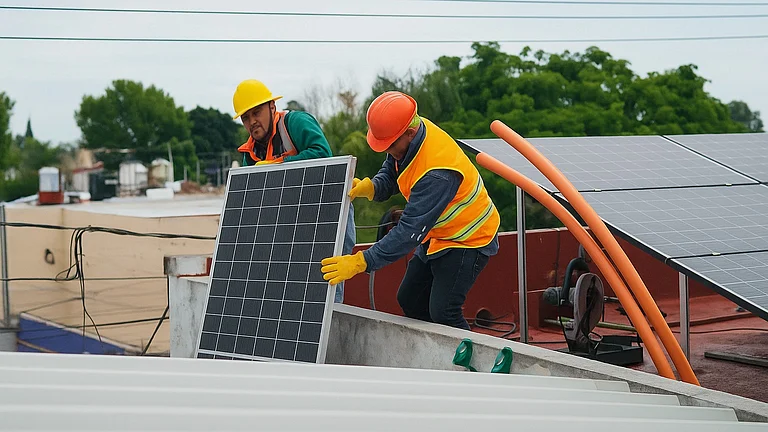
Skilling has long been viewed as a downstream activity and a social-sector issue. But in this context, manufacturing strength of renewable energy systems depends as much on human capabilities as on capital. The Energy Transition for the next target of 500 GW and beyond is ultimately become a Human Transition and if India invests boldly in skilling, it will not only meet its 2030 targets but help shape the global clean energy landscape. That’s the cappuccino lesson: scale is never just about demand. It’s about repeatable capability.
(Sandeep Lanjewar is senior director at Palladium India. The views expressed are personal.)