US–Iran peace talks begin with Pakistan as mediator; India stays out.
India focuses on managing energy risks rather than diplomatic mediation.
Heavy reliance on Gulf oil and gas shapes its response strategy.
US-Iran Peace Talks: Where India’s Focus Lies as Mediation Moves Next Door
India’s absence from the negotiating table has drawn criticism from the opposition, particularly given its ties with both the US and Iran, its dependence on Gulf energy, and the presence of a large diaspora in the region

@Iran_GOV
Summary
Advertisement
Long-awaited peace talks between the United States and Iran are set to begin tomorrow, with Pakistan emerging as an unlikely diplomatic broker.
For India, however, the focus has been markedly different.
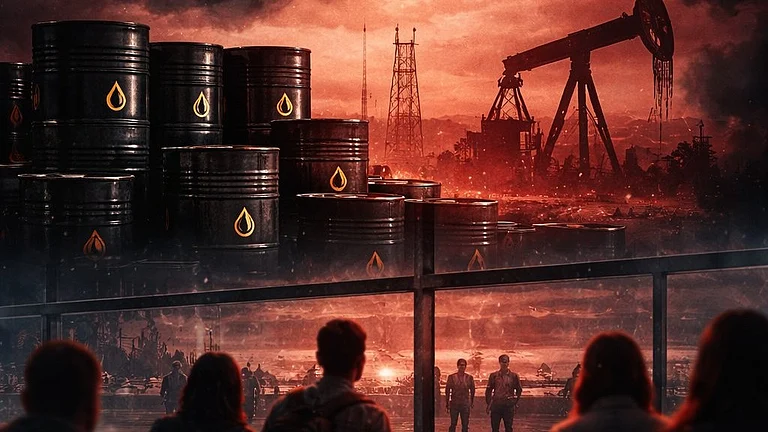
Since February 28, escalating hostilities around Iran and across the Gulf have constricted the Strait of Hormuz, disrupting global energy flows. For India, the immediate concern has been less about mediation, and it seemed more engaged in managing the consequences—keeping fuel supplies steady, cushioning price shocks, and navigating an increasingly uncertain flow of cargo.
India’s initial response to the crisis called for restraint, even as the situation escalated. The International Energy Agency later described the disruption as the largest in oil-market history, with flows through Hormuz falling from roughly 20 million barrels a day to a near standstill.
A two-week ceasefire, brokered by Pakistan and announced on April 8, has offered a narrow window of relief. But there is little sense of normalcy returning. Shipping traffic has yet to normalise, and tensions continue to simmer across the region. Global shipper Hapag-Lloyd has indicated it could take at least six weeks for flows to return to pre-conflict levels, as per Reuters.
Advertisement
India’s absence from the negotiating table has drawn criticism from the opposition, particularly given its ties with both the US and Iran, its dependence on Gulf energy, and the presence of a large diaspora in the region. But the government’s response suggests a different reading of the moment: that the risks are immediate, material, and economic—and require attention closer to home.
A Diplomatic Flurry, Without Mediation
Even as Pakistan hosts negotiations, India has stepped up its own engagements—though not in a mediating role.
New Delhi has backed the ceasefire in principle, while stressing the need to restore “unimpeded” maritime trade through the Strait of Hormuz.
External Affairs Minister S. Jaishankar’s visits to Mauritius and the United Arab Emirates this week are expected to focus on regional stability and existing partnerships.
The Mauritius leg to witness meeting with ministers from West Asia theatre countries Oman, Saudi Arabia and Egypt, from maritime vicinity partners such as Sri Lanka, Maldives, Seychelles, Madagascar and Tanzania, from South East Asia countries Thailand, Singapore and Cambodia, and from neighbours Bhutan and Bangladesh – will frame the challenges being faced post 40 days of conflict.
Advertisement
At the same time, Petroleum Minister Hardeep Singh Puri’s visit to Qatar points to a more immediate concern: securing LNG and LPG supplies at a time of disruption.
Taken together, the outreach underscores a pattern—engagement without mediation, and a tilt towards managing supply chains rather than shaping negotiations.

The Energy Constraint
That priority is shaped by structural dependence.
India imports over 88% of its crude oil requirements, and roughly half of its natural gas consumption. Qatar alone accounts for more than two-fifths of LNG imports, underscoring the country’s exposure to Gulf supply routes.
Buffer capacity is limited. Strategic petroleum reserves stand at 5.33 million tonnes—equivalent to under 10 days of demand at full capacity—while total storage capacity is estimated at around 74 days.
The disruption in Hormuz has already had visible effects. LNG shipments from the Persian Gulf have stalled since early March, and LPG flows have slowed sharply. At the same time, higher global prices have forced India to secure supplies at elevated costs.
Advertisement
Domestically, this has translated into trade-offs. Gas supplies to certain industries have been curtailed, while LPG distribution has been prioritised for households over commercial users.
According to Nomura, India ranks among the three most vulnerable Asian economies to oil price shocks. A 10% increase in oil prices typically widens the current account deficit by 0.4% of GDP.
The uncomfortable reality is that a ceasefire does not resolve these pressures. Even a partial disruption of flows through the Gulf—accounting for a significant share of global crude and LNG supply—carries outsized consequences.
For now, as Pakistan positions itself at the diplomatic centre, India’s approach reflects a different calculus: in a fragile ceasefire, securing energy may matter more than shaping the peace.