The RBI has launched a special FCNR(B) swap facility, allowing banks to mobilise fresh foreign currency deposits from NRIs and swap them with the central bank.
The move revives a strategy first used during the 2013 taper tantrum, when the scheme helped attract nearly $34 billion in foreign currency inflows.
While analysts expect lower FCNR(B) inflows than in 2013 due to higher US interest rates, the combined impact of FCNR(B), ECB incentives, tax exemptions, and bond market reforms could bring in up to $40-50 billion.
RBI Revives a Crisis-Era Tool. Can It Save the Rupee Again?
The RBI has revived a crisis-era FCNR(B) swap facility to attract foreign currency inflows, boost forex reserves, and support the rupee amid sustained capital outflows and global uncertainty

RBI Revives a Crisis-Era Tool AI Generated
Summary
Advertisement
The Reserve Bank of India on Friday announced a slew of measures to attract foreign capital. Announcing the June policy meeting decision, the RBI’s Monetary Policy Committee decided to keep the benchmark repo rate steady at 5.25%, providing stability to financial markets.
However, the question of currency stability and the plight of hot money flight took centre stage, with the central bank bringing back a tool to attract foreign inflows.
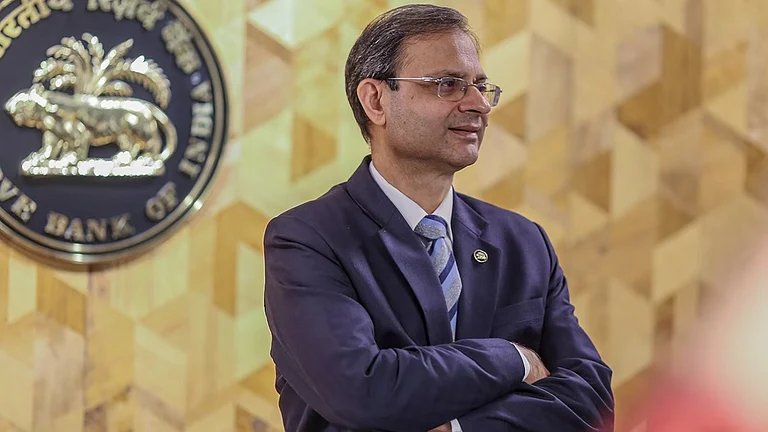
RBI Governor Sanjay Malhotra announced the launch of a US dollar-rupee foreign exchange swap beginning Monday for fresh Foreign Currency Non-Resident Bank (FCNR-B) account deposits with maturities of three to five years.
The FCNR-B account allows NRIs, Persons of Indian Origin (PIOs), and Overseas Citizens of India (OCIs) to park their deposits in foreign currency and earn interest on them.
This is attractive since there is no need to exchange currency, and it is protected from currency value fluctuations. Moreover, interest earned on FCNR-B deposits is also tax-free in India.
Advertisement
This is not the first time the central bank has introduced a swap window, apart from its daily interventions in the forex market.
The Return of a Crisis-Era Tool
Back in 2013, the central bank, headed by Raghuram Rajan, was mulling policy tools to attract foreign money against the backdrop of what is known as the taper tantrum. It refers to a period of market volatility and speculation triggered by fears of monetary policy tightening by global central banks.
But why is the RBI bringing back that tool? How does FCNR-B support the rupee, and how effective has it been in the past?
The Fall of the Rupee
The primary reason for the central bank to bring back the tool is the faster-than-expected depreciation of the rupee. The domestic currency was the worst-performing currency in 2025, having fallen nearly 10% against the greenback. Six months into 2026, the rupee has already depreciated by over 6%.
Advertisement
The rupee came under pressure following foreign fund outflows, elevated crude prices, and escalating geopolitical tensions in West Asia.
Investor sentiment turned jittery, prompting withdrawals from Indian financial markets and a move towards safe-haven assets amid rising uncertainty around global crude prices and the Iran-US conflict.
So far in 2026, FPIs have pulled a record $32 billion out of Indian equities.
How Does the Tool Help in Stabilising the Rupee?
Unlike the 2013 framework, where the central bank gave a 3.5% subsidy to Authorised Dealer (AD) banks, the RBI will fully bear the exchange rate risk this time on all new three-to-five-year deposits mobilised until September 30.
Under the framework, banks can sell US dollars to the RBI in multiples of $1 million and buy back the same amount at the end of the swap period. This inflow of dollars helps bolster the central bank's foreign exchange reserves, easing pressure caused by market interventions.
Advertisement
Did the 2013 Framework Help?
The 2013 launch of the FCNR-B swap brought nearly $34 billion into the Indian banking system, including $26 billion via FCNR-B deposits and $8 billion via external commercial borrowings. It accounted for 12% of India’s forex reserves in 2013.
However, the situation is different from 2013. Interest rates in the US are now much higher, while bond yields and interest rates in India are lower than they were a decade ago. As a result, the potential returns from bringing dollars into India are less attractive than before, MUFG noted.
Even so, the scheme is still expected to draw significant foreign currency inflows. Analysts estimate that around $20 billion could come into India through this route, although the final amount may be lower than what was seen during the 2013 programme.
The additional dollar inflows would help strengthen the RBI's forex reserves and ease pressure on the rupee at a time of heightened global uncertainty, the note said.
Advertisement
FCNR-B alone may raise less than the $34 billion seen in 2013 because the economics are less attractive. But when combined with ECB incentives, tax exemptions, and bond market reforms, total foreign currency inflows could still exceed 2013 levels.
At the December 2024 MPC meeting, the RBI announced an increase in the upper ceiling for FCNR-B accounts with similar objectives. However, it brought only moderate inflows of $6.75 billion.
“Unlike the 2024 framework, the RBI is now absorbing the full 3.5% interest rate cost. This lets banks offer 6.5%, which is likely to attract more deposits,” Gaura Sengupta, Chief Economist, IDFC First Bank, said.
Will It Help the Rupee?
According to economists, the move is expected to bring nearly $50 billion through FCNR-B deposits and ECBs. Analysts expect the rupee to stabilise around 94 per dollar in the medium term, depending on the quantum of flows, before likely coming under pressure again after November. The FCNR-B swap window ends on September 30.
“Net-net, our preliminary estimates suggest that there could be around US$40 billion of inflows from these policies, and more so if India were to be included in the Bloomberg Global Aggregate Index as an indirect result,” MUFG said in a note.
Market participants are of the view that once the swap window closes, the rupee’s further movement will depend on RBI actions in the market.
The Balancing Act
Moreover, the Centre removed the capital gains tax in a bid to attract foreign portfolio investors, especially into the government bond market. Earlier, investors had to pay a 12.5% capital gains tax on assets held for over 12 months and a withholding tax of 20% on assets held for less than 12 months.
Taken together, these measures suggest that the RBI is currently trying to keep the currency stable, attract foreign capital, and keep interest rates steady.
Unlike the monetary policy tightening cycle of 2013, when the RBI had to raise rates to 8% and maintain a tight stance for a year, the central bank is now attempting to manage free-flowing capital through tax exemptions, stabilise the rupee by attracting foreign capital, and maintain the benchmark repo rate at current levels.
Economists often describe this challenge through the lens of the "impossible trilemma", which argues that a country cannot simultaneously maintain a stable exchange rate, free capital movement and an independent monetary policy.
However, economists caution that the equity market may continue to experience foreign fund outflows due to rapidly evolving geopolitical conditions.
“Though measures have been announced to attract foreign capital, the equity market might still face problems. Unless global investor sentiment calms, the FPI and FDI repatriation problem will persist. The West Asia crisis needs to be resolved. Until that improves, it might be difficult to attract investors into the equity market,” Sengupta said.
Whether the strategy succeeds will depend less on the RBI's incentives and more on global risk appetite. If geopolitical tensions ease and capital flows return, the central bank may buy itself time. If not, the rupee could once again test the limits of policy intervention.