Long-term policy frameworks, particularly for hybrid renewables energy, along with a thrust on adoption of technologies and incentive-driven manufacturing, will help the country meet its renewable energy goals, experts said.
Long-term Policy Support Key to Meeting India's Renewable Energy Goals: Experts
Experts also believed decarbonisation will continue to be a priority for the industry.

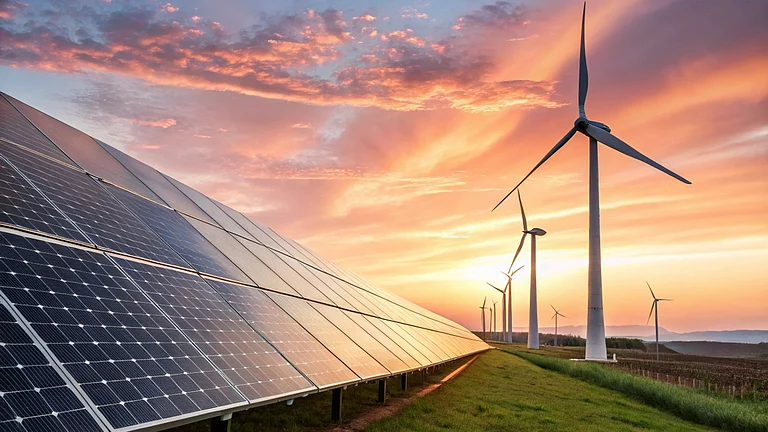
Renewable Energy Photo by XYZ
Advertisement
Experts also believed decarbonisation will continue to be a priority for the industry.
Sharing his views, Piyush Goyal, CEO and Co-founder of Volks Energie, said there are certain areas which are essential not only for meeting climate commitments, but also for powering India’s industrial growth, enhancing energy security, and ensuring affordable electricity for consumers.
"Accelerating grid upgrades and storage adoption must be treated as national priorities as India's future energy mix depends on both. Further, incentivising domestic manufacturing of inverters, batteries, and critical components will reduce import dependencies and build supply-chain resilience," Goyal said.
Manish Dabkara, CMD of carbon credits firm EKI Energy Services, said emerging technologies, including green hydrogen, advanced storage chemistries, and smart grid systems have the potential to address intermittency and ramping flexibility challenges.
"Stable, long-term policy frameworks particularly for hybrid renewables, offshore wind, and green hydrogen will be critical in attracting sustained private and global capital flows," he noted.
Advertisement

Gaurav Moda, Partner and Energy Sector Leader, EY-Parthenon India, said that accelerating renewables, efficiency-led decarbonisation, and digital adoption are delivering measurable returns, while renewed momentum in nuclear energy point to a more integrated and commercially grounded phase of the energy transition.
Further, he said AI is rapidly democratising technology adoption across the energy value chain, with global majors already unlocking 1-1.5% incremental EBITDA through sharper decision-making and operational optimisation. The focus is shifting from technology deployment to measurable value realisation.

Ankit Jain, Vice President and Co-Group Head, Corporate Ratings at ICRA Ltd, said, "While bidding slowed with only 8.6 GW auctioned in 8M FY2026 amid delays in signing of PPAs/PSAs, transmission infrastructure remains a critical focus to sustain capacity expansion." Grid curtailments during peak renewable generation hours highlight the urgency for storage and grid strengthening. These measures are essential to ensure grid stability and enable the sector's continued growth momentum and will remain the key monitorable in FY2027, he noted.
Advertisement

Amit Rautela, CFO of UP-based largest power Company Meja Urja Nigam Private Ltd, said that as of September 30, 2025, India has crossed a significant milestone with 500.89 GW of total installed power capacity, of which 256.09 GW (51%) is from non-fossil sources and 244.80 GW (49%) from fossil fuels, marking tangible progress towards India's Net-Zero commitment.
He added that this scale-up, combined with historically low renewable tariffs, demonstrates that the energy transition is increasingly cost-competitive and financially credible.