India, New Zealand to sign free trade pact aimed at doubling trade.
Agreement offers duty-free access, expanded visas and $20 billion investment flow.
Deal boosts exports, services mobility and strengthens Indo-Pacific economic cooperation framework.
India–New Zealand FTA Signing Set for April 27 to Bolster Trade, Market Access
India and New Zealand set to sign FTA on April 27, boosting trade and investment ties

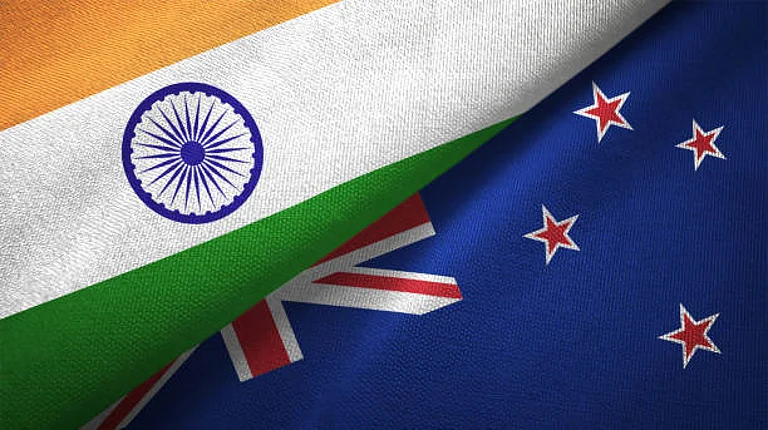
India and New Zealand flags symbolising upcoming free trade agreement signing
Summary
Advertisement
India and New Zealand are set to sign a free trade agreement (FTA) on April 27, aimed at doubling bilateral trade between the two countries, reported PTI.
The agreement will give India companies duty-free access to the island nation’s markets and bring in $20bn of investment over the next 15 years.
It will be signed in the presence of Commerce and Industry Minister Piyush Goyal and Todd McClay, New Zealand's Minister for Trade and Investment, here at Bharat Mandapam, according to the commerce ministry.
The deal will also give India more temporary employment visas, easier access for pharmaceuticals and medical devices.
The agreement is aimed at doubling bilateral trade to $5bn in five years. The pact will help Indian exporters, reeling under the impact of global uncertainties, including the West Asia crisis, diversify shipments in the Oceania region. India has already implemented a trade pact with Australia, expanding its presence in trade engagement in the region.
Advertisement
Kirit Bhansali, Chairman, Gem and Jewellery Export Promotion Council (GJEPC)
“In today’s turbulent global environment, India’s continued progress in advancing and concluding FTAs is enabling the industry to strategically diversify its export markets and reduce overdependence on any single geography such as the US or regions like the GCC.”
Bhansali further added that the India–New Zealand FTA, following the Australia agreement, is a timely step in this direction. He noted that India’s gems and jewellery exports to New Zealand currently stand at around $16.61mn and are expected to grow to nearly $50mn over the next three years with zero-duty access. Highlighting New Zealand’s strong jewellery consumption trends, he said that the agreement offers a clear duty advantage over key competitors such as China and Thailand, supporting a more balanced and resilient growth trajectory for the sector.
Bhansali also outlined key provisions of the agreement, noting its trade and tariff implications.
Advertisement

Overview of Pact Terms
According to PTI, the pact will offer New Zealand a duty-free access to goods such as sheep meat, wool, coal and over 95% of forestry and wood articles.
Meanwhile, the agreement will eliminate or reduce tariffs on 95% of New Zealand's exports of items ranging from wool, coal, wood, wine, to avocados and blueberries to India, New Delhi made no concessions on allowing imports of dairy, onions, sugar, spices, edible oils and rubber to protect farmers and domestic industry.
New Zealand, which committed to investing $20bn in India over the next 15 years in manufacturing, infrastructure, services, innovation and job creation, will also get quota-based tariff cuts for kiwifruit and apple exports.
In addition, it will get duty concessions on a number of items such as kiwifruit, wine, some seafood, cherries, avocados, persimmons, bulk infant formula, Manuka honey and milk albumins.
Advertisement
To protect the interests of domestic farmers and MSMEs, India will not give any duty concessions in the politically sensitive dairy sector, like milk, cream, whey, yoghurt and cheese.
The other products that will not be covered under the pact include vegetable products (onions, chana, peas, corn, almonds), sugar, artificial honey, animal, vegetable or microbial fats and oils, arms and ammunition, gems and jewellery, copper and its products, and aluminium and articles.
As regards the services sector, New Zealand will give a temporary employment entry visa pathway for Indian professionals in skilled occupations with a quota of 5,000 visas annually and a stay of up to three years.
This pathway covers Indian professions such as AYUSH practitioners, yoga instructors, Indian chefs, and music teachers, as well as high-demand sectors, including IT, engineering, healthcare, education and construction, strengthening workforce mobility and services trade.
Under the pact, New Zealand will set up a dedicated Agri-Technology Action Plan on kiwifruit, apples and honey with a view to help Indian farmers enhance productivity and quality.
Advertisement
The cooperation includes the establishment of centres of excellence, improved planting material, capacity building for growers and technical support for orchard management, post-harvest practices, supply chain performance and food safety.