India’s exports are expected to gain momentum following the conclusion of a bilateral free trade agreement (FTA) with New Zealand, as several sectors remain under-represented in the country’s import basket.
A GTRI report flagged significant untapped export potential in processed foods, pharmaceuticals, petroleum products, industrial chemicals, and manufacturing.
The FTA, expected to be signed in early 2026, could help India expand exports by addressing market access, regulatory barriers and supply-chain diversification needs.
India to Gain Export Momentum Through Bilateral FTA With New Zealand
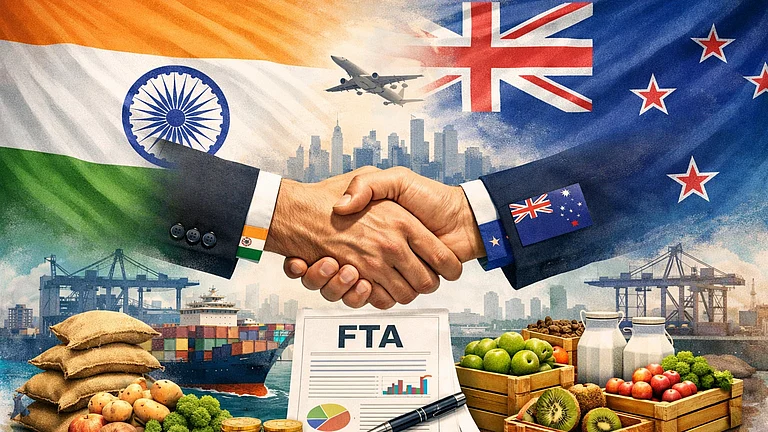
India and New Zealand concluded negotiations on the FTA on Monday, with the agreement expected to be formally signed in early 2026. In FY25, New Zealand imported $711 million worth of goods from India, compared with imports of nearly $10 billion from China

FreePik
Summary
Advertisement
India’s exports are expected to receive a significant boost following the conclusion of a bilateral free trade agreement (FTA) with New Zealand, as trade data point to substantial untapped potential across multiple sectors, according to a report by the Global Trade and Research Initiative (GTRI).
The report highlights that India remains under-represented in New Zealand’s import basket across several product categories where it is otherwise a major global exporter. Processed foods show the widest gap and the greatest scope for expansion, followed by food preparations and pharmaceuticals.
While India exports around $602 million worth of bakery products and $817 million in food preparations globally, its exports to New Zealand in these segments stand at just $6.5 million and $7.7 million, respectively. In pharmaceuticals, India is a leading global supplier, yet exports to New Zealand amount to only $75 million, compared with New Zealand’s total pharmaceutical imports of $962 million.
The research suggests that gaps in sectors such as processed foods, pharmaceuticals, machinery, electronics, automobiles and aerospace point to under-penetration rather than a lack of competitiveness. The proposed FTA is expected to create the conditions needed to expand India’s exports in these areas.
Advertisement
India–New Zealand FTA
India and New Zealand concluded negotiations on the FTA on Monday, with the agreement expected to be formally signed in early 2026. In FY25, New Zealand imported $711 million worth of goods from India, compared with imports of nearly $10 billion from China. New Zealand’s total imports stood at around $50 billion.
“India’s exports to New Zealand are negligible—often between $0.1 million and $5 million in several product lines—even though Chinese competition in these categories is limited,” Ajay Srivastava, former trade official and founder of GTRI, said in the report. “This points to an untapped market rather than one blocked by entrenched suppliers.”
Apart from food and pharmaceuticals, petroleum products and industrial chemicals also present significant opportunities. India is among the world’s top exporters of refined petroleum products, with global exports of $69.2 billion. New Zealand imports around $6.1 billion worth of petroleum products, of which China supplies $181 million, while India’s exports to New Zealand in this segment amount to just $2.3 million.
Advertisement
Similarly, India exports more than $1.1 billion worth of aluminium oxide globally, while New Zealand imports about $225 million, yet India’s share is only $0.2 million.
Other areas with scope for export expansion include plastics and rubber, consumer goods, textiles and apparel, machinery and industrial equipment, electronics and electrical equipment, transport equipment, and high-value manufacturing.

“For India, the challenge now is to complement the FTA with targeted export promotion, standards cooperation, regulatory facilitation and logistics support,” Srivastava said. “For New Zealand, diversifying imports away from a single dominant supplier would strengthen supply-chain resilience.”