Nike will leave the S&P 100 on September 21 after an extended decline in market value
The company’s push towards direct-to-consumer and digital sales weakened wholesale relationships just as rivals gained ground
Nike is now reversing course, rebuilding wholesale distribution and product innovation while trying to address a prolonged downturn
Nike To Be 'Deleted' From S&P 100: How The Giant Shoe Brand Is Losing Ground
Nike's struggles have coincided with a sportswear market that has become more competitive and fragmented. The larger challenge is whether Nike can restore growth, product relevance and pricing power quickly

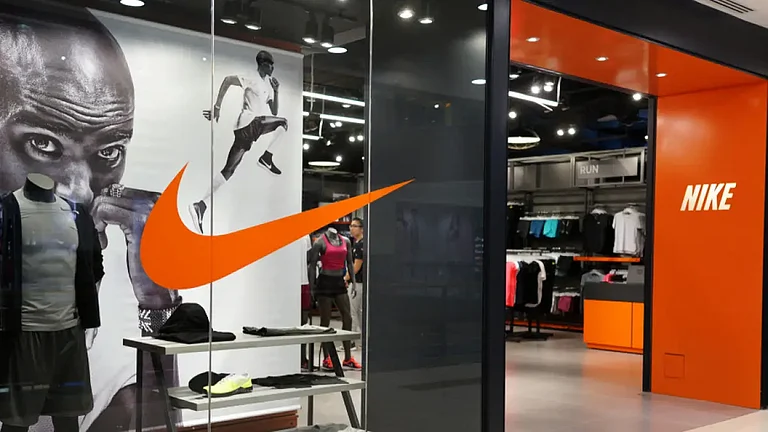
Nike To Be 'Deleted' From S&P 100: How The Giant Shoe Brand Is Losing Ground AI generated representative image
Summary
Advertisement
Nike is set to lose its place in the S&P 100 after 18 years, with a sharp fall in its market value pushing the sportswear giant out of the index of the 100 largest companies in the S&P 500.
As part of its quarterly rebalance, Nike will be removed from the S&P 100 before the US market opens on September 21, S&P Dow Jones Indices said on September 4.
Dell Technologies, Palo Alto Networks, Arista Networks and Sandisk will be added, replacing Honeywell Aerospace, Nike, Simon Property Group and Colgate-Palmolive, respectively.
The change is primarily a reflection of market capitalisation rather than a separate judgement on Nike's business. The company will remain in the S&P 500. However, the move is a stark marker of how far the stock has fallen from its earlier standing.
Nike’s Market Value Has Slumped
Nike shares closed at $38.40 on September 4, valuing the company at around $57 billion, according to Reuters, reported The Economic Times (ET). That compares with roughly $264 billion at the end of 2021.
Advertisement
The deterioration has been reflected in the company's financial performance. Nike's revenue reached $51.4 billion in fiscal 2024 before declining to $46.3 billion in fiscal 2025, as per a report by Business Standard (BS). Revenue was broadly flat at $46.39 billion in fiscal 2026.

The more important shift has been within its sales channels. Nike Direct revenue fell 13% to $18.8 billion in fiscal 2025, while Nike Brand Digital declined 20%. By fiscal 2026, Direct revenue had dropped further to $17.7 billion, while wholesale revenue increased 6% to $27.5 billion.
That reversal matters because Nike had spent years moving in the opposite direction.
Direct-To-Consumer Bet Lost Momentum
Nike's Consumer Direct Acceleration strategy, introduced in 2020, placed its own stores and digital platforms at the centre of its growth plans.
The idea was to gain greater control over pricing, customer data, brand presentation and the consumer experience while reducing reliance on traditional retailers.
Advertisement
The strategy initially appeared logical, but its momentum weakened. As Nike pulled back from some wholesale relationships, its own channels failed to generate enough additional demand to compensate.
The financial impact was visible in margins too. Gross margin fell 190 basis points to 42.7% in fiscal 2025, with Nike attributing the pressure to higher discounts, channel mix changes and inventory obsolescence reserves, per BS.
Nike is now moving in the opposite direction. Wholesale distribution is being rebuilt, particularly in North America, where wholesale revenue increased 14% in fiscal 2026 even as Direct revenue declined 6%.
Rivals Have Taken Advantage Of Gap
Nike's struggles have coincided with a sportswear market that has become more competitive and fragmented.
On, a Swiss brand, reported 2025 sales of CHF3.01 billion, up 30%, and expects constant-currency sales growth of at least 23% in 2026.
Advertisement
Hoka, owned by Deckers Brands, increased revenue 15.9% to $2.59 billion in fiscal 2026. New Balance recorded global sales of $9.2 billion in 2025, up 19%, per BS.
The challenge is not limited to newer specialist brands. Adidas has also regained ground, while Nike's global sports footwear market share declined from 25.9% in 2022 to 22.9% in 2025, according to Euromonitor data cited by Reuters.
The competitive pressure has made product innovation particularly important. Nike is accelerating new launches and reducing supplies of some existing footwear to rebalance its portfolio, according to its regulatory filings.
China Has Become A Persistent Weakness
Greater China has emerged as one of Nike's biggest problems. Revenue from the region declined from $7.55 billion in fiscal 2025 to $6.59 billion in fiscal 2026, a 13% fall on a currency-neutral basis, per BS.
Footwear revenue dropped 15%, while Direct revenue fell 12% and digital sales declined 29%. Nike attributed the weakness to lower store traffic, heavier discounting and elevated inventory.
Advertisement
The company is also facing increasingly strong domestic competition. ANTA Sports reported RMB80.2 billion, or about $11.2 billion, in revenue in 2025, up 13.3%, and said its market share in China reached a record level, per BS. Li-Ning is another established domestic competitor.
Nike is therefore attempting a deeper reset in China, including greater local influence over product development and tighter control over online distribution.
India Offers A Different Growth Route
India is emerging as a contrasting market for Nike. Rather than relying entirely on its own digital infrastructure, the company has partnered with Nykaa to manage its India digital commerce operations, including its website, app, fulfilment and customer experience.
Nykaa said in its August earnings call that Nike's India app had crossed 1.5 million installs within six months and that Nike had become one of the top three brands on Nykaa Fashion, per Reuters, reported ET.
The approach highlights a broader rethink: Nike is no longer treating direct ownership of every part of the customer journey as the only route to growth.
Bigger Problem Is Rebuilding Demand
Nike's turnaround now depends on more than restoring distribution. It needs new products to generate consumer excitement, reduce reliance on discounting and rebuild its position in categories where specialist competitors have gained ground.
Gregory Kennedy, in a post on X, described the company's strategic shift in particularly blunt terms: "How to destroy a beloved brand."

He argued that Nike's emphasis on data-driven decision-making and direct sales damaged retail relationships and created room for competitors such as On and Hoka before a new management team attempted to reverse course.
Nike CEO Elliott Hill, who returned to the company in 2024, has acknowledged that the recovery is taking longer than expected. "Overall, the results aren't there yet," he told analysts after the June quarter, as per Reuters.
That may be the most important takeaway from Nike's S&P 100 exit. The index change is an effect of the company's shrinking market value, not the cause of it. The larger challenge is whether Nike can restore growth, product relevance and pricing power quickly enough in a market where rivals are no longer waiting for the Swoosh to find its stride.