FIIs pulled out nearly ₹45,000 crore from HDFC Bank and ICICI Bank in Q4
The sell-off contributed to sharp stock declines despite stable earnings performance
Global tensions and regulatory changes added pressure, clouding near-term outlook
Foreign Investors Dump HDFC, ICICI Bank Shares; What's Behind the Sell-Off?
Massive FII outflows from India’s top private banks rattle sentiment, even as strong fundamentals and steady earnings highlight underlying operational resilience amid global and regulatory headwinds

Summary
Advertisement
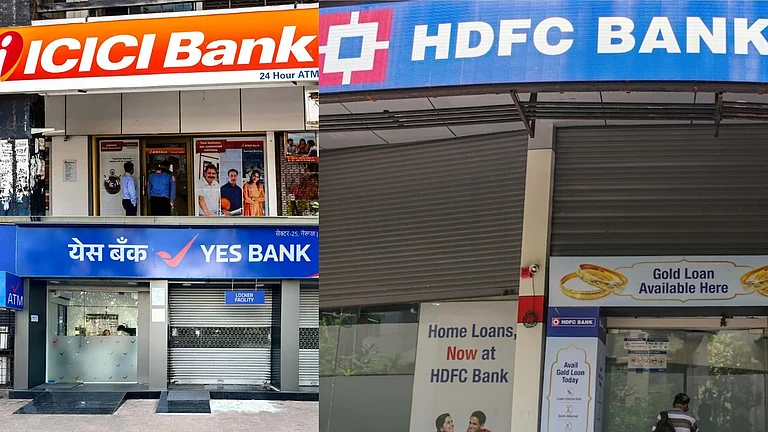
India’s leading private lenders, HDFC Bank and ICICI Bank, witnessed a significant exodus of foreign institutional investor (FII) capital during the March quarter, with combined outflows nearing ₹45,000 crore.
This accounted for roughly three-fourths of the total ₹60,000 crore withdrawn from financial stocks during the period, according to media reports.
FIIs sold nearly ₹35,000 crore worth of shares in HDFC Bank, reducing their stake from 47.66% to 44%. Meanwhile, ICICI Bank saw outflows of about ₹10,000 crore, with foreign ownership dropping sharply from 43.87% to 34.48%.
Stocks Underperform Broader Market
The aggressive selling weighed heavily on stock performance. HDFC Bank shares plunged around 26%, while ICICI Bank declined close to 10%. In comparison, benchmark indices like the BSE Sensex and Nifty 50 fell approximately 15% each during the same period.
Investor sentiment around HDFC Bank was further shaken by the sudden resignation of its part-time chairman, Atanu Chakraborty over ethical concerns. At the same time, banking stocks broadly remained under pressure due to geopolitical uncertainties, including ongoing US–Iran–Israel conflict and trade tensions.
Advertisement
Regulatory Moves Add to Pressure
Recent measures by the Reserve Bank of India also contributed to the strain. The RBI capped banks’ net open positions (NOP) in the forex market at $100 million, forcing large banks to cut exposure significantly.
This impacted treasury income, adding another layer of pressure during a quarter already marked by declining equity and bond markets.
Fundamentals Stay Strong, Risks Remain
Despite the sell-off, both banks reported solid financial performance. Profit growth remained healthy, asset quality stable, and credit expansion steady. Strong balance sheets and adequate capital buffers indicate resilience at the operational level.
However, uncertainties persist. Prolonged geopolitical conflicts could drive up oil prices, stoke inflation and weaken consumer demand. Such factors may eventually affect asset quality, making global developments a key determinant of the sector’s near-term trajectory, experts noted.