Budget ramps up capex to boost infrastructure, manufacturing and long-term growth.
Manufacturing push targets semiconductors, biopharma, electronics and capital goods expansion.
Customs reforms aim to ease imports for exporters and strengthen domestic value chains.
Capex, Fiscal Deficit, Manufacturing, Customs Shape Budget 2026 Priorities — Key Takeaways from FM Sitharaman's 9th Budget
Union Budget 2026 outlines priorities across capex, manufacturing push and customs reforms

FM Nirmala Sitharaman
Summary
Advertisement
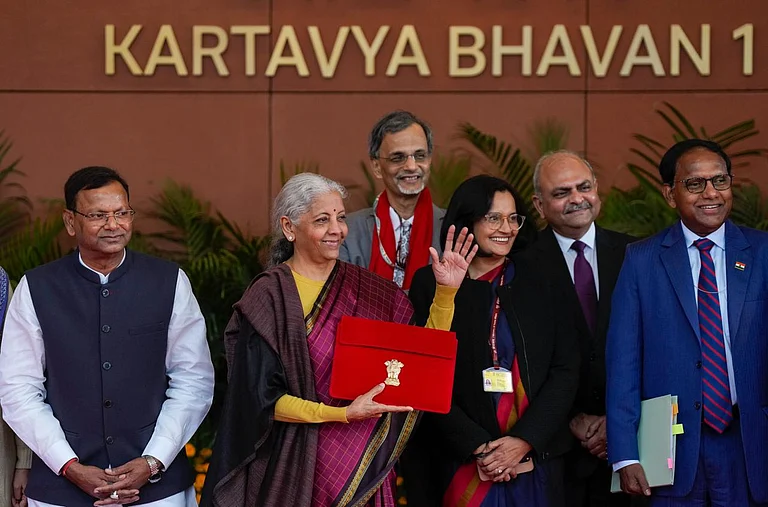
Finance Minister Nirmala Sitharaman, while presenting her ninth consecutive Union Budget on February 1, said the country’s “Reform Express” will be driven by the government.
FM Sitharaman proposed raising capital expenditure (capex) target to ₹12.22 lakh crore for FY27, up from 11.2 lakh crore and effective capital expenditure of ₹17.15 lakh crore, up from revised spending of ₹49.65 lakh crore in 2025–26. Total expenditure in the Budget Estimates for 2026–27 is projected to be ₹53.47 lakh crore, showing a growth of 7.7% over RE 2025-26 of ₹49.65 lakh crore.
Manufacturing
Scaling up manufacturing across seven strategic and frontier sectors took centre stage in the presentation of Union Budget 2026-27, with an aim to strengthen India’s industrial base, reduce import dependence and position the country as a global manufacturing hub.
Presenting the Budget in Parliament on Sunday, FM Nirmala Sitharaman said the proposed manufacturing initiatives form part of the six focus areas under the “First Kartavya” outlined in the Budget framework.
Advertisement
To position India as a global biopharma manufacturing hub, the Budget proposed the five-year, ₹10,000 crore Biopharma SHAKTI programme, aimed to strengthen manufacturing, research and regulatory capacity for biologics and biosimilars. This was proposed to create a full-stack domestic biopharma ecosystem.
The initiative also intends to address skill gaps throughout the biopharma value chain, from research and clinical development to large-scale manufacturing, by setting up three new National Institute of Pharmaceutical Education and Research (NIPERs). The programme will ensure establishment of more than 1,000 accredited clinical trial sites across the country. The regulatory procedures are expected to be in line with international standards if the Central Drugs Standard Control Organisation (CDSCO) is strengthened concurrently with a dedicated scientific review cadre.
The Budget also announced India Semiconductor Mission (ISM) 2.0 to produce semiconductor equipment and materials, designing full-stack Indian intellectual property, and strengthening supply chains. The aim is to develop industry-led research and training centres to support technological development and create a skilled workforce in the semiconductor sector.
Advertisement

In addition, the Budget proposed an expansion of the Electronics Components Manufacturing Scheme, increasing its outlay from ₹22,919 crore to ₹40,000 crore, to capitalise on the growing momentum in electronics manufacturing and strengthen domestic value chains.
Rare Earth Corridors and Chemical Parks also received support from the Budget this time with proposals dedicated to Rare Earth Corridors to promote mining, processing, research and manufacturing of rare earth permanent magnets in mineral-rich states such as Odisha, Kerala, Andhra Pradesh and Tamil Nadu. In addition, a new scheme will support states in establishing three dedicated Chemical Parks through a challenge-based, cluster-driven, plug-and-play model, aimed at enhancing domestic chemical production and reducing import dependence.
In order to boost domestic value chains and competitiveness, the budget suggested a multi-sector manufacturing push. Hi-Tech Tool Rooms at two CPSE locations, a new plan to increase domestic production of cutting-edge infrastructure and construction equipment, and a five-year container manufacturing project worth ₹10,000 crore are some of the measures. Along with Mega Textile Parks, the textile industry will receive an integrated program covering fibers, cluster modernisation, sustainability, and skilling. Supporting rural livelihoods and establishing India as a global center for high-quality, reasonably priced manufacturing are the goals of the Mahatma Gandhi Gram Swaraj initiative and a dedicated sports goods push.
Advertisement

Customs
While presenting the Union Budget 2026-27, FM Sitharaman announced the limit for duty-free imports of specified inputs used for processing seafood exports will be increased from the current 1% to 3% of the free-on-board (FOB) value of the previous year’s export turnover.
Meanwhile, duty-free import facility for the leather and footwear sector will also be expanded. The benefit, previously available for exports of leather or synthetic footwear, will now be extended to exports of shoe uppers, allowing manufacturers greater flexibility in sourcing inputs.
Over 350 reforms have been rolled out. These include GST simplification, notification of Labour Codes, and rationalisation of mandatory Quality Control Orders. High Level Committees have been formed and in parallel, the Central Government is working with the State Governments on deregulation and reducing compliance requirements.
The budget further aims to rationalise the customs duty structure for individuals by reducing the tariff rate on all dutiable goods imported for personal use from 20% to 10%, simplifying compliance and reduce the cost burden on passengers. The government also proposed to exempt basic customs duty on 17 drugs and medicines, particularly for patients suffering from cancer.
Advertisement

Data Centres
FM Nirmala Sitharaman announced a ‘tax holiday’ or zero tax until 2047 on global cloud services for promoting the setting up of data centres in India.
“Attracting global business and investment, recognising the need to enable critical infrastructure and boost investment in data centres, I propose to provide tax holiday until 2047 to any foreign company that provides cloud services to customers globally, by using data centre services from India,” FM Sitharaman said.
However, she added that the foreign companies will need to provide services to Indian customers through an Indian reseller entity. “I also propose to provide a safe harbour of 15% on cost in case the company providing data centre services from India is a related entity,” she added.

Key Fiscal Number
FM Sitharaman proposed raising capital expenditure (capex) target to ₹12.22 lakh crore for FY27, up from 11.2 lakh crore and effective capital expenditure of ₹17.15 lakh crore, up from revised spending of ₹49.65 lakh crore in 2025–26. Total expenditure in the Budget Estimates for 2026–27 is projected to be ₹53.47 lakh crore, showing a growth of 7.7% over RE 2025-26 of ₹49.65 lakh crore.
Contrary to the 75 year tradition, FM Nirmala Sitharaman used Part B of her speech to reveal a detailed vision for the future of the country. Traditionally, policy announcements dominated Part A, while Part B focused largely on tax proposals.
This time, the Budget laid a data-driven plan for the Union Budget 2026, which calls for ₹12.20 lakh crore in capital expenditures and ₹1.40 lakh crore in state grants from the Finance Commission.
Sectoral allocations include ₹20,000 crore for carbon capture, utilisation and storage (CCUS), ₹10,000 crore each for SMEs, Biopharma SHAKTI, and container manufacturing, and ₹40,000 crore to support semiconductors. Seven high-speed rail corridors, 20 new national waterways and ₹5,000 crore for city economic regions are all proposed in the budget. According to fiscal metrics, FY27 will have a 4.3% fiscal deficit, gross market borrowings of ₹17.20 lakh crore, a debt-to-GDP ratio of 55.6%, total expenditures of approximately ₹53.5 lakh crore, and non-debt receipts of ₹36.5 lakh crore.
"This is the result of conscious choices we have made, even in times of heightened uncertainty and disruption. Our government, led by Hon'ble Prime Minister Modi, has decisively and consistently chosen action over ambivalence, reform over rhetoric and people over populism," she said.