In 1991, Berger Paints was on the brink. Despite being part of Vijay Mallya’s sprawling business empire and ranked among India’s top five paint makers, the company could not pay salaries for months. Cash had run dry. High excise duties and steep import taxes had squeezed margins of all paint makers. But what truly broke the firm, at the time, was something more basic: undisciplined use of cash under Mallya’s leadership.
When Delhi-based paint exporters and brothers Kuldip and Gurbachan Singh Dhingra stepped in to acquire the company, their first task was survival. They had to infuse nearly ₹9cr to restore working capital and clear employee dues.
Berger’s turnaround at the time began with restraint. More than three decades later, that instinct was put to test again. In 2024, Berger was in the fray to acquire the India business of AkzoNobel.

1 October 2026
Get the latest issue of Outlook Business

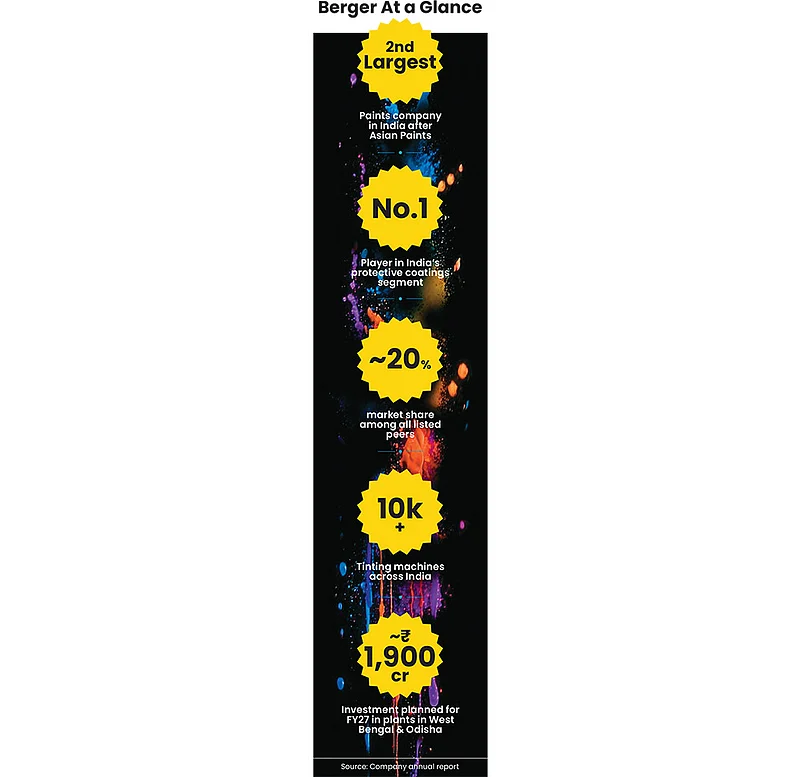
As India’s second-largest paint maker after Asian Paints, the deal could have dramatically altered Berger’s market presence overnight, adding nearly 4% market share in the highly competitive decorative paints segment. It would have also strengthened its industrial coatings business, which currently accounts for about 18% of total revenue.
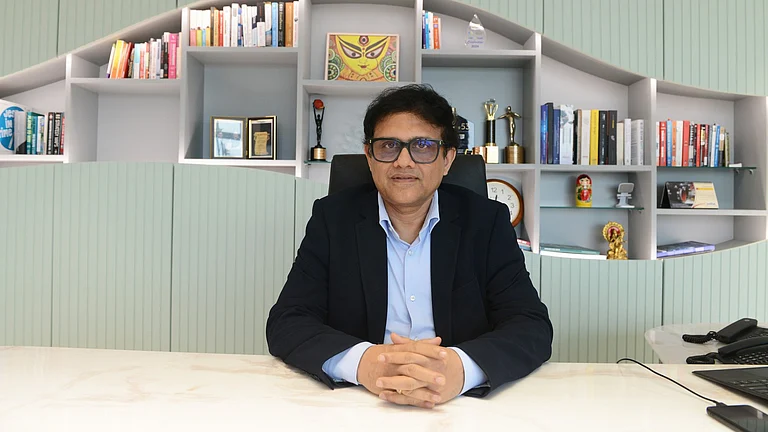
There was bidding. The price kept climbing, and Berger gave up rather than match it. “We walked off at the last moment. The reason was valuation. We are risk-averse in terms of capital allocation,” says Abhijit Roy, managing director and chief executive (CEO) of Berger Paints.
The decision to walk away from AkzoNobel offers a glimpse of how Berger plans to compete.

Slow and Steady
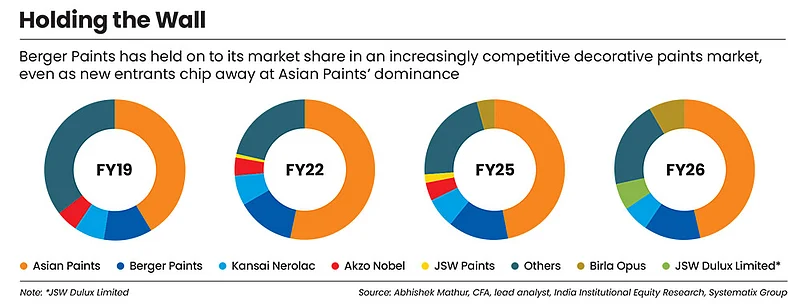
The challenge for Berger is that the market is getting harder to defend. For years, the decorative-paints market has been a stronghold of a handful of players, with deep dealer networks and scale keeping newcomers from gaining a foothold. That is now changing. Since 2019, Sajjan Jindal-backed JSW Group and Kumar Mangalam Birla-led Aditya Birla Group have entered with large investments, while Pidilite Industries, JK Cement and Sirca Paints have also stepped up their presence.
And the new entrants are not waiting around to build share slowly. Steep discounts, free tinting machines and rapid capacity additions are becoming part of the battle for market share.
Berger Paints prefers not to take “bold risks”. Roy calls the strategy “slightly boring, but consistent.” It has worked so far. Berger has largely held on to its 14% market share in the decorative-paints segment even as Asian Paints slid from 53% to 47%, between 2022–23 and 2024–25, mostly to JSW and Birla Opus, data from brokerage firm Systematix Institutional Research shows.
“We have no such ego that I am No. 1, No. 2...As long as we are profitable, growing well, growing better than the industry, it’s fine,” Roy says.
The question is whether that approach can keep working.
Berger has been here before. For decades, paint companies in India had largely been fighting for industrial customers. Liberalisation changed that. As urban housing expanded and middle-class incomes rose, the bigger opportunity was moving into people’s homes. British-origin players such as ICI, Goodlass Walls, Jenson & Nicholson, Blundell & Eomite and British Paints (later renamed Berger) found themselves competing with global names such as AkzoNobel, PPG, DuPont and BASF.
Both groups rushed into decorative paints to chase the new demand.
Under former CEO Subir Bose, Berger too shifted its focus to decorative paints, while reducing dependence on industrial paints.
The paint maker’s strategy then was simple: mirror market leaders’ product lines, but price slightly lower to win the mass segment.
To win, however, Berger Paints had to build a decorative-paints distribution network from scratch and strengthen its brand.
Strokes of Innovation
Roy joined the company in 1996 and was part of the team pushing newly introduced tinting machines to dealers. Until then, dealers had to stock paint in every shade; tinting machines let them cut inventory and mix shades on demand. But at ₹8.3 lakh apiece, the machines weren't cheap.
To make them affordable, Berger introduced a leasing policy, allowing dealers to pay in monthly instalments. It worked. The company installed around 200 machines between 1996 and 1998, helping them grow more than 30–35% in revenue terms over the same period.
This even got the sector leader, who hadn’t yet rolled out its own tinting machines, “a bit worried…so then they jumped into the fray with a low-cost machine and low-priced colourants”, Roy says. Berger “had to furiously innovate”.
The combination of sharper branding and selective distribution is central to Berger’s next phase of growth
The company turned to backward integration, developing its own colourants instead of importing them. Innovation became an important part of the company’s DNA. It created yellow, brown and grey bases that needed far less imported colourant to produce the same range of shades.
Around 2010, the Kolkata-based paint maker doubled down on R&D with the launch of Easy Clean, which claimed to remove wall stains with just a scrub. The product was a hit, helping cement the brand’s name in the market.
Easy Clean was one of many new products Berger rolled out in the years that followed, helping it secure the second-largest market share in India. It helped, too, that Roy, who had been at the forefront of many of these launches, took over as CEO in 2012.
Today, Berger finds itself in a similar position in the 1990s. Its new competitors, Birla Opus and JSW Dulux have deeper pockets and can afford to spend heavily to gain ground.
Berger, he emphasises, aims to “grind” its way upwards. It doesn’t “jump very heavily” and remains resilient and consistent.
Roy sees three growth bets for the next few years: strengthen the brand and expand distribution in under-penetrated markets, particularly the south and west; build construction chemicals and waterproofing into a larger business; and grow protective coatings and general industrial paints as infrastructure spending and manufacturing expand in India.
The Brand, Recalibrated
When someone walks into a paint shop looking for a wall paint, names like ‘Vinyl’ or ‘Luxol’ don’t tell them much about the product.
Most buyers end up buying what the dealer pushes.
On the advice of management guru Gurcharan Das, Berger began simplifying its product names. If a product promises durability, call it ‘Long Life’. A stain-resistant paint became ‘Easy Clean’, a long-lasting emulsion became ‘Bison’ and an exterior paint that resists dust became ‘WeatherCoat Anti Dust’.
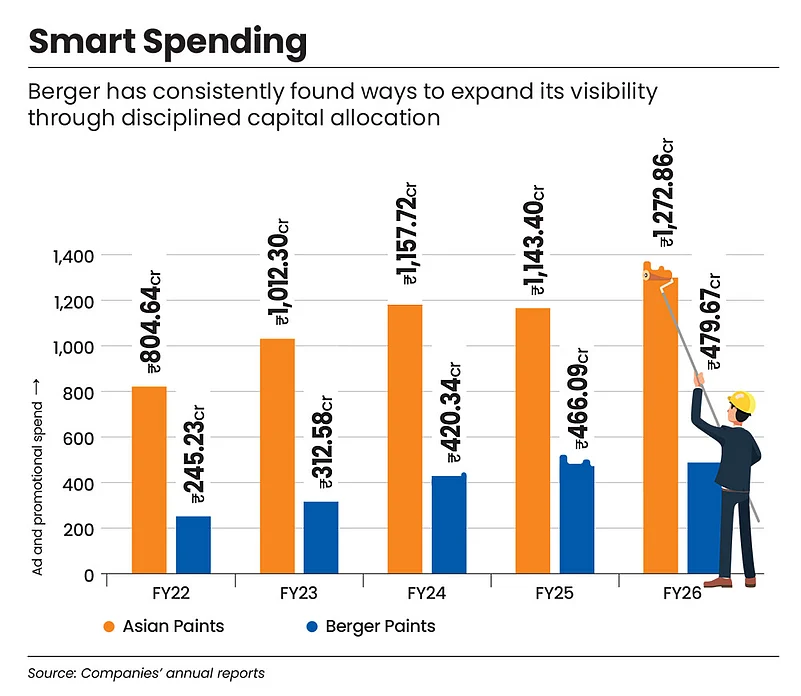
It was a small change, but it captured something important about Berger’s approach: make the marketing work harder before simply spending more on it. In the past four years, the company has raised its advertisement and promotional spending from 3% of its revenue from operations in 2021–22 to 4% in 2025–26, in line with industry trends. In absolute terms, however, Berger spends less than half of market leader Asian Paints’ annual advertisement expenses.
“They’ve focused on the basics rather than spending heavily on above-the-line brand building and that approach seems to have worked,” says Ambi Parameswaran, founder of consulting firm Brand-Building.com.
Berger, he adds, has stayed disciplined, doing exactly what is needed without getting carried away by large-scale campaigns.
“It has been selective in its geographic focus, concentrating on a few key markets rather than going all-India. That has helped it maintain a strong No. 2 position.”
That combination of sharper branding and selective distribution is central to Berger’s next phase of growth, particularly as it looks to strengthen its presence in the south and west.
Around 2022, the company pushed its own retail footprint rather than relying solely on dealer networks that sell multiple brands. Today, it has expanded its ‘Berger Exclusive’ and ‘Berger Kolor N Style’ stores to about 1,900, with over 700 additions in 2025–26.
For the ongoing 2026–27 period, Roy says the paints manufacturer will focus more on visibility in sports channels. “We are also not so present in sports…we are correcting that media mix,” he told analysts during the fourth quarter of 2025–26 earnings call.
Adding to its recalibration, the company decided to introduce ‘Khushrangi’, a clown for its new corporate ad campaign. It maintains a smile despite facing rain, dust and life’s challenges. Though it doesn’t mean the company is doing away with the celebrities. “We have sub-brands where we use celebrities. Like in Berger Silk, we have Kareena [Kapoor Khan], and for some of the other brands, Pankaj Tripathi is currently being used ,” Roy says.
A New Coat
Painting a home is rarely simple. It means emptying rooms, living with dust and fumes for days, and hoping the finished walls look the way they were promised. For older people or those with respiratory problems, the mess can be more than an inconvenience. It can be a reason to put off painting altogether.
That was a problem Roy kept hearing about during his visits to dealers. Then, on a trip to Poland, he saw painters using machines to reduce the amount of manual labour involved. The reason there was largely economic: labour was expensive. Roy saw a different opportunity: use the same technology to make painting less of a hassle for the customer.
That became Express Painting, which Berger launched in 2015 as India’s first professional home-painting service. The sanding machine used vacuum suction to prevent dust from flying around during the sanding and rubbing process.
Berger trained painters to use the equipment, standardised the process and bundled consultation with after-sales support.
The service caught on so fast that market leader Asian Paints followed Berger Paints and launched its own home-painting service.
Express Painting has since scaled to over 500 towns and roughly 2.5 lakh homes, creating a captive stream of volume growth and painter loyalty that keeps Berger’s brand present inside customers’ homes, according to a Systematix Institutional Research’s 2025 report.
This problem-solving approach led to many industry-firsts in the company portfolio from WeatherCoat Anti Dustt for India’s dustier regions to DampStop for waterproofing.
The company has now expanded into the construction chemicals and adhesives segment, which so far have been dominated by Asian Paints and Fevicol maker Pidilite Industries. The segment in India is still around ₹20,000cr and is the newest frontier, driven by rising demand for waterproofing.
“Earlier, people did not give too much importance to waterproofing… increasingly paints and waterproofing are being sold through the same channels,” noted analysts at Asit Mehta Investment in a 2024 report.
Berger’s way in was an acquisition: STP Ltd, bought in 2019 for ₹167.5cr, brought in waterproofing chemicals, flooring compounds, bitumen and coal-based products, all sold through Berger’s existing dealer network rather than a separate sales set-up. That purchase has grown into revenues of ₹335.30cr in 2025–26.
Growth Vs Profit
While Berger Paints walked away from AkzoNobel India, JSW paid a whopping ₹8,986 crore—nearly 25 times the Dulux owner’s operating profit, catapulting the newcomer to number 4 spot. Birla had committed ₹10,000cr upfront to rapidly scale Birla Opus—breaking into a tightly held group of five players controlling 90% of the market.
Heavy spending has clearly helped the new entrants buy market share. The harder question is whether they can keep spending at that pace as the cost of raw materials rises and investors begin to demand returns.
A 2025 report from broking company Nirmal Bang noted that Birla Opus is targeting markets where Asian Paints is strongest—Maharashtra, Gujarat and Tamil Nadu. Berger has a relatively smaller presence in these regions. Even JSW Paints is currently concentrated in the south and west.
That may put pressure on Berger to accelerate in precisely the markets where its competitors are trying to gain ground. But Roy points to another factor for his confidence.
The company for years has steadily added to its capacity across key regions without taking much external debt. In 2023, it commissioned its Sandila (Uttar Pradesh) facility with an outlay of ₹1,097cr, adding 4 lakh kilolitres capacity annually. It is also planning projects in Panagarh (West Bengal) and Odisha, with combined investments exceeding ₹1,900cr.
Berger has largely held on to its 14% market share in the decorative-paints segment
Together, these expansions are expected to increase overall capacity by 60% compared to 2022–23. Much of this is funded through internal accruals. As per CareEdge Ratings, Berger’s borrowing stands at just 14 paise for every rupee invested by shareholders.
Meanwhile, Birla Opus and JSW Paints reported losses of hundreds of crores of rupees. This strong balance sheet is expected to help at a time when raw-material prices are rising. Raw-material costs—largely crude-oil derivatives—account for around 60% of total costs for paint companies. With the conflict in West Asia pushing up oil prices, Indian paint companies have been forced to raise prices across portfolios.
Birla Opus, which had been selling at around a 20% discount earlier, hiked prices by 15–16%, according to its fourth quarter of 2025–26 earnings report, narrowing the pricing gap with its market peers.
Real Test
“Price war-driven market penetration is unlikely to last. Once companies reach a certain market share, they will have to focus on profitability. Ultimately, investors will expect returns,” says Antu Eapen Thomas, senior research analyst at brokerage firm Geojit Investments.
Roy says “most of the storm” seen by the industry with the new players has passed. He remains bullish that this will work in Berger’s favour as it continues steady expansion while maintaining strong profitability.
But this is where Berger’s strategy faces its biggest test. Its rivals can tolerate losses for longer, while Berger doesn’t want to sacrifice its profitability. Its market share has softened marginally, and 2025–26 marked a minor decline in net profit after a multi-year growth streak.
Berger’s focus on cost control, steady execution and capital discipline has allowed it to steadily build share without compromising on profitability. The question now is whether this “boring” strategy can continue to hold as competition intensifies further.