In hindsight it was a risk worth taking. Leaving the comfort of family and surroundings, Tibarumal Gupta followed his passion for precious stones and landed in Hyderabad around 1915–16. Known as the City of Pearls, Hyderabad has traditionally been a trading centre for jewellery and precious stones.
Tibarumal Jewellers is Recrafting its Allure Through Tech to Stay Relevant
Tibarumal Jewellers, an over 100-year-old heritage brand, continues to uphold tradition, premium quality and craftsmanship while adapting to changing customer preferences and technology

A Tibarumal Jewellers' store
Advertisement
Coming from a land-owning family in Haryana, Tibarumal’s decision was fraught. Opting for entrepreneurship over tilling was not an easy choice. But he was desperate to get into the jewellery business. And so was born Tibarumal Jewellers in 1920.
“My grandfather used to travel to Bombay [now Mumbai], Jaipur, Gujarat and Chennai, because different regions in India had their own jewellery styles. He would carefully source pieces from across the country and bring them back to Hyderabad,” says Pankaj Gupta, Tibarumal’s grandson and the present-day owner of Tibarumal Jewellers.
With an eye for quality and his ability to recognise exceptional gems helped Tibarumal build a reputation. And very soon he came to the notice of the Nizam of Hyderabad. Their passion for exquisite jewellery was the bedrock of a long friendship.
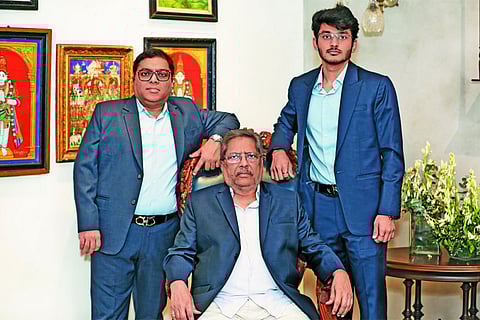
Rambharos Gupta (seated) with son Pankaj (left) and grandson Trishank
A Touch of Royalty
While Tibarumal birthed the business, the credit for expansion largely goes to Rambharos Gupta (one of the three sons of Tibarumal and father of Pankaj Gupta) who expanded the venture and began creating distinctive designs.
Advertisement
Tibarumal Jewellers opened its first store near the iconic Charminar, in the heart of Hyderabad’s historic trading district. What truly sets the brand apart, however, is its deep connection with history; the brand served the 7th Nizam of Hyderabad, Osman Ali Pasha.
Serving the house of the Nizam of Hyderabad gave Tibarumal Jewellers a distinct edge in the jewellery business. It helped them understand refined royal tastes and inspired them to explore how craftsmanship and design could evolve with greater richness and sophistication over time.
Hyderabad is often described as a mini-India. Over the past century, people from many regions including Rajasthan, Haryana, Gujarat, West Bengal and Tamil Nadu have settled in the city. Because of this diverse mix of communities, including Marwaris, Telugus, Gujaratis and Sindhis, the jewellery demand here reflects a wide range of styles in the country, which has greatly benefited Tibarumal.
“Our jewellery are not limited to just South Indian designs. We create jewellery suitable for customers from across India,” says Pankaj.
Advertisement
As the market evolved, they also shifted locations from Charminar to Basheerbagh, a commercial centre and later to the posh Banjara Hills, home to the rich and famous.
In 1988, the legacy was transferred to Pankaj , who introduced modern design ideas while continuing to focus on gemstones that make the brand distinct.
Under his creative direction, the company continued producing handcrafted jewellery inspired by classic Indian and Nizami aesthetics.
When asked how they see themselves in the jewellery sector, Pankaj says: “Comparing us with a regular jeweller is like comparing a local tailor with Sabyasachi Mukherjee [a top couturier]. Just like designers set fashion trends, we aim to set jewellery trends.”
Lessons From Pandemic
Staying connected to their rich history has certainly set apart Tibarumal but they also understand that they cannot afford to miss opportunities that align with the future demands of the jewellery business.
During the Covid-19 pandemic, the world came to a standstill as people were confined to their homes. Many individuals struggled to earn a living and secure basic needs. In such uncertain times, buying jewellery was not a priority.
Advertisement
However, as the Tibarumals deal in high-end jewellery and do not cater to the mass-market segment the pandemic did not affect their business significantly.
Trishank, Pankaj’s son and the fourth-generation Tibarumal to join the business, says that post-Covid weddings and celebrations became smaller and people spent much more on luxury purchases such as high-end jewellery.
Apart from a black-swan event like a pandemic, the jewellery business is also a complex sector, because customers consider even a ₹50,000 purchase as an investment.
Pankaj agrees that, unlike other products, customers expect to recover around 90% of their purchase value, so the responsibility on the jeweller is very high.
As far as the surge in gold prices is concerned, it does not significantly affect the Tibarumal brand, as they already position themselves as a luxury brand within the jewellery sector. “We don’t deal in plain chains or bars. We specialise in occasion jewellery with intricate designs,” Pankaj says.
Advertisement
The minimum ticket size at the legacy store starts at around ₹5 lakh and can go up to ₹5cr.
Heritage Meets Tech
“One day, a client came to us with a diamond she had bought elsewhere. When I examined it, I realised it was a lab-grown diamond, but the jeweller who sold it didn’t even know that,” says Trishank. “That incident made me think about the future of the industry.”
He began exploring ways to source the best lab-grown diamonds and how to make them more accessible. Eventually, in 2025, the company launched Elevé Diamonds, a separate lab-grown diamond brand under Tibarumal Jewellers with Trishank as the managing director.
The Tibarumal family operates six stores in total, including one of Tiraa, and five of Elevé Diamonds.
Recent trends show that people who opt for destination weddings prefer not to carry jewellery worth crores of rupees to another country. Elevé Diamonds stepped in with a solution where they create designs similar to those of global brands like Cartier or Bvlgari but crafted with lab-grown diamonds at a fraction of the price.
Along with keeping up with the demands of the new generation, Tibarumals are also incorporating technology into their craft.
“Earlier we would show customers sketches. Now we create 3D CAD [computer-aided design] designs, allowing customers to visualise their jewellery before it’s made,” says Pankaj.
There is often a fear in manufacturing and crafting that technology might replace the human workforce. However, Tibarumals assure that most of their jewellery is still handcrafted.
They strongly believe in institutional memory, and many employees have been with them for 15–20 years, while several artisans have worked with the family for generations. “Machines are used only for small processes, about 10–15% of production,” Pankaj says.
For the third and fourth generations of Tibarumals, continuing a legacy brand is not easy.
Customer tastes are constantly changing and technology is evolving, yet they must consistently deliver the highest standards of quality, pricing and finishing to uphold the reputation of what Tibarumal first established.