Consider this, an ambitious space-tech start-up has a groundbreaking design—the kind of tech that could make India a global leader. It has intellectual property (IP), the vision and the initial seed money to get the project off the ground. But then it hits the ‘growth-stage wall’.
Drones, Space Tech Start-Ups Lack Growth-Stage Capital in India
Drones and space-tech start-ups sorely need growth-stage funding to transition from prototype to production

Illustration: Shutterstock
Advertisement
Garuda Aerospace’s founder and director Agnishwar Jayaprakash is no stranger to this. For him, the most challenging phase was not at the inception, but after crossing the Series A stage. He is not alone.
Scores of Indian aerospace start-ups are finding it difficult to scale their products after having spent years developing IPs—as growth-stage funding is hard to come by.
It’s not just a matter of concern for these start-ups. At a time when the world is becoming more fragmented and countries are ever more cautious in sharing critical technologies, especially those with defence applications, India’s pursuit of tech sovereignty will take a hit. The country will have to continue relying on imports if start-ups in the aerospace sector can’t come of age.
“If someone embeds a Trojan or hidden virus in a drone, they could control it remotely from China, Taiwan, or even the US. In critical situations, such drones might act unpredictably or stop supporting India altogether,” says Peeyush Kumar, chief executive of Pixella, a drone tech company.
Advertisement
Funding Gaps
Garuda’s most recent growth-funding round took nearly a year to close, significantly longer than the four to six months required to raise seed and early-stage capital.
And Agnikul’s co-founder Moin SPM says his organisation had to turn to family offices. Why? The investment ecosystem was not patient enough to back the start-up's vision and mission, he adds.
Of the top 100 start-ups among the Outlook Business Outperformers, only nine belong to the aerospace sector. For the purpose of this ranking, we have combined space-tech and drone-tech start-ups under the aerospace umbrella.
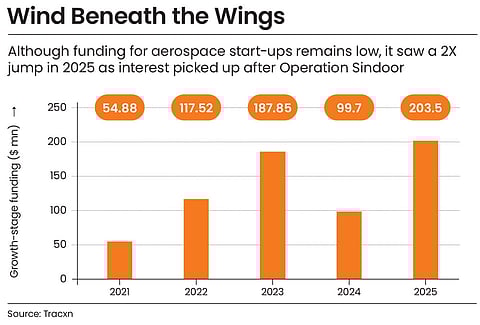
According to data platform Tracxn, there are 225 companies in India’s space-tech sector, including 78 that have collectively raised $808mn from venture capital (VC) and private-equity firms. Of these, only 19 are Series A funded. In drone tech, there are 526 start-ups. Of these, 144 are funded, with only 33 having secured Series A or more.
Bolstering these start-ups is need of the hour as underscored by India’s recent military operation, Operation Sindoor, during which multiple aerospace companies played a critical role in ensuring success.
Advertisement
Ankit Kumar, founder, Skye Air, recalls that when drones started gaining attention, many companies jumped into manufacturing. But most subsystems are still sourced from a limited number of suppliers.
Investor hesitation persists, particularly at the growth stage, evident from the fact that India is yet to produce a defence tech unicorn.
The primary barriers to funding have been the longer gestation period inherent to the deep-tech sector and the need for substantial upfront investment. “[But] investors often seek predictable cash flows and short-term visibility,” says Garuda’s Jayaprakash.
This does not imply that investors adopt the same approach at the early and seed stages. Government initiatives such as iDEX—an incubation programme for defence-tech start-ups—and the creation of a dedicated ₹1,000-crore VC fund exclusively for the space sector is a definite boost. But support is crucial when these start-ups are moving towards commercialisation.
Investors’ Take
According to Manu Iyer, co-founder and partner at VC firm Bluehill, 100% of the firm’s capital is allocated to IP-led deep-tech companies. However, he says funding is focussed on areas where both software and hardware are developed.
Advertisement
This was a prompt for many aerospace start-ups, which are now building dual-use solutions to serve both defence and civilian markets. “Over 50% of space-tech applications are civilian, which typically have shorter gestation periods. Commercially, this is highly rewarding,” says Govindrajan DS, a space-tech adviser and investor.
However, critical components require intense R&D. This is where these start-ups need patient capital.
Anil Joshi, managing partner, Unicorn India Ventures, says despite making the VC firm’s ₹1,200-crore Fund III deep-tech focussed with at least 65% deployment, he sees multiple risks from investing at growth stage.
Investors say most Series B frameworks in India are based on models that work well for software-as-a-service, fintech and consumer-tech start-ups. “Whereas these [drones and space-tech] start-ups follow a very different path. By Series B, they may have spent a lot of time and capital on building and validating complex technology rather than on generating large revenues,” says Bluehill’s Iyer.
Advertisement
Government initiatives provide support through long-term, low-interest capital. But Abhay Karandi-kar, secretary, Department of Science and Technology, says there should be equal or greater participation from the private sector too.
Also, investor collaboration—more than just capital—could help. They could bring their market insight and business expertise for successful commercialisation. This just might be the recipe for a successful space-tech lift-off. And it bodes well for India's tech sovereignty ambition too.