Indian officials attended the 40th-day mourning for Iran’s late Supreme Leader in Delhi
MoS Pabitra Margherita and the MEA’s PAI division head led the "solemn respects"
President Trump announced an immediate US Navy blockade of the Strait of Hormuz
Indian Officials Join Iran's Mourning of Ayatollah Ali Khamenei in Delhi
Condolence meet at Iranian embassy in Delhi highlights India’s outreach and regional sensitivities following Khamenei’s passing

Indian Officials Join Iran's Mourning of Ayatollah Ali Khamenei in Delhi MEA
Summary
Advertisement
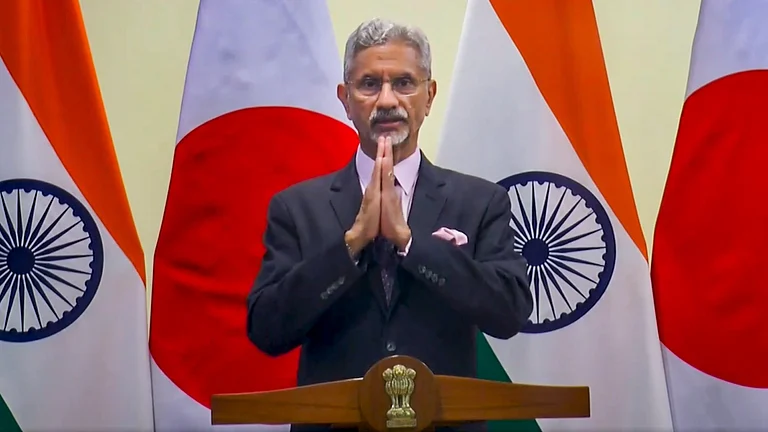
In a calculated gesture, India on Saturday evening deputed Minister of State for External Affairs Pabitra Margherita and senior MEA official Anand Prakash to attend the 40th day mourning (Chehelum) of Iran’s late Supreme Leader Ayatollah Ali Khamenei which was organized by the Iranian embassy in New Delhi.
Prakash, who currently heads the Pakistan-Afghanistan-Iran (PAI) division in the MEA, joined Margherita in offering condolences and “solemn respects” on behalf of the Government of India.
The presence of both a political representative and a key bureaucrat overseeing India’s PAI division signals a carefully crafted outreach to Tehran at a sensitive geopolitical moment.
“Minister of State Pabitra Margherita offered solemn respects on behalf of the Government of India at the 40th day (Chehelum) mourning ceremony organized by the Embassy of Iran in New Delhi,” External Affairs Ministry spokesperson Randhir Jaiswal said in a post on X.
“India-Iran relations are anchored in deep rooted civilizational, cultural and people-to-people ties,” he added.
Advertisement
The move comes against the backdrop of failed engagements between Washington and Tehran. Recent talks held in Islamabad failed to yield any concrete outcome, further deepening uncertainty around the already strained US-Iran equation.
Notably, adding to tensions, US President Donald Trump in a social media post on Sunday indicated the possibility of initiating a blockade of the Strait of Hormuz — a critical global energy artery through which a significant portion of the world’s oil supply transits.
"Effective immediately, the United States Navy, the Finest in the World, will begin the process of BLOCKADING any and all Ships trying to enter, or leave, the Strait of Hormuz," Trump posted on his Truth Social platform.
"Any Iranian who fires at us, or at peaceful vessels, will be BLOWN TO HELL!" he said.
Against this volatile backdrop, India’s gesture appears to carry layered messaging. Diplomatically, it underscores New Delhi’s intent to maintain stable and respectful ties with Iran, a country central to India’s connectivity ambitions in Central Asia and a key stakeholder in projects such as Chabahar Port. Symbolically, participation in the Chehelum ceremony reflects cultural sensitivity and recognition of shared civilizational ties, particularly important in moments of national mourning.
Advertisement

The outreach also follows a recent expression of gratitude by Iran’s envoy in New Delhi Dr. Mohammad Fathali, who thanked the Indian government for dispatching a second shipment of humanitarian assistance.
This ongoing aid flow has helped sustain a positive undercurrent in bilateral ties despite external pressures and shifting regional alignments.
While India has consistently advocated dialogue and de-escalation in West Asia, it has also walked a fine diplomatic line — balancing its historical ties with Iran alongside its expanding strategic partnership with the United States.
At a time when geopolitical fault lines are hardening, New Delhi’s presence at the Iran Embassy offered a visible message that India remains an empathetic and engaged partner, willing to stand by longstanding relationships even as the regional chessboard shifts.