India and the UAE have set a $200 billion bilateral trade target by 2032, reinforcing ties under the CEPA framework.
A 10-year LNG supply agreement between HPCL and ADNOC Gas will begin in 2028, enhancing India’s energy security.
The two sides signed pacts covering defence manufacturing, technology transfer, space cooperation, and infrastructure investments.
Explained: Why the India–UAE Defence Pact Matters Amid Shifting Regional Alignments
Energy security, defence cooperation and space collaboration anchor expanding India–UAE strategic partnership.

PM Modi and UAE President Nahyan PIB
Summary
Advertisement
India and the United Arab Emirates on Monday agreed to double bilateral trade to $200 billion by 2032, marking a significant expansion of their commercial and strategic partnership spanning trade, security, defence cooperation, space, and investment. The agreements were signed during UAE President Sheikh Mohamed bin Zayed Al Nahyan’s one-day official visit to New Delhi.
“Committed to fostering sustainable development and economic growth, the UAE and India will continue working together to drive progress in future-focused sectors while achieving mutual benefit for our nations and peoples,” President Nahyan said in a post on X.
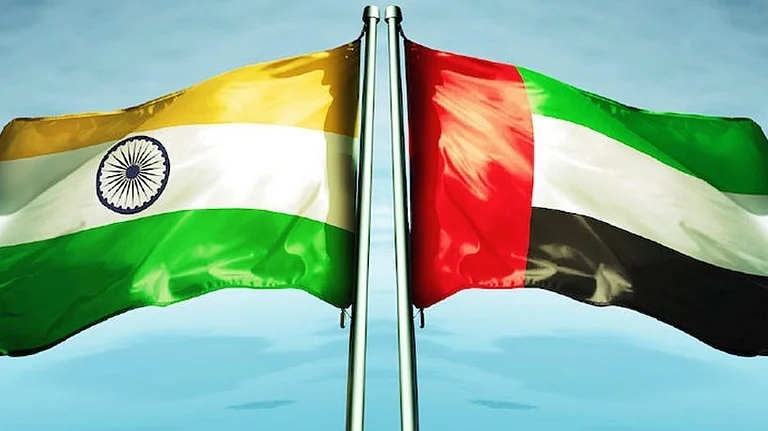
The three-hour engagement centred on boosting bilateral trade, with a focus on micro, small and medium enterprises (MSMEs), digital trade corridors, and market diversification. A key outcome was an investment framework for Gujarat’s Dholera region and GIFT City. The partnership includes plans for an international airport, a greenfield port, a smart urban township, railway connectivity, and energy infrastructure, according to reports.
Advertisement
The two leaders also discussed regional geopolitics and evolving global conditions. The visit comes amid heightened instability in West Asia, with escalating tensions in Gaza, Iran, and Yemen.
Foreign Secretary Vikram Misri said the $200 billion trade target reflects the deepening economic relationship between New Delhi and Abu Dhabi, strengthened under the Comprehensive Economic Partnership Agreement (CEPA). The UAE has emerged as India’s second-largest supplier of liquefied natural gas (LNG), Misri added.
Pacts Inked on the Energy Front
A major agreement was signed in the energy sector, with Hindustan Petroleum Corporation Limited (HPCL) and ADNOC Gas entering into a 10-year Sales and Purchase Agreement. Under the deal, India will receive LNG supplies starting in 2028, providing long-term energy security amid volatile global markets.
Strategic Defence Partnership
The two sides also signed a Letter of Intent on a Strategic Defence Partnership, signalling closer cooperation in defence manufacturing, technology transfer, and capability development. The move comes as the regional security environment evolves, with Pakistan seeking to expand its strategic footprint beyond South Asia through defence diplomacy, arms exports, and military coordination in West Asia and Southeast Asia, Moneycontrol reported.
Advertisement
Why a Defence Pact Matters for India Now
The timing of the India–UAE defence partnership is significant amid shifting regional alignments and growing competition for influence. Pakistan has been actively strengthening its defence relationships, including discussions with Saudi Arabia and Turkey on a potential trilateral defence framework. While Turkish officials have confirmed talks, no formal agreement has yet been finalised. According to Moneycontrol, such a framework—if concluded—could mark a meaningful shift in regional security cooperation and alter military balances across parts of West Asia.
Against this backdrop, advancing defence cooperation with the UAE allows New Delhi to deepen strategic engagement with a key regional partner and reinforce its security presence beyond South Asia.
Pakistan has also been promoting defence exports as a tool of influence. Reports indicate that Islamabad has been marketing the JF-17 Thunder—its jointly developed lightweight combat aircraft with China—across multiple regions. Indonesia has been negotiating a potential defence arrangement that could include the acquisition of over 40 JF-17 jets, while Iraq has also expressed interest in the aircraft and related support systems. These developments underscore Pakistan’s efforts to expand its defence footprint and cultivate security partnerships across Southeast Asia and West Asia.
Advertisement
India and the UAE, meanwhile, share aligned positions on counter-terrorism, with both countries unequivocally condemning terrorism. They have also reaffirmed cooperation under the Financial Action Task Force (FATF) framework to combat terror financing and money laundering.
Foreign Secretary Vikram Misri sought to contextualise the defence engagement, noting that deeper cooperation does not necessarily imply involvement in regional conflicts. “Our involvement in the defence and security front with a country from the region does not necessarily lead to the conclusion that we will get involved in particular ways in the conflicts of the region. There is already a great deal of content in defence cooperation and engagement on the defence front between India and the UAE,” he said.
Why a Defence Pact Matters for UAE Now
The defence partnership is also shaped by Abu Dhabi’s own security concerns. The UAE has been navigating rising regional tensions, including competition with Saudi Arabia for influence in West Asia and parts of Africa.
Advertisement
According to The Indian Express, geopolitical frictions intensified in December 2025 when UAE-backed forces launched an offensive to seize oil-rich provinces, clashing with Saudi-backed units. Tensions escalated further after a Saudi-led airstrike reportedly hit a UAE-linked shipment at the port of Mukalla.
These developments highlight why Abu Dhabi is seeking to diversify and strengthen its defence partnerships, even as it balances complex regional rivalries—making defence cooperation with India strategically relevant for both sides.
Beyond Trade and Investments
In the space sector, the Indian National Space Promotion and Authorisation Centre and the UAE Space Agency signed a Letter of Intent to promote space industry development and commercial collaboration. The agreement aims to encourage private-sector participation, joint ventures, and cooperation in space infrastructure and downstream applications.
New Delhi and Abu Dhabi also announced plans to establish a ‘House of India’ in Abu Dhabi—a cultural space to showcase Indian art, heritage, and archaeology—and to promote youth exchanges, underscoring the growing soft-power dimension of bilateral ties.