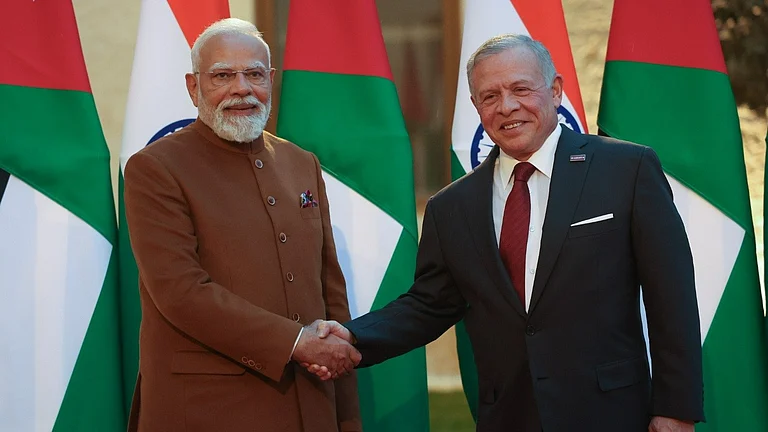
India and Oman signed a Comprehensive Economic Partnership Agreement during Prime Minister Narendra Modi’s West Asia visit.
The agreement aims to reduce or eliminate tariffs, liberalise services and facilitate investment.
The pact comes as India seeks to diversify export markets amid global trade uncertainties.
India, Oman Sign CEPA During Last Leg of PM Modi’s West Asia Visit, Boosting Bilateral Ties
The pact comes at a crucial juncture for India’s export sector, which is actively diversifying market access amid reciprocal tariffs imposed by Washington and the absence of an India–US trade deal

India and Oman Inks CEPA PIB
Summary
Advertisement
India and Oman signed the Comprehensive Economic Partnership Agreement during the last leg of Prime Minister Narendra Modi’s three-nation West Asia visit. The pact is expected to enhance bilateral relations between the two countries and marks a historic milestone in India’s ties with the region. It is the second bilateral trade agreement signed by New Delhi in West Asia after the pact with the United Arab Emirates, which was concluded in 2022.
“The agreement aims to substantially reduce or eliminate tariffs on a wide range of goods, liberalise services trade and facilitate investment flows,” Ajay Srivastava, former trade officer and founder of the Global Trade and Research Initiative (GTRI), said in a report.
Speaking at the India–Oman Business Summit, Modi said the summit would give a new direction to the India–Oman partnership and provide “new confidence” and “new energy” for the two countries in the 21st century. Talks for the free-trade agreement began in November 2024, and the two countries have held five rounds of negotiations, with the latest round conducted in New Delhi in January. The CEPA negotiations were finalised in August.
Advertisement
“This is beneficial for the entire world. However, it is even more beneficial for Oman because, in addition to being close friends, we are also maritime neighbours. Our people know each other well. We have generations of trust in our business relations, and we understand each other’s markets very well,” Modi said. India is now expected to soon begin trade talks with Qatar, media reports said.
India–Oman bilateral trade stood at nearly $10.5 billion in 2024–25. India’s exports to Oman, currently valued at about $4.1 billion, are expected to have significant headroom to expand in high-value sectors including engineering goods, automobiles, pharmaceuticals, food products, textiles and electronics. The pact comes at a crucial juncture for India’s export sector, which is actively diversifying market access amid reciprocal tariffs imposed by Washington and the absence of an India–US trade deal. According to media reports, Indian exporters have been urging officials to seek better market access in West Asia, citing relatively less stringent standards compared with the European Union.
Advertisement
"The deal provides India with unprecedented market access, offering zero-duty on 98.08% of Oman's tariff lines, which cover 99.38% of India's exports by value," Union Minister of Commerce and Industry Piyush Goyal posted on X. "This will significantly benefit labour-intensive sectors, generating employment and strengthening MSMEs, artisans, and women-led enterprises."
CEPA Mirrors Pact With UAE
According to the GTRI report, the structure of the CEPA mirrors the India–UAE bilateral trade pact. The agreement covers several negotiating areas, including goods, services, intellectual property, government procurement, digital trade, rules of origin, customs cooperation, sanitary and phytosanitary measures, technical barriers to trade, dispute settlement and support for small and medium-sized enterprises.
"A major highlight is an 8 times extension of permitted duration of stay for Contractual Service Suppliers from 90 days to two years, with the possibility of a further two-year extension," Goyal said in his post.
Advertisement
“For India, the main gains lie in merchandise exports,” the report said. “Tariff elimination under the CEPA is expected to improve competitiveness for Indian industrial exports, though sustained growth will depend on quality upgrades and product differentiation in Oman’s relatively small market.”
The report also highlights that Oman will gain from improved access to the Indian market for energy and industrial inputs, reinforcing existing supply chains in critical goods such as crude oil, liquefied natural gas, fertilisers and chemical inputs.
“With more than 6,000 India–Oman joint ventures and Indian investments exceeding $7.5 billion, particularly in Oman’s Sohar and Salalah free zones, the CEPA is as much about geopolitics and regional presence as it is about tariffs. For India, it represents another step in cementing its economic footprint in the Middle East,” Srivastava noted.