Merz’s first India visit spotlights trade, tech and security cooperation.
India–EU FTA talks remain difficult, with CBAM and market access hurdles.
Germany backs swift FTA closure as India holds just 1% trade share.
Berlin’s economic reset opens a narrow chance for India to scale up.
German Chancellor Merz in India for Talks on Trade, Investment as EU FTA Negotiations Intensify
Notably, his visit is set against the backdrop of India-EU's ongoing negotiations for a free trade agreement (FTA), which officials have said entered a "decisive yet difficult" phase

PM Narendra Modi visits Sabarmati Ashram with the Chancellor of Germany Friedrich Merz X/@narendramodi
Summary
Advertisement
German Federal Chancellor Friedrich Merz arrived at Sardar Vallabhbhai Patel Airport this morning for a two-day official visit to India. This marks his first official trip to India. On the visit, he will also travel to Bengaluru along with Ahmedabad.
Merz is met Prime Minister Narendra Modi today, a bosth leaders will take stock of the progress made in various aspects of the India-Germany Strategic Partnership, which marked its 25th anniversary last year.
According to the Ministry of External Affairs, the discussion will also focus on further intensifying cooperation in trade and investment, technology, education, skilling, and mobility, while advancing collaboration in key domains of defence and security, science, innovation, research, green and sustainable development, and people-to-people relations.
Notably, his visit is set against the backdrop of India-EU's ongoing negotiations for a free trade agreement (FTA), which officials have said entered a "decisive yet difficult" phase.
The India–EU FTA has missed its 2025 deadline as both sides continue to negotiate market access for goods. The EU’s carbon border adjustment mechanism (CBAM) remains a major sticking point. Other areas of friction include tariffs on cars, dairy and other sensitive sectors, where India fears regulatory overreach while Europe is pushing for deeper market access.
Advertisement
Germany is one of the few countries, along with France, to back the seamless finalisation of the India–EU FTA. It also considers India as a key partner in maintaining security and stability across the Indo-Pacific, particularly in the context of China’s continued assertiveness.
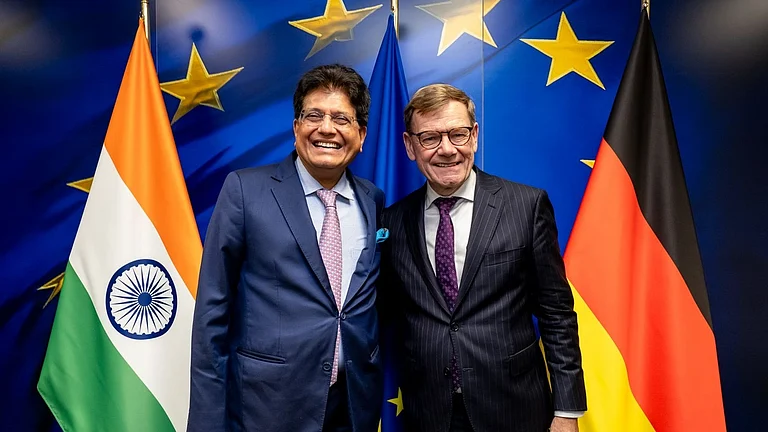
India-Germany Ties
Germany is India’s eighth-largest trade partner. From FY2021 to FY2025, India’s goods exports to Germany grew at 7% CAGR and crossed $10bn. Imports from Germany grew faster at 9% CAGR to nearly $19bn as well. While India’s trade deficit with Germany widened to $8.4bn, India’s share in Germany’s imports and exports has stayed at just 1%.
Germany, the world’s third-largest and Europe’s largest economy, is experiencing consecutive contractions in 2023 and 2024. Berlin is currently trying to rebuild competitiveness after an energy shock and export slowdown, and insulate itself from geopolitical dependencies by investing in domestic systems and trusted supply lines.
Advertisement
It presents a narrow opportunity for India not because Germany is looking away from China— but because Germany is trying to design resilience into its economy and New Delhi can move from being a 1% partner to a more consequential one.
External Affairs Minister S. Jaishankar and Commerce and Industry Minister Piyush Goyal were in Europe last week, even as a string of high-profile European leaders prepare to visit India over the next two months. The line-up includes European Commission President Ursula von der Leyen, European Council President Antonio Costa, and French President Emmanuel Macron.