Skyroot CEO Pawan Kumar Chandana says space could host the world's cheapest data centres within five years.
Executives from SpaceX, Microsoft, Google and Amazon have also flagged orbital computing as a future solution.
Skyroot plans to launch once a month from next year while building larger, reusable rockets.
Like Musk, Skyroot's Chandana Sees Space Hosting World's Cheapest Data Centres
Leaders at companies such as SpaceX, Microsoft, Google and Amazon have also pointed to orbital computing as a possible answer to the growing demand for AI infrastructure, particularly as power availability becomes a bottleneck on Earth

Pawan Kumar Chandana
Summary
Advertisement
Data centres located in space could become a common sight within the next five years, according to Pawan Kumar Chandana, co-founder and chief executive of Skyroot Aerospace. He said constant access to solar energy in orbit would make computing there cheaper than running data centres on Earth.
Chandana made these remarks at Network18's Rising Bharat Summit in Bengaluru. He explained that solar panels placed in space do not face the energy losses caused by Earth's atmosphere, and can function without interruption throughout the day. According to him, this would eventually make orbital compute more cost-effective than terrestrial alternatives.
"I strongly believe that the lowest cost of compute will be in space," he said, noting that solar installations in orbit could produce up to eight times the output of comparable Earth-based systems, since they run continuously without weather or daylight limitations.
Big Tech Is Watching Too
Chandana is not alone in this view. Leaders at companies such as SpaceX, Microsoft, Google and Amazon have also pointed to orbital computing as a possible answer to the growing demand for AI infrastructure, particularly as power availability becomes a bottleneck on Earth.
Advertisement
Earlier this year, on a podcast with Stripe co-founder Patrick Collison, Musk laid out the rationale behind the plan to build a million-satellite AI data centre network in space. "It’s harder to scale on the ground than it is to scale in space," he had said. "Any given solar panel is going to give you about five times more power in space than on the ground, so it’s actually much cheaper to do in space," he added.
"In 36 months, the most economical place for AI will be space", he said.
Chandana cautioned, however, that the technology is still in its infancy.
He expects working prototypes of space-based data centres to be launched within two to three years, followed by broader commercial adoption in the years after that.
Chandana said satellite launches represent only the starting point of the space economy. He pointed to satellite broadband, direct-to-mobile connectivity, and orbital computing as the sectors likely to define its next stage.
Advertisement
He cited current estimates that value the global space economy at roughly $600 billion, with projections of $1.8 trillion by 2035, but suggested these numbers may undersell the sector's real potential once new applications tied to cheaper space access are factored in.
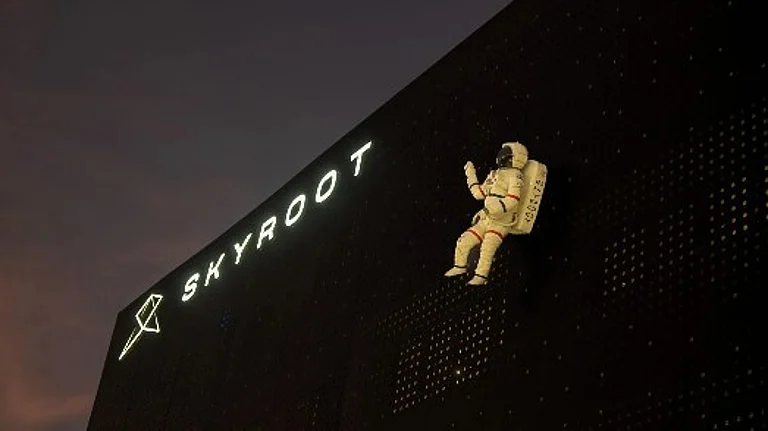
Skyroot made history earlier this year as the first Indian private firm to successfully place a rocket into orbit on its first attempt, through the Vikram-1 mission. The Hyderabad-headquartered company is now working to ramp up its launch schedule.
From next year, Skyroot intends to launch roughly once every month, while simultaneously building larger rockets and working toward reusable launch vehicles. Chandana said the company's ambitions go beyond providing launch services. It wants to build the underlying infrastructure for the space economy's next chapter.
He also noted that Skyroot's engineering staff average 28 years in age, calling it a reflection of how young professionals are shaping India's private space industry. "Humans are exploratory species," he said. "Sky is not the limit for space."
Advertisement