Adani Group’s airport unit has reportedly urged the government to grant additional flying rights to airlines
It said additional capacity was essential for Indian Airports to emerge as a global aviation hub.
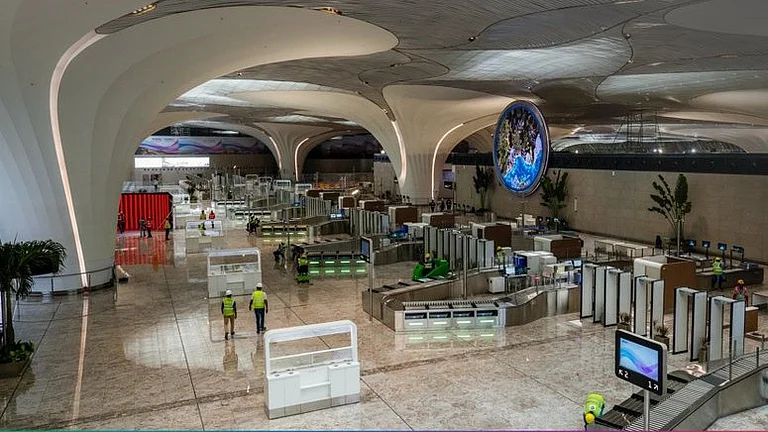
Adani Airports Holdings earlier this month inaugurated its eighth airport in Navi Mumbai.
Adani Wants More Airlines in Indian Sky Amid $11 Bn Airport Upgrade Plans
Adani Airports Holdings, which earlier this month inaugurated its eighth airport in Navi Mumbai, wrote to the Union government last month, to initiate talks with countries such as the UAE, Saudi Arabia, Qatar, Singapore, Indonesia and Malaysia to expand bilateral flying rights

Adani Airport Holdings
Summary
Advertisement
Adani Group’s airport unit has reportedly urged the government to grant additional flying rights to airlines in an effort to boost footfall at its eight airports. The request comes amid Adani Airports Holdings’ plans to invest over $11 billion in upgrades to its terminals and runways.
Adani Airports Holdings, which earlier this month inaugurated its eighth airport in Navi Mumbai, wrote to the Union government last month, according to a report by the Economic Times (ET).
The group urged the Centre to initiate talks with countries such as the UAE, Saudi Arabia, Qatar, Singapore, Indonesia and Malaysia to expand bilateral flying rights. It said additional capacity was essential for Indian Airports to emerge as a global aviation hub.
Who Controls Flying Rights in India?
Flying rights refer to the permissions granted to airlines under bilateral air service agreements between India and other countries, which determine whether and how airlines can operate cross-border routes.
Advertisement
These rights specify key conditions such as the number of flights, seats, destinations and designated airlines allowed on a particular route and are allocated by the government.
Airlines cannot launch international services without these approvals, even if they have aircraft and operational readiness, and must also secure airport slots separately.
An Adani Group official also told the publication that restricting capacity could undermine heavy investments in airport infrastructure and would amount to a waste of assets. He claimed that it would also push up fares for Indian travellers due to limited flight options.

In 2016, under the National Civil Aviation Policy, India laid down guidelines stating that additional flying rights would not be granted to foreign airlines unless Indian carriers had utilised at least 80% of their allocated capacity.
Because of this policy, overseas airlines have been unable to add capacity despite sharp growth in international travel demand, pushing up airfares, the report claimed. The government’s reluctance stems from concerns that passengers could increasingly shift to well-funded Gulf carriers, which operate large wide-body aircraft and route travellers to Europe and North America via hubs such as Dubai, Abu Dhabi and Doha.
Advertisement
Air India CEO Campbell Wilson recently said that more than 70% of traffic carried by some foreign airlines from India is transit traffic, arguing that liberalisation should be paced carefully so it does not undercut investments made by Indian carriers.
However, this cautious approach could affect investments by airport operators such as the Adani Group, which are building new runways and terminals, as Indian airlines like Air India and IndiGo do not yet have aggressive international expansion plans.
Adani Airport Holdings plans over $11 billion in investment by 2030 to expand India’s airport infrastructure, targeting 11 new government-leased airports, upgrading terminals and runways, and entering aviation services such as aircraft maintenance.