Sensex and Nifty 50 fell nearly 2% on February 1 after the FM Sitharaman announced a hike in STT on derivatives in Budget 2026.
The market, which opened marginally lower during a special holiday trading session, slipped over 2% intraday.
Overall BSE market capitalisation dropped by ₹9.72 lakh crore to ₹450.15 lakh crore.
How a Surprise STT Hike Triggered a Market Rout, Eroding ₹9.72 Lakh Crore Investor Wealth
At the closing bell, the BSE Sensex dropped 1.88% to 80,722.94, while the NSE Nifty 50 fell 1.96% to settle at 24,825.45. Broader markets also remained under pressure. The BSE MidCap Select Index declined 1.71% to 16,525.92, while the BSE SmallCap Select Index slid 2.75% to 7,447.95

Summary
Advertisement
Benchmark indices Sensex and Nifty 50 fell nearly 2% on Sunday, February 1, after Finance Minister Nirmala Sitharaman announced a hike in the Securities Transaction Tax (STT) on derivatives. The market, which opened with a marginal cut in the morning during a special trading session on a holiday, slipped more than 2% intraday.
Overall, the market capitalisation of all BSE-listed companies declined by ₹9.72 lakh crore to ₹450.15 lakh crore.
At the closing bell, the BSE Sensex dropped 1.88% to 80,722.94, while the NSE Nifty 50 fell 1.96% to settle at 24,825.45. Broader markets also remained under pressure. The BSE MidCap Select Index declined 1.71% to 16,525.92, while the BSE SmallCap Select Index slid 2.75% to 7,447.95.
Among individual stocks, IT majors such as TCS and Infosys bucked the broader weakness, gaining 1.92% and 1.17%, respectively. Sun Pharma and Titan also ended in the green. However, most heavyweight stocks saw sharp losses, led by SBI, Adani Ports, BEL, ITC, Tata Steel and Reliance, which fell between 3% and over 5%. Banking, capital goods and metal stocks were among the worst hit, dragging the indices lower in the session.
Advertisement

Why STT Hike Triggered Market Decline
Under the Budget 2026 proposals, the securities transaction tax on futures contracts will be raised to 0.05% from 0.02%. The tax on options premiums will increase to 0.15% from 0.10%, while the levy on exercised options will be hiked to 0.15% from 0.125%.
Together, these changes significantly raise trading costs for derivatives investors and could dampen volumes in a segment that has seen rapid growth in recent years. With futures and options accounting for a large share of revenues for stock exchanges and retail brokerages, the sector is likely to feel the impact of this policy shift sharply.
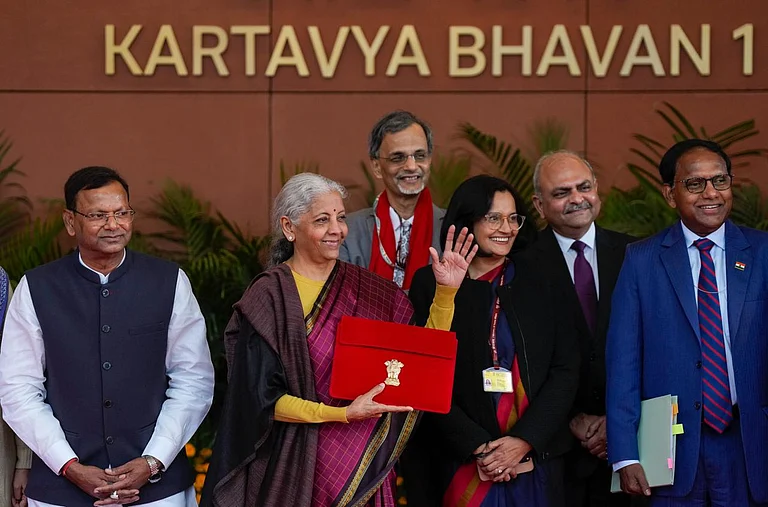
During the post-Budget press conference, Sitharaman said the move was aimed at de-risking “high speculation” trading to reduce losses for small retail investors.
“The Budget supports sectors affected by global trade tariffs and focuses on emerging areas of development, including data centres, GCCs, semiconductors, biopharma, rare earth elements and manufacturing. It also extends support to traditional sectors such as textiles, aquaculture and MSMEs impacted by global protectionist trade policies. Despite these measures, the market reaction has been negative, primarily due to low expectations, limited outlays and the negative bias created by the increase in STT on futures, triggering a knee-jerk response,” said Vinod Nair, head of research at Geojit Investments Limited.
Advertisement
“On the flip side, the hike in STT on futures and options—futures to 0.05% from 0.02%, and options premium and exercise to 0.15% from 0.10% and 0.125%—is a negative for active traders and the derivatives ecosystem,” said Ashwani Dhanawat, executive director and chief investment officer at Shriram General Insurance. He explained that higher transaction costs could curb speculative volumes, impact liquidity in the F&O segment and contribute to immediate market pressure. While the move aims to moderate excessive derivatives activity and boost revenue, it could dampen retail participation during a bull phase and affect broking revenues in the short term, he added.
Market nervousness also rose, with the India VIX jumping over 17% to 15.66, signalling heightened volatility and cautious trading. PSU bank stocks bore the brunt of the sell-off, as the Nifty PSU Bank index slid more than 4%, making it the worst-performing sector.
Advertisement
Pockets of Gains
At the same time, select Budget announcements lifted pockets of the market. Shares of Biocon and Sun Pharma surged after the government unveiled a ₹10,000 crore ‘Biopharma Shakti’ plan. Textile stocks such as Arvind and KPR Mill rallied up to 9% following announcements related to Samarth 2.0 and mega textile parks.
Electronics manufacturing stocks gained after the Budget raised sectoral outlay to ₹40,000 crore for FY27, while GMDC jumped 5% on plans for a rare earth corridor. The Budget also proposed developing seven high-speed city corridors, increased infrastructure spending to a record ₹12.2 trillion for 2026–27, doubled the overseas resident investment limit to 10%, and allowed individuals living abroad to invest in Indian equities through a portfolio investment route.
“The government appears to be walking a fine line between driving growth and maintaining macroeconomic stability, gradually tapering support while safeguarding capital expenditure. Markets have welcomed this measured approach,” said Amit Modani, senior fund manager and lead – fixed income at Shriram AMC. He added that key highlights include a fiscal deficit target of 4.3% for FY27, “signalling a credible path of consolidation”, and a medium-term debt-to-GDP target of 50% by 2031. Debt-to-GDP for FY27 is expected at 55.6%.
Advertisement
While gross borrowing at ₹17.2 lakh crore slightly exceeded estimates, largely due to ₹5.5 lakh crore in old debt repayments, net borrowing at ₹11.7 lakh crore keeps the trajectory stable.
“Markets expect RBI liquidity support to keep bond yields in check. Overall, this Budget balances growth-oriented spending with fiscal prudence, reflecting a strategy likely to sustain investor confidence and market stability,” Modani said.
On the commodities exchange MCX, silver prices for March futures slipped by ₹7,099, or 2.43%, to open at ₹2,84,826 per kilogram, compared with the previous close of ₹2,91,925. Gold prices also extended losses, with the yellow metal falling by ₹13,711, or 9%, to ₹1,38,634 per 10 grams.