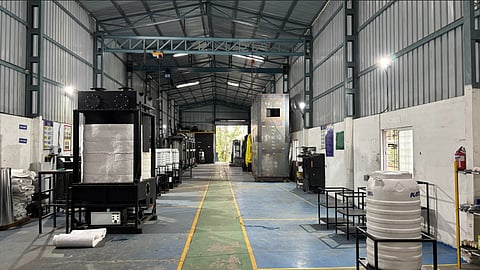
NovorbisItusPvt. Ltd., a Pune-based cleantech startup, has raised ₹13.35 crore in a seed funding round led by Rainmatter, the investment initiative of Zerodha. The company develops emission control and air purification systems for decentralised pollution sources such as diesel generator (DG) sets and crematoriums, including retrofit solutions for existing infrastructure. The round also saw participation from Rockstud Capital, an early-stage fund focused on manufacturing-led companies. The transaction was advised by Indorient Financial Services Ltd.
The Pune-based startup will use the funds to scale its emission control solutions for diesel generators and crematoriums and expand into new product lines.
The round is led by Nithin Kamath’s Rainmatter, with participation from Rockstud Capital, an early-stage fund focused on manufacturing-led and sustainability-driven businesses.
The fresh capital will be used to scale deployment of its existing solutions, expand its product portfolio to address additional use cases such as emissions reduction in boilers and large industrial facilities, including steel plants, and enable industries to implement on-site carbon capture technologies.
NovorbisItus was founded by Harsh Neekhra, Gagan Tripathi, and Divyank Gupta. The company’s first product was a filter-less Retrofit Emission Control Device (RECD) that can be retrofitted to existing DG sets, enabling companies to meet emission norms without requiring equipment replacement. This was followed by a product for crematoriums called Crematorium Air Purification System (CAPS).
Harsh, CEO, said, “We started NovorbisItus as second year college students in Indore with an idealistic view to fix air pollution at its source and leave clean air for future generations. Over the past few years, we have translated that vision into deployable solutions that are now being used across industrial and commercial settings in India. With this investment, we aim to scale our technology, expand our product portfolio, and accelerate adoption across sectors where emission control has traditionally been limited.”