Delhi permits transplantation of 32 trees for IGI expansion.
No tree-felling allowed; 320 saplings to be planted.
Survival conditions imposed under Trees Act compliance framework.
Delhi Approves 32 Tree Transplants for IGI Airport Expansion Amid Poor Air Quality
Delhi approves 32 tree transplants for IGI Airport apron expansion

Terminal 3 of the Indira Gandhi International Airport
Summary
Advertisement
The Delhi forest department has allowed transplantation of 32 trees in Dwarka area for expansion of apron facilities at the Indira Gandhi International (IGI) Airport, while prohibiting tree-felling, according to an official order.
The permission was granted on January 22 under the Delhi Preservation of Trees Act, 1994, for expansion of the airport's Maintenance, Repair and Overhaul (MRO) area, the order stated. An apron is the area of an airport where aircraft are parked for boarding, refuelling and maintenance.
The application had sought permission to cut and transplant 34 trees. After inspection of the site, the department allowed transplantation of 32 trees, prohibiting any tree-felling in the area, the document said.
For compensatory plantation, 320 saplings will be planted at the New Udaan Bhawan, opposite Terminal 3 of IGI Airport. The saplings, which are 10 times the number of trees being transplanted, have to be maintained for seven years, it added.
Advertisement
The applicant has deposited ₹18,24,000 as security for carrying out the transplantation and complying with the conditions laid down in the permission, the order said.
Each transplanted tree must be geo-tagged and its progress, along with dated photographs, must be uploaded on the department's portal, the document said. Transplanted trees must be spaced at least four metres apart, while the new saplings must be planted at a minimum distance of three metres from each other.
According to the order, the tree officer must be informed at least three days before starting the work, and transplantation cannot be carried out if a tree has active nests of birds or other wildlife.
The permission will be valid for two years and can be extended by one more year if required. In case the agency fails to complete the plantation or ensure survival of the trees, the department may undertake the plantation and recover the cost from the security deposit, besides initiating action under the law, the order added.
Advertisement
Poor Air Pollution Persists
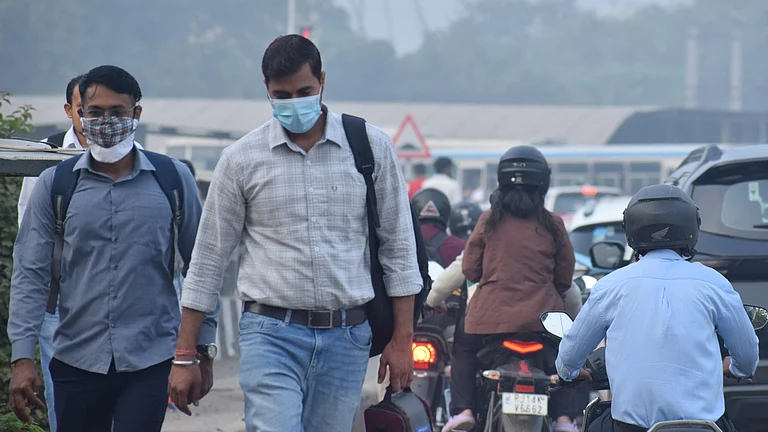
This comes at a time when Delhi’s air pollution is seeing marginal improvement, with average air quality index (AQI) of past 24 hours recorded as poor at 228 on February 25 at 4pm, according to the Central Pollution Control Board (CPCB). The AQI levels were recorded at poor levels at 239 on February 24 at 4 pm.
According to the CPCB classification, an AQI between 201 and 300 falls in the ‘poor’ category, while readings between 301 and 400 are categorised as ‘very poor’.

Tree Survival Under Scrutiny
According to Times of India, in 2022, only 41% of the total trees transplanted using modern technology between April and September could survive in Delhi. Over 8,508 trees were transplanted in the stated period. The transplantations were done to approve 23 projects. The report further stated that 3,457 trees were transplanted in the financial year 2021-22, of which only 64% survived.
Advertisement
According to reports, the Delhi Cabinet had initially approved the ‘Tree Transplantation Policy’ for the preservation of trees in the national capital at a meeting on October 9, 2020, making it the first state in India with a transplantation policy. Chief Minister Arvind Kejriwal said that the Cabinet also gave its nod for the installation of the second smog tower in the world at Connaught Place.
Citing Kejriwal, The Hindu said that a minimum of 80% of trees affected by a development or construction project will be transplanted and as much 80% of the transplanted trees must survive after transplantation.
The policy aims at the conservation of existing trees at the planning stage of a project for minimising the loss of existing green cover.
(With inputs from PTI.)