Oil rose above $85 on renewed US-Iran tensions, but markets stayed resilient as investors expect the conflict to remain contained.
The "TACO Trade" reflects the belief that Trump will eventually soften his stance, limiting long-term market disruption.
Strong FII inflows, softer US inflation and resilient domestic fundamentals have helped Indian equities withstand higher crude prices.
Trump, Oil And The TACO Trade: Why Investors Keep Buying The Dip
Brent crude has climbed above $85 amid renewed US-Iran tensions, yet equities remain resilient as investors bet Donald Trump will ultimately avoid a prolonged conflict

Return of TACO Trade
Summary
Advertisement
Fresh geopolitical tensions in the Middle East have once again pushed oil prices sharply higher, with Brent crude climbing above $85 a barrel after the United States tightened pressure on Iran and concerns resurfaced over the Strait of Hormuz, one of the world's most critical energy shipping routes.
Ordinarily, such developments would trigger a broad sell-off in global equities, particularly in oil-importing economies such as India. Instead, markets have remained surprisingly resilient.
Instead of panic selling, both global and Indian markets have shown surprising resilience. While crude prices have surged amid renewed US-Iran tensions, equities have largely looked through the geopolitical risks, supported by softer-than-expected US inflation, expectations of a less hawkish Federal Reserve and growing belief that the conflict may not escalate into a prolonged disruption to global energy supplies.
The resilience reflects a growing belief among global investors that while geopolitical headlines may continue to generate volatility, the conflict is unlikely to spiral into a prolonged disruption of global energy supplies. Underpinning that optimism is what Wall Street has increasingly begun calling the "TACO Trade."
Advertisement
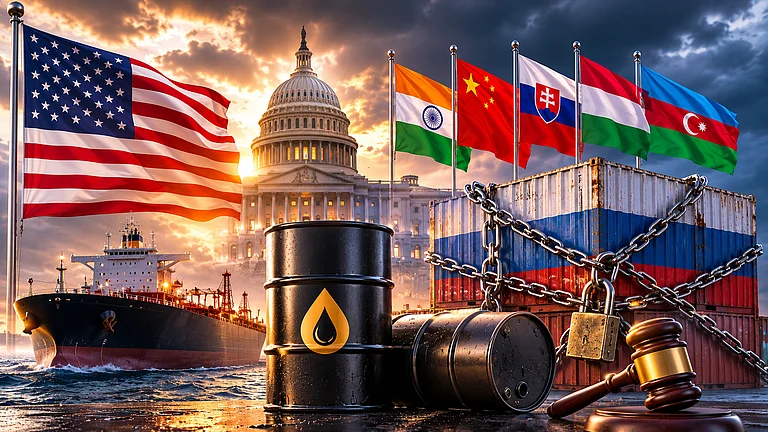
Why Has Oil Climbed Above $85?
The latest surge in crude prices has been driven by renewed military tensions between the United States and Iran.
The conflict intensified after Iran threatened to shut additional export routes following the closure of the Strait of Hormuz and the US decision to tighten restrictions on Iranian oil exports through a renewed naval blockade. The Islamic Revolutionary Guard Corps warned that regional energy exports would either benefit everyone or no one, raising fears of supply disruptions across one of the world's most strategically important oil corridors.
At the same time, US President Donald Trump escalated rhetoric by warning that the United States could target Iran's energy infrastructure if Tehran refuses to return to negotiations.
The developments pushed Brent crude above $85 per barrel while US benchmark WTI also rose sharply.
For India, higher crude prices remain a macroeconomic concern. The country imports nearly 85% of its crude oil requirements, making sustained increases in oil prices negative for inflation, the current account deficit, corporate profitability and the rupee.
Advertisement
How Have Markets Reacted?
Despite fresh geopolitical tensions in the Middle East and Brent crude climbing above $85 a barrel, equity markets have remained remarkably resilient.
Indian benchmark indices rebounded on Wednesday after a brief sell-off in the previous session, nearly erasing all of Tuesday's losses. The Sensex opened 520.41 points, or 0.68%, higher at 77,575.34, while the Nifty 50 gained 159.70 points, or 0.66%, to 24,211.75 during morning trade.
The recovery suggests investors are treating the latest escalation between the US and Iran as a short-term risk rather than the beginning of a prolonged geopolitical crisis. Even over the past week, the Nifty has declined only around 1.4%, while the Midcap and Smallcap indices have managed to gain about 0.6% each, indicating that broader risk appetite remains intact despite higher crude prices.
Global markets also reflected a similar trend. Wall Street ended higher overnight, with the Nasdaq outperforming on renewed enthusiasm for AI-related stocks. Asian markets followed suit, led by a sharp rally in South Korea's Kospi, while Japan's Nikkei and Hong Kong's Hang Seng also traded firmly higher.
Advertisement
What Is Driving The Recovery?
The biggest catalyst for Wednesday's rally was softer-than-expected US inflation data, which eased concerns that the Federal Reserve may need to tighten monetary policy further.
Cooling inflation improved global risk sentiment by reducing pressure on US bond yields and the dollar, making emerging-market assets such as Indian equities more attractive. Investors also took comfort from signs that US lawmakers were softening a proposed sanctions bill on countries importing Russian energy. The revised proposal reduced the earlier plan for 500% tariffs to a framework allowing tariffs of up to 100%, easing fears of a broader escalation in global trade tensions.
Another factor supporting sentiment is improving foreign investor participation. Foreign portfolio investors have turned net buyers in July after four consecutive months of heavy selling, reinforcing expectations that overseas outflows may be nearing an end.
Advertisement
Santosh Meena, Head of Research at Swastika Investmart, said the resilience reflects what markets have increasingly come to describe as the "TACO Trade".
According to him, investors expect geopolitical tensions to de-escalate relatively quickly, encouraging "buy the dip" behaviour instead of panic selling. He added that reduced dependence of Western economies on Middle Eastern oil due to shale production and renewable energy, healthy refining margins supporting energy companies, and continued enthusiasm around AI and technology stocks have also helped global equities absorb the recent surge in oil prices.
Together, easing inflation concerns, expectations of a less aggressive Fed, improving foreign flows and optimism that geopolitical tensions may eventually de-escalate helped investors look past the immediate risks posed by higher oil prices.
The TACO Trade: Why Investors Think Trump Will Back Down
Much of the market's calm can be explained by the emergence of the so-called TACO Trade.
Coined by Financial Times columnist Robert Armstrong, TACO stands for "Trump Always Chickens Out."
The phrase reflects an increasingly common view among investors that President Donald Trump often adopts aggressive positions on tariffs, trade disputes or geopolitical issues before eventually moderating or delaying those actions.
Meena said investors continue to believe that risks are unlikely to escalate significantly because previous episodes have often ended with negotiations or policy reversals under President Donald Trump. He added that ongoing diplomatic efforts, alternative energy supply routes and strong economic incentives against a prolonged disruption have reinforced this belief. According to him, the TACO trade reflects an increasingly optimistic, risk-tolerant mindset in which investors view geopolitical volatility as temporary, although such positioning could unwind sharply if expectations prove wrong.
Markets have observed this pattern repeatedly. The latest Middle East tensions appear to fit that framework.
Although Trump initially threatened stronger measures, he subsequently softened some of his earlier comments, including proposals involving charges on ships passing through the Strait of Hormuz.
That sequence has reinforced investor confidence that the administration may ultimately seek negotiations rather than prolonged military escalation.
As a result, many investors are treating recent market weakness as temporary volatility rather than the beginning of a sustained bear market.
What Could Change Market Sentiment?
The current optimism remains conditional.
Markets continue to assume that oil prices will stabilise and geopolitical tensions will eventually de-escalate. If either assumption proves incorrect, investor sentiment could deteriorate rapidly.
A prolonged disruption to oil supplies, a sustained closure of the Strait of Hormuz or further military escalation could keep crude prices elevated for longer, increasing inflation risks globally.
For India, higher crude prices would put additional pressure on inflation, the rupee and corporate margins while limiting the Reserve Bank of India's policy flexibility.
Domestic factors also remain important.
Rising consumer inflation, an uneven monsoon, quarterly corporate earnings and foreign institutional flows will all influence market direction over the coming weeks.
Meena cautioned that the current narrative could change quickly if the conflict results in a prolonged disruption to global oil supplies, particularly through an extended closure of the Strait of Hormuz or a wider regional conflict. He said such a scenario could push inflation higher, force tighter global monetary policy and trigger a broader risk-off move across financial markets.
For India, sustained high crude prices would put pressure on inflation, widen the current account deficit, weaken the rupee, increase costs for oil importers and oil marketing companies, and weigh on economic growth and corporate earnings. Conversely, a swift diplomatic resolution and the reopening of supply routes would reinforce the market's current resilience.
For now, markets appear willing to give the TACO trade the benefit of the doubt. Whether that confidence proves justified will depend less on headlines and more on whether geopolitical tensions translate into lasting disruptions to oil supplies, inflation and global growth.