Jio Platforms lists at a 21.36% premium, reaching a market capitalisation of ₹12.5 lakh crore.
India’s ₹30,213-crore Jio Platforms IPO attracts bids worth ₹7.3 lakh crore and 1.3 crore applications.
Jio Platforms becomes India’s second-most valuable listed company as investors track digital growth and profitability.
Jio Platforms Debuts At 21% Premium, Becomes India’s Second Most Valuable Firm
Jio Platforms shares debut at a 21.36% premium at ₹1,358, taking its market capitalisation to ₹12.5 lakh crore and making it India’s second most valuable listed company

Jio Platforms Debuts At 21% Premium, Becomes India’s Second Most Valuable Firm
Summary
Advertisement
Jio Platforms made a blockbuster stock market debut on Wednesday, with shares listing at ₹1,358 on the BSE and NSE, a premium of 21.36% over the initial public offering (IPO) price of ₹1,119. The listing took the Mukesh Ambani-led digital and telecom company’s market capitalisation to around ₹12.5 lakh crore, making it India’s second most valuable listed company, according to the figures available during early trade.
The stock touched an early high of ₹1,374 before trading around ₹1,357.45, up ₹238.45, or 21.31%, from its issue price. On the NSE, it was trading at ₹1,357, up 21.27% over the IPO price, as the shares held on to most of their initial gains.
Reliance Industries, which holds a 64.48% stake in Jio Platforms, was trading at ₹1,175 around 11:44 am, marginally higher than its previous close of ₹1,196.20.

Record IPO Demand Fuels Strong Listing
Jio Platforms’ ₹30,213-crore IPO attracted bids worth around ₹7.3 lakh crore, marking the biggest-ever investor response to a public issue in India, according to the figures provided. The issue was subscribed 22.19 times, reflecting strong investor appetite for the company’s telecom and digital businesses.
Advertisement
Qualified institutional buyers (QIBs) led the demand, bidding 70.55 times their allotted quota on the final day of the offer, according to stock exchange data. The offering also attracted more than 1.3 crore applications, Akash Ambani, chairman of Reliance Jio Infocomm, said at the listing ceremony. He said demand for the IPO exceeded ₹7.5 lakh crore.
The strong response followed the company’s position across mobile connectivity, broadband, digital entertainment, cloud services and enterprise technology, giving investors exposure to a broad range of India’s digital economy.
Listing Gains
Investors who received shares under the eligible shareholder category gained ₹5,497 on the minimum lot of 23 shares, based on the listing price. Retail investors allotted the minimum lot of 12 shares earned a listing gain of ₹2,868.
High-net-worth individual (HNI) investors allotted 180 shares gained ₹43,020 at the listing price.
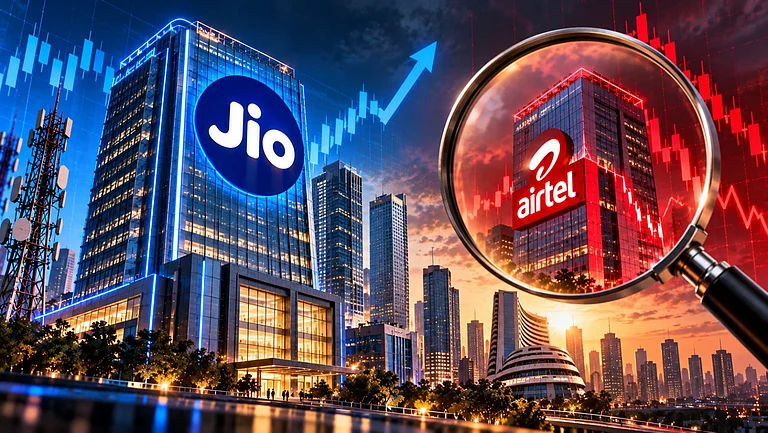
Jio Platforms’ entry into the market has reshaped the rankings of India’s most valuable companies, bringing it into close competition with Reliance Industries and Bharti Airtel. HDFC Bank and ICICI Bank remain among the country’s five most valuable companies, while Tata Consultancy Services (TCS) has moved out of the top five following Jio Platforms’ entry, based on the market-cap figures provided.
Advertisement
Digital Economy Growth In Focus
“Jio Platforms Limited made a positive debut in the Indian stock market today, listed at ₹1,358 on both NSE and BSE, a premium of 21.36% over its issue price of ₹1,119,” said Ravi Singh, Chief Research Officer at Master Capital Services.
Singh said the company’s proprietary technology platform and pan-India digital connectivity support a broad portfolio of consumer and enterprise services, including mobile and fixed broadband, digital entertainment, cloud and productivity solutions, Internet of Things (IoT), cybersecurity, managed services and artificial intelligence applications.
India’s digital economy is projected to reach ₹125.8 trillion by FY31, according to the estimates cited by Master Capital Services. The mobile connectivity market is expected to expand from ₹2.9 trillion in FY26 to ₹5.2 trillion by FY31, while the fixed broadband market could grow from ₹340-350 billion to ₹920-930 billion.
Digital entertainment is projected to rise from ₹562 billion to ₹920 billion, implying a compound annual growth rate (CAGR) of 10%. Personal digital productivity solutions are expected to grow from ₹160 billion to ₹482 billion at a CAGR of 25%.
Advertisement
Singh said investors should focus beyond the listing-day gains and track quarterly revenue growth, earnings before interest, taxes, depreciation and amortisation (EBITDA) margins, average revenue per user (ARPU) and cash flows. The company’s ability to improve profitability and execute its expansion plans while sustaining healthy cash flows will be important in assessing its long-term performance.