At dusk, when the glass towers begin reflecting the last orange light of the evening, the wide roads of Gujarat International Finance Tec-City (GIFT City) start to empty out. Saurabh, a 40-year-old director at a financial services firm, is already mentally on his way back to his home in Mumbai. He runs a small four-member team in GIFT City, but on most visits, he prefers to arrive and leave the same day. This is true for most employees as GIFT City offers little to keep people engaged once the workday ends.
Towers, Tax Structures and Regulations in Place. All GIFT City Needs Now is Society
GIFT City has built world-class financial infrastructure, but its long-term success will depend on creating a vibrant urban ecosystem and a thriving community

GIFT City lacks a vibrant residential community | Photo: Shutterstock
Advertisement
Contrast this with a typical evening at Gurugram’s Cyber City: the streets come alive as groups gather at cafés and bars, people drift from meetings to dinner, all punctuated by the faint echo of live music in the background.
This is how professional ecosystems deepen through informal conversations, networking and referrals that keep people connected to a place beyond office hours.
At GIFT City, it’s different. “There are places that offer five-star experience. But most employees cannot spend that kind of money every day. You need places where people can spend time after work,” says Saurabh. The ecosystem still feels “transactional” rather than “organic”, he adds. “People work there, but many still emotionally belong to another city.”
People say one of the key deterrents is Gujarat’s status as a dry state. Though authorities have made an exception by allowing alcohol consumption within the city perimeter, an affordable bar culture has still not taken root in the area.
Advertisement
Also, on any given day, offices inside GIFT City feel the opposite of a bustling Tier-I city workplace. Entire rows of workstations can be found unoccupied, with only a handful of employees scattered across large office floors. These are not vacancies. Many firms are functioning as secondary units rather than fully staffed offices.
“Inside the big office complex buildings, one or two floors are occupied by large entities, but some floors remain empty,” says Nayana, a senior hospitality-sector professional working in GIFT City. “You feel the void everywhere,” she adds.
This raises an important question: why is GIFT City turning into a work-only town, despite nearly 30,000 people working there?
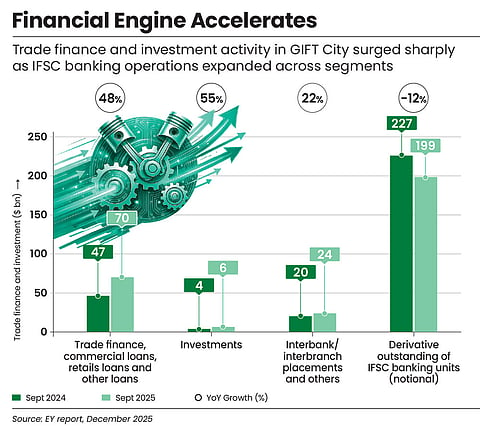
Trade finance and investment activity in GIFT City
The Missing Pieces
Among the key pieces still missing is affordable housing. Part of this may be because it is primarily a commercial centre. Only 22% of the built-up area is allocated for residential, compared with 67% for commercial.
However, those working inside GIFT City say investment-driven ownership patterns have made actual living costs unaffordable for younger professionals. “Many apartments have effectively become investment assets,” says a new employee who moved there only a couple of months ago. “People bought them expecting appreciation, so rents are very high.”
Advertisement
According to a property agent based in Gandhinagar, two-bedroom apartments are priced as high as ₹1.5cr, while monthly rentals range between ₹30,000 and ₹50,000, making it unaffordable for most employees.
Residential prices in GIFT City have appreciated by 30–35% in recent months, says Karan Singh Sodi, senior managing director, Mumbai MMR & Gujarat and Alternatives at real estate consultancy JLL India. “Residential inventory of around 70–80% is sold before project completion,” he adds.
Despite strong headline residential sales, a large part of the demand is investor-led, keeping occupancy levels relatively modest on the ground.
With rents remaining unaffordable, junior- to mid-level professionals look for shared flats or simply choose to live outside the district’s perimeters. “You cannot build a community if everybody leaves after office hours,” says the executive quoted earlier.
Other concerns centre around the availability of schools and local transport. Among senior professionals considering relocation with their families, schools repeatedly emerged as one of the biggest sticking points.
Advertisement
One mid-level banking executive who was looking to shift with his family says the decision became a complicated one with “the ecosystem around schools, recreation, after-work options, hospitals and daily convenience still evolving”.
Saurabh, too, noted that senior professionals are often ready to move: “Then the family asks about schooling, health-care and social life. That’s where the hesitation begins.”
Transportation has similarly failed to keep pace. Metro infrastructure exists, but frequency is a concern. “You cannot have people waiting uncertainly for transport during office rush hours,” says Nayana.
Movement on foot is challenging too as walking long distances in Gujarat’s heat, which can reach 40°C at the peak of summer, is impractical.
Executives say there is a need for climate-sensitive planning similar to Gulf financial centres, including shaded pathways, continuous mobility systems and stronger transportation networks. The irony is that GIFT City was originally conceptualised around a “walk-to-work” philosophy.
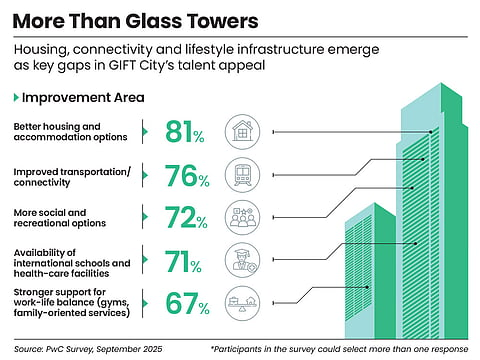
Key gaps in GIFT City's talent appeal
The Missing Anchor
Advertisement
In many ways, GIFT City’s challenges in building a vibrant residential community are unique to its location.
Most of the world’s top financial districts are located inside or adjacent to a major city, with its cultural hotspots and nightlife. Canary Wharf works because it is part of London. Dubai International Financial Centre works because it exists within the city’s wider ecosystem. Mumbai’s Bandra Kurla Complex sits inside the social, cultural and residential density of the city itself.
GIFT City has no such anchor. It is neither a part of Ahmedabad’s commercial hub, nor socially connected to Gandhinagar, the state capital. Moreover, neither Ahmedabad nor Gandhinagar offers the cosmopolitan, after-hours density that gives a financial district its borrowed pulse.
Even though the 10–12km distance to Gandhinagar looks manageable on a map, employees describe last-mile connectivity as inconsistent. “For younger employees travelling back on two-wheelers or depending on public transport is a real concern,” says a sales supervisor at a leading bank who was transferred to GIFT City a year ago.
Only 22% of GIFT City’s built-up area is allocated to residential use, compared with 67% for commercial
Nayana points out that the city is well-lit, but the routes to Ahmedabad and Gandhinagar see very little traffic. “Cab drivers here don’t easily accept rides because they have to take detours due to ongoing construction and road blockages. On top of that, you won’t find autos here after 7 or 7:30pm,” she adds.
On paper, the city looks near-perfect. Spread across 886 acres on the banks of the Sabarmati, GIFT City is roughly equivalent in area to more than 200 cricket grounds laid side by side. New towers continue to rise and occupancy has deepened.
According to official estimates, around 29.5mn sq ft, nearly half of the project’s planned 62mn, has been allotted. The district currently has 25 operational buildings and 37 towers are under construction.
But financial centres do not run on policy incentives alone. They run on talent density, social mobility and the willingness of people to relocate their lives, not merely their offices.
Beyond the Blueprint
Major financial hubs succeed because they become embedded inside the broader urban life.
Girish Jain, professor of finance at Birla Institute of Management Technology, agrees that the next phase of growth will depend less on towers and tax incentives and more on softer urban layers. “A welcoming urban culture often ranks above talent policies and even career opportunities as a key attraction,” says Jain.
Pointing to business districts like La Défense in France, Songdo (South Korea) and Crystal City (the US), Jain says these were built around planning that took years to develop a stronger social identity and long-term community attachment. This is what will transform GIFT City into a self-sustaining financial hub.
GIFT City has delivered what urban planners are good at: towers, tax structures and regulatory frameworks. What it is yet to deliver is what happens organically over decades: the density of informal life.
The missing ingredient is the urban experience: the chai stall that becomes a fixture and Friday evenings that turn into unexpected connections. These cannot be built by a master plan. They happen when people start putting down roots.
For now, the focus needs to be on affordable housing, school infrastructure, last-mile transport and the kind of cultural openness that attracts talent. Harder part will be to build the community that fills them.