Not long back, one of the most frequent refrains about the start-up ecosystem in India was the stereotype of what maketh a successful founder.
No Research Depth to Innovate: PhD Founders Missing from India's AI Start-Up Ecosystem
Only 3 of 35 founders at India’s top AI start-ups hold PhDs, highlighting a research gap that risks India being a user of AI rather than an innovator in the global AI race

The shortage of PhD start-up founders in India is the product of deeper structural constraints inside the country’s academic and research institutions
Advertisement
The consensus was that it was somebody who had at least one of three important ingredients in their curriculum vitae—Indian Institute of Technology (IIT), Indian Institute of Management and MBB (McKinsey, BCG, Bain). Of course, there was a hierarchy within this structure as well such as the city or branch of study.
Those who fell outside this archetype complained as it became an unfair filter that deprived them of funding and talent. But the successes of the past decade, like Flipkart, Zomato, Swiggy, Delhivery and Meesho, meant that the thumb rule just worked fine.
However, the formula that led to the creation of scores of internet unicorns may not be working anymore—as the Indian start-up ecosystem grapples with the artificial-intelligence (AI) race.
“The internet and mobile app boom were largely about delivering commerce and transactions. AI is a completely different paradigm,” said Kailash Nadh, chief technology officer at brokerage firm Zerodha.
Advertisement
Industry insiders are of the view that AI as a technology is still in the research phase and start-ups that succeed in this market will be the ones that can pioneer new technology, rather than cook up cosmetic innovations. And for start-ups to do that, their founders themselves have to be trained in deep-tech research. Something that is not the case in India’s AI ecosystem at the moment.
In the US, the most influential AI companies of the current wave are being built by researchers steeped in deep science. Anthropic’s Dario Amodei holds a PhD in physics from Princeton. OpenAI’s leadership includes researchers trained in mathematics and machine learning. Perplexity AI’s Aravind Srinivas earned his PhD from University of California, Berkeley.
However, India’s AI ecosystem can’t boast of many such founders.
According to data platform Tracxn, among the 20 most-funded AI start-ups in the country, only two have founders with PhDs.
Advertisement
Of the 35 founders behind these companies, 20 hold engineering degrees, three are from management backgrounds and three with doctoral degrees. Two of these PhD founders—Pratyush Kumar and Vivek Raghavan—are part of Sarvam AI, a start-up developing large language models (LLMs) for Indian languages and contexts.
In a glaring contrast, 25 of the 47 founders behind the top 20 US AI start-ups hold PhDs across mathematics, physics, computer engineering and machine learning.
Home and the World
The shortage of PhD start-up founders in India is the product of deeper structural constraints inside the country’s academic and research institutions. India’s top engineering and science institutes produce world-class undergraduates. But at the doctoral level, the pipeline narrows sharply.
Grants are limited. Bureaucracy is heavy. Industry linkages are weak. Professors are evaluated more on administrative duties and number of papers rather than on research that can be monetised. In fact, many researchers view entrepreneurship as a distraction or worse, a professional risk.
Advertisement
On the other hand, US universities like Stanford and MIT actively encourage professors and doctoral students to set up ventures. For instance, Google emerged from Stanford research. Nvidia’s early breakthroughs were shaped by close ties to US academic work in computer architecture.
“In Stanford, professors introduce students to investors. There’s a clear path from a doctoral project to venture funding. Back home [India], that path still feels fragmented,” says Aman Chadha, a Stanford graduate and generative AI team head at Amazon Web Services.
According to data platform Tracxn, among the 20 most-funded AI start-ups in the country, only two have founders with PhDs
In contrast, India’s academic system offers little support. “The grant infrastructure is thin and private organisations can’t easily fund labs. These structural gaps push talent overseas, where research and commercialisation paths are clearer,” says Siddarth Pai, managing partner at 3One4 Capital.
Take for instance the trajectory of Siddharth Panwar. After completing his Bachelor and Master of Science at the University of Arizona and Stanford University, respectively, he returned to India for his PhD. But when in 2022 he decided to set up NeuroDx, a deep-tech company that analyses brain signals to detect epilepsy sooner, he found that institutional backing was thin.
Advertisement
“Foreign universities offer a clearer pathway from academia to entrepreneurship,” he says.
The result is a self-reinforcing loop: fewer PhD founders lead to fewer successful research-led start-ups, which in turn makes investors even more wary of backing such ventures. The consequences are already visible.
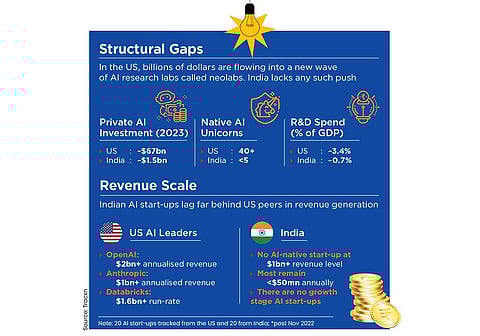
On an average, the top 20 AI start-ups in the US have raised $2.8bn each, compared to $13mn by their Indian peers. Fourteen of India’s top 20 remain at the seed stage
A Shallow Pool
According to Tracxn, only three of the 20 Indian AI start-ups are working on foundational models: Bhavish Aggarwal-led Krutrim, Sarvam AI and OnFinance, which is developing an LLM for the banking, financial services and insurance sector. Others remain dependent on foundational models built overseas.
Moreover, on an average, the top 20 AI start-ups in the US have raised $2.8bn each, compared to $13mn by their Indian peers. Fourteen of India’s top 20 remain at the seed stage.
Zero is the number of growth-stage AI start-ups (those who have reached Series B in funding) that are headquartered in India.
In the US, more than half are already in Series B or later stages.
Ironically, many US start-ups pushing the AI perimeter are led by Indian-origin founders; engineers who studied at IITs before pursuing advanced research abroad. Among them are Parallel Web Systems’ Parag Agarwal, Emergent’s Madhav Jha and Cartesia’s Karan Goel.
In a field where success increasingly depends on doctoral training, access to frontier research and patient capital, investors and researchers warn that this outflow of Indian talent is likely to accelerate rather than slow.
Unless the system continues to evolve in the country, the next generation of AI unicorns built by Indian PhDs may still emerge everywhere except India.
For a country aspiring to lead the global AI race, the message is stark. Without founders steeped in deep research, India risks becoming a powerful user of AI but not its architect.