Around this time last year, Kunal Shah described building a start-up in parental terms. The first goal of a founder is to ensure survival, he explained. Next comes growth. “After that, you operate with an institution-building mindset, where the belief that it will last for the time you are alive or even outlast every team member.”
Money, Glamour and the Death of Hunger: The Great Indian Founder Exit
India’s start-up founders are cashing out, stepping aside and starting over rather than staying put to build generational companies

Illustration: Ragini Singh
Advertisement
Yet, Shah won’t be around to nurture Cred anymore. The fintech unicorn that he birthed eight years back will have to grapple with the risks and chaos of growing up without its iconic founder.
As Shah was appointed to lead WhatsApp in June, there were cheers all around. Indians celebrated as they typically do when a desi techie enters the elite club of Silicon Valley CEOs. Entrepreneurs lined up to shower praises on one of their own. Headlines lionised his rags-to-riches journey. From delivering parcels and grinding it out in call centres to becoming a czar at the heart of the global technology ecosystem, Shah was held up as an inspiration to budding founders.
But beneath the elation lay an unsettling question: why did Shah quit when his start-up is miles away from maturity?
Cred has only just recorded its very first profitable quarter. Despite its valuation at $4.5bn, after Meta’s $900mn infusion, the fintech firm is still in the middle of scaling up. Sustainable profits are a distant dream, and by his own admission, it is far too young to go public.
Advertisement
A somewhat similar story is playing out inside food-delivery platform Swiggy. Its co-founder Nandan Reddy left recently to pursue a new venture. Of the company’s three founders, only one remains now.
Reddy’s exit has happened even as Swiggy is in the middle of a war. Its share price has plunged more than 40% in a year. Quick-commerce arch-rivals Blinkit and Zepto are pulling ahead, and new players with deep pockets like Rapido and Flipkart are making an entry into its core business of food delivery.
Shah and Reddy are two recent examples of a wider phenomenon. The founders of a growing number of Indian start-ups—frequently celebrated and with towering valuations—are heading for the exit door.
Dozens of founders have quit operational roles or parted ways altogether from their start-ups in the past five years
Dozens of well-funded start-up founders have quit operational roles or altogether parted ways from their companies in the past five years, even as the period saw an unprecedented amount of money chasing young companies in the country.
Advertisement
In the last five years, Indian start-ups attracted close to $107bn while 89 of them have turned unicorn, according to data-platform Tracxn.
The tragedy of founder exits is happening at a time when the rapid explosion of generative artificial intelligence (AI) is making start-ups go back to the drawing board.
At a critical moment, when India has its hopes pinned on the start-up ecosystem as the primary growth-driver, premature founder exits threaten to derail the country’s long-term economic ambitions.
“India’s start-up ecosystem needs entrepreneurs who are interested in creating institutions that leave behind a lasting legacy. I don’t see enough of that mindset today and that is the real challenge,” says Vaitheeswaran K, one of India’s earliest internet entrepreneurs.
Money and Mayhem
At the turn of the millennium, becoming rich from a start-up was not easy for founders in India. Becoming rich before the start-up succeeded was harder still.
For a long time when building online job portal Naukri, Sanjeev Bikhchandani lived off his wife’s income and later took up part-time jobs in academia and media.
Advertisement
Just before the dot-com bubble burst in 2000, Bikhchandani succeeded in getting the first funding round for Naukri.com. However, there was a stringent rider: neither founder nor the management could sell a single share without investor approval.
The rationale was if founders unlocked personal wealth too early, their hunger could evaporate. As a result, Bikhchandani and his generation of founders made big bucks only when their start-ups went public or got acquired at premium valuations.
But things began to change as the start-up ecosystem grew. With billions of dollars pouring in, investors competed to invest in the buzziest of start-ups. And that’s when founders turned the table on them.
During the funding boom of 2021–22, when the Indian start-up ecosystem attracted a record $42bn, an often-unspoken term of dealmaking took shape. Investors had to agree to buy a chunk of shares from founders while entering a start-up. They couldn’t choose to buy only fresh shares in exchange for wiring money to the start-up’s bank account, which was the norm earlier when the likes of Bikhchandani raised capital for the first time.
Advertisement
The contrast between founders who stay committed to their ventures and those who exit often determines whether a company compounds over decades or loses the vision on which it was built
And this wasn’t just restricted to growth-stage start-ups who were raising hundreds of millions of dollars at a go in their Series D or E funding rounds. At the peak of the boom, industry insiders say that even founders of younger start-ups were given the leeway to sell their shares and make quick gains.
“A few Series A start-up founders, whose companies had already raised earlier rounds and were now gearing up for a Series B, started offloading some of their shares during those Series B rounds,” says Devansh Lakhani, an investment banker.
“One of the primary reasons was the massive inflow of capital into private markets during the Covid period, especially from US-based investors. A lot of money was flowing into start-ups at the time,” he adds.
Like any other boom-time excess, it did not end well. Of the 77 unicorns who raised funding during 2021–22, well over two-thirds of them have not managed to attract even $100mn in funding since then, according to Tracxn.
As the funding mania subsided, many founders lost their appetite for carrying on the fight when the dopamine hit of surging valuations and bumper share sales ended. But then they had made enough money.
“You think about short-term needs and dreams of wanting to buy a house and all of that at a very basic stage of your journey instead of looking at the larger picture,” says Mohit Gulati, chief investment officer and managing partner at early-stage investment firm ITI Growth Opportunities Fund.
Take the case of social-media unicorn ShareChat’s co-founder Bhanu Pratap Singh. He reportedly once told employees that his aim in life was to make ₹20cr and chill. That dream did not take very long to become reality.
Singh and two of his co-founders sold shares worth ₹80cr in a secondary sale sometime in late 2022. By the next year, even as the company battled rising losses and slowing growth, he and another co-founder had stepped down, abandoning the mission of building a homegrown social-media giant to rival the likes of Facebook and TikTok.
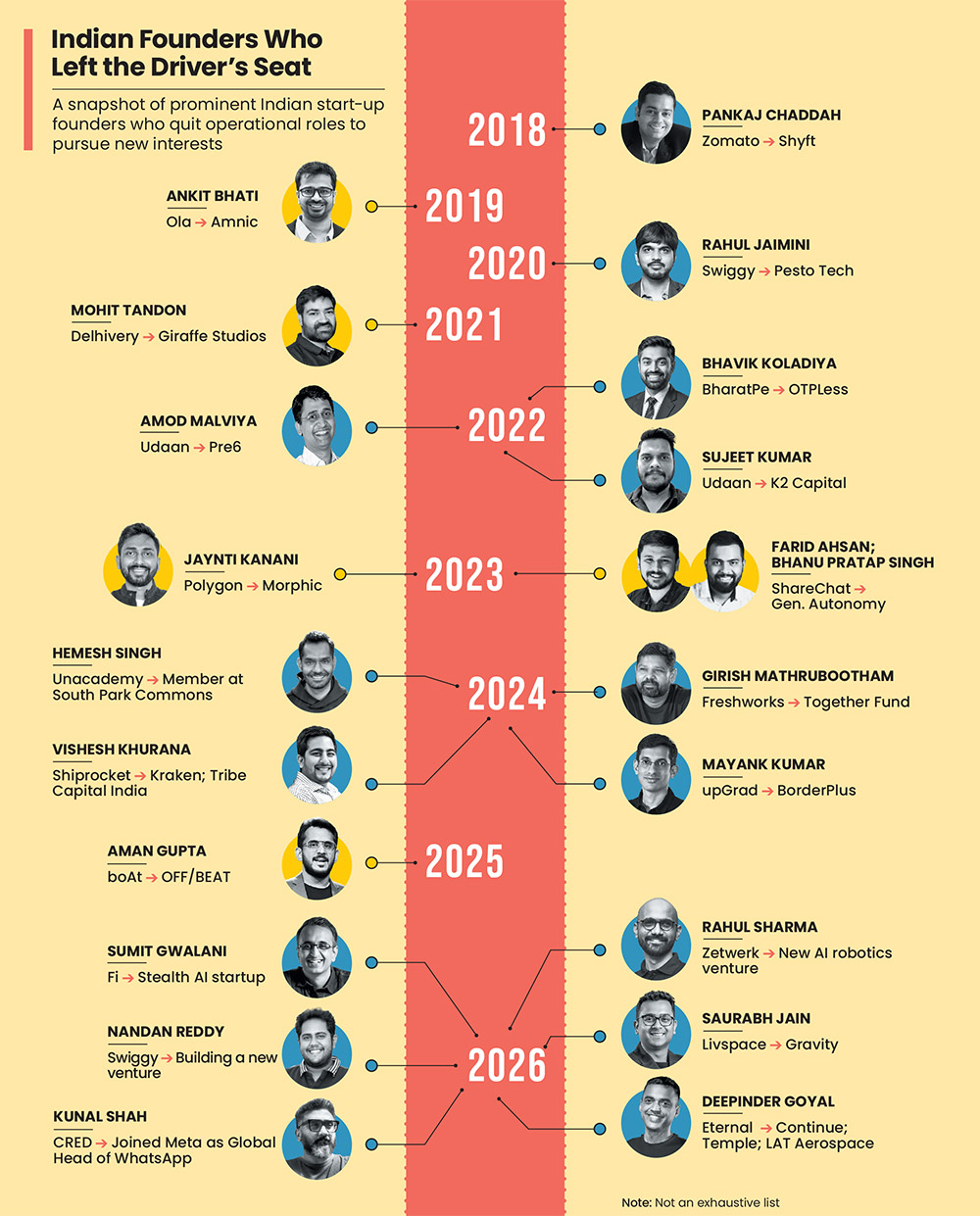
Founders who quit operational roles
Cheque-Mate
Earlier this year, consumer electronics start-up boAt’s co-founder Aman Gupta gave a home tour on a YouTube show. One thing that stood out is that he has made it big.
But money’s deepest promise has never been luxury. For the rich, it is the freedom to choose: the power to walk away, to say no, to decide what opportunity to pursue next.
In September last year, with a month to go before boAt filed its application to go public, Gupta quit as the chief marketing officer. He didn’t want to remain in an executive role.
Over the past few years, boAt’s Gupta has become popular as a judge on reality show Shark Tank, where successful founders bless upcoming ones with funding. He has racked up 1.7mn followers on Instagram, gets mobbed by youngsters and is a favourite with ministers for selfies.
Meanwhile, Gupta has backed 98 start-ups, which makes him one of India’s most active angel investors, according to Tracxn.
While the Shark Tank effect is credited with making entrepreneurship aspirational for the middle class, its less noticed effect has been to glamourise the act of investing itself.
For founders who have already made substantial fortunes, this creates an attractive exit ramp: they can leave the grind of running a company without leaving the ecosystem.
Sujeet Kumar, who moved away from an operational role in his e-commerce platform Udaan around 2022, has become a prominent angel investor. He has backed scores of start-ups such as Ultrahuman and Blue Tokai.
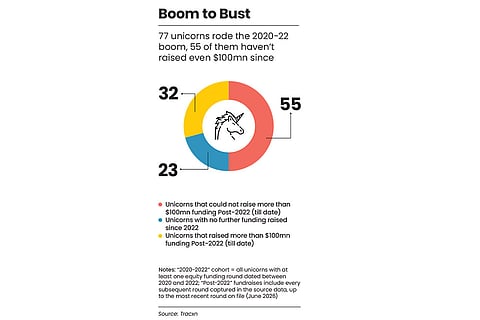
Indian unicorns are starved of funds now
Cred’s Shah has investments in around 190 start-ups across fintech, SaaS, consumer internet and enterprise applications like Zetwerk, Shiprocket and BigBasket.
In a way, investing confers wealthy founders with status, access and relevance, but with fewer operational burdens. They can appear on viral podcasts, dispense advice on social media, judge other founders and build personal brands around their fame.
As such, the founder-to-investor pipeline is becoming increasingly visible and formalised.
Girish Mathrubootham stepped away from cloud-based software-as-a-service (SaaS) company Freshworks in 2024 to a full-time role at a venture-capital (VC) firm called Together Fund he had co-founded earlier.
In the same year, Magicpin co-founder Brij Bhushan left his operating role to join VC firm Prime Venture Partners, while Shiprocket co-founder Vishesh Khurana quit to move to VC firm Tribe Capital to lead its India investments.
Of course, there are still founders who continue to straddle both running their companies and investing. Yet, their portfolios suggest that it is becoming more than just a pastime.
“Initially, founders want to build a company, succeed and create wealth. Once they achieve all of that, they sometimes feel less committed and begin looking for something new,” says Vaitheeswaran.
But the choice of something new can vary.
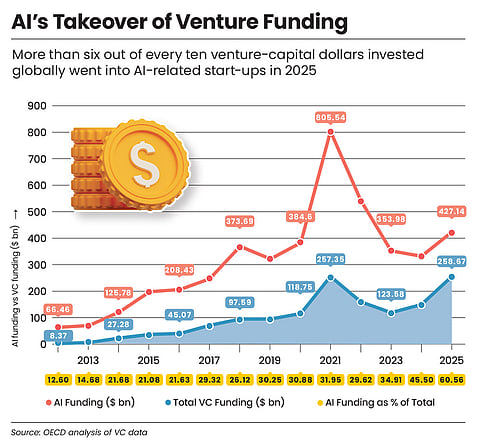
AI start-ups see the maximum VC fund flow
Back to Basics
Over the past decade-and-a-half, Deepinder Goyal has emerged as one of India’s most famous technology founders. He started a restaurant-discovery website and pivoted to make it one of India’s largest food-delivery platforms. In 2021, Zomato became one of India’s first new age technology companies to enter the public markets.
While surviving bruising competition and expensive experiments, Goyal managed to turn it profitable. He made an audacious bet, acquiring the struggling quick-commerce company Blinkit for about $560mn. The deal was greeted with scepticism, but Blinkit would eventually go on to becoming the company’s crown jewel in the eyes of public-market investors.
Yet, all that success and adulation was not enough to keep him interested in running the company that he had—ironically—rechristened as ‘Eternal’ a few years back.
In February, he stepped down as chief executive and managing director, relinquishing control of its daily operations.
“Of late, I have found myself drawn to a set of new ideas that involve significantly higher-risk exploration and experimentation. These are better pursued outside a public company like Eternal,” Goyal wrote to shareholders.
He has launched Continue, a longevity-research lab, and Temple, an experimental wearable device being developed under a separate health-tech start-up. He has also co-founded aviation venture LAT Aerospace, which is attempting to build low-cost short-take-off-and-landing aircraft.
It’s not just the Zomato’s Goyal who finds starting up from scratch yet again a more seductive option.
UpGrad co-founder Mayank Kumar stepped away from day-to-day management in 2024 and launched BorderPlus, a platform for placing Indian workers overseas.
PharmEasy founders Dharmil Sheth, Dhaval Shah and Hardik Dedhia re-emerged in 2025 with All Home, moving from digital pharmacy into architecture and home improvement.
These are just a handful of examples. India’s start-up ecosystem is developing a second-act habit. Founders who once persuaded investors and employees that their companies were lifelong missions are increasingly treating them as one chapter of a portfolio career.
The attraction of staying on for the long haul and building institutions is fading.
“Entrepreneurs are naturally excited by building something from scratch. Once a company reaches a certain scale, the work becomes process-driven and focused on execution,” says Vaitheeswaran.
And one of the biggest culprits of accelerating this trend is AI.
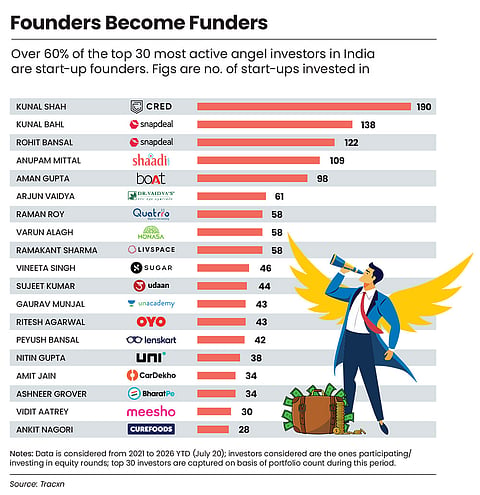
Many founders have become angel investors
The AI Psychosis
Fi started with a bang in 2019. The fintech start-up was founded by two Google veterans and backed by investors such as Peak XV (formerly Sequoia’s India arm), Temasek and Alpha Wave Ventures. It reached a peak valuation of over $522mn.
Then came the funding winter and Fi, like many other start-ups, hit the capital wall. This year, it announced a pivot from consumer-facing offerings to focus on business-to-business AI and enterprise technology. In March, it shut its consumer banking chapter entirely.
Amid this business pivot and cash crunch, co-founder Sumit Gwalani stepped down in May. “Next chapter: AI for the enterprise intelligence problems I lived at Fi,” he said in a LinkedIn post.
He is now building an AI start-up.
The rise of generative AI has simultaneously created a fear of disruption and a fear of missing out (FOMO). These two forces are to some extent reshaping the founder behaviour.
Investors have also become increasingly vocal about this reality. Manav Garg, co-founder of Together Fund, argued recently that start-ups can no longer think in terms of occasional pivots as something new comes up every week. Many fear if their product will even exist in its current form three years from now.
American VC giant Andreessen Horowitz’s co-founder Ben Horowitz calls this fear of not moving fast enough “AI anxiety”. The window that once gave a strong software product 10 years of runway, then five years has now compressed to “maybe five weeks”, he pointed out recently. AI and robotics are about to hit like a “supersonic tsunami”, proclaimed Tesla founder Elon Musk this year.
They are not wrong. The edtech industry has seen this disruption already with a rising number of start-ups choosing to be AI-native. SaaS companies are facing intense pricing pressure as AI agents replace traditional workflows.
“A founder building a SaaS, consumer, fintech or logistics business now faces a difficult question: will AI disrupt what I am building today? This is creating a level of self-reflection we have rarely seen before,” says Aditya Singh, co-founder of VC firm All In Capital.
Another way AI is insidiously leading to founder exits is less about survival and more about opportunity. Founders see AI cornering investor attention, talent and media coverage.
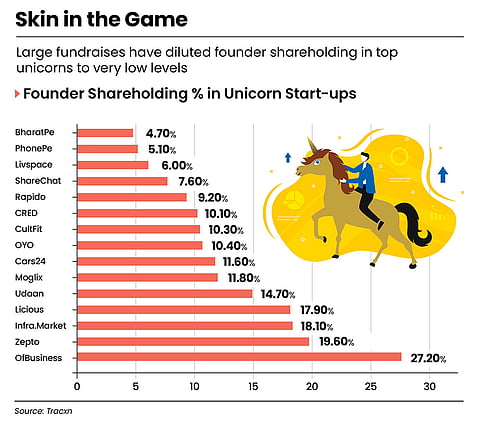
Founder shareholding in unicorn start-ups
AI firms accounted for 61% of global VC investment in 2025, or $258.7bn out of a total of $427.1bn, according to a new OECD analysis of VC data.
This kind of capital concentration in a sector can create a temptation to abandon an existing company, even a well-oiled one, to begin anew in AI.
When all three co-founders of a Bengaluru-based fintech start-up left their venture in 2023, Arnab (name changed), a 32-year-old employee, knew it was time for him to leave too. The reason: across the office, employee morale had dropped sharply.
This start-up had once raised over $150mn from the likes of Goldman Sachs and Naspers.
Suddenly, the conversation shifted towards profitability, reducing cash burn and slowing things down. For Arnab, it was a dramatic shift in the company’s vision.
“You lose the soul of the company if all the founders get up and leave,” he adds.
Arnab eventually left the company in mid-2023. The start-up was eventually acquired, and most of its employees moved on.
Take the case of a business-marketing company, where the founder exited after a clash with investors over equity.
“When he left, there was no one with the same vision. Most people do not naturally have vision; they just go with the flow,” says Sharadd Raaj Utsav, founder of enterprise data security provider FutureX and tech firm Agility AI.
Edtech has been disrupted already with a rising number of start-ups choosing to be AI-native. SaaS seems to be next
Soon after the founder’s exit, internal friction started building. Leads were not converting. Sales and marketing teams began blaming each other. Eventually, the company shut down.
And this, employees and industry executives say, is often what follows when founders leave a company midway: confusion, disruption and a gradual loss of direction.
“The moment a founder walks away, while the company still has a large runway for growth, whether it is making profits or not, I don’t know what the next management team will do,” says Ashish Kumar, co-founder and general partner at growth-stage VC firm Fundamentum.
The contrast between founders who stay and those who drift away often determines whether a company compounds over decades or loses the vision on which it was built.
Founders can alter a company’s entire trajectory. Silicon Valley offers two powerful examples.
After Steve Jobs was forced out of Apple, the company struggled for the next 12 years. Its market share fell from 10-12% in 1985 to just 3-5% by 1996. When he returned as interim CEO in 1997, Apple was 90 days away from insolvency. Jobs restored focus and product vision, and within a year the company posted a $309mn profit. Jobs then went on to usher in the era of the iPod, iPhone and iPad.
Google offers a more recent parallel. After co-founders Larry Page and Sergey Brin stepped back from executive roles in 2019, the search giant became more measured in areas such as AI.
But when OpenAI’s ChatGPT triggered a race, CEO Sundar Pichai brought Page and Brin back into strategic discussions, valuing their instincts and long-term conviction.
The duo brought back chatbot features to Google Search and advised the leadership team as AI became the top priority.
Investors get this. Founders are vital to a company’s growth as they are willing to take long-term bets to keep up with market disruptions.
So, in order to keep founders interested in running the shop in the long run, VCs are granting them large stock grants. Their rationale is that founders often don’t have enough skin in the game as their shareholding gets diluted over successive fundraises.
In many unicorns like PhonePe, Zepto and Rapido, founders own less than 10% of the company.
“If you were hiring a CEO from outside, what Esop [employee stock option] grant would you give them to incentivise them to do the best possible job for the company? That same logic should apply to founders,” Razorpay co-founder Shashank Kumar told Outlook Business earlier this year.
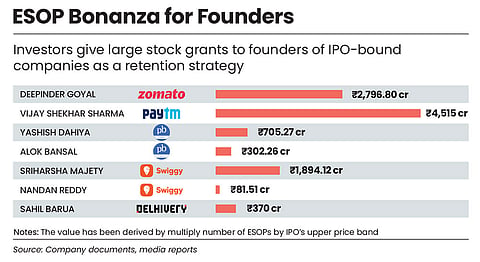
Granting Esops has become a retention strategy
For the Long Haul
Bikhchandani, an early investor in Zomato, believes that enduring companies require a fundamentally different mindset. “It takes 30-35 years to build a truly great company. You can build a company, sell it and become financially successful personally. But did you build a truly great company?”
Indian start-ups are entering a new phase, with more IPOs, larger pools of private capital and an increasing number of global ambitions. But if founders view their ventures as assets to monetise or a passing phase, the ecosystem risks producing fewer ins-titutions that thrive in the long run.
“If the founders view their start-up as anything other than parental, they will be unfair to their conscience. But if they view it as an institution they are building to strengthen the country, then they will have passion to be the parent of their enterprise,” Infosys founder Narayana Murthy told Outlook Business earlier this year.
For the Murthys and Bikhchandanis of yore, the hard, unglamourous marathon of creating a generational company looked more compelling than cashing out, stepping aside or starting again.
Indian start-ups have come to carry the hopes of a country that is impatient for prosperity: to create jobs, build technologies and challenge foreign giants. They are vessels of an economic aspiration finding utterance at long last. At such a critical juncture, there won’t be a greater tragedy if today’s rockstar founders continue to quit before building eternal institutions.