A young corporate employee, Pallavi Singh often faces the conundrum of how to give her traditional sarees a modern touch while also adding a flavour of luxury. A belt is one such accessory on her mind to add that final flourish. But after scrolling through websites of global luxury brands like Gucci and Louis Vuitton, she realised the prices were not within her budget.
India’s Luxury Couturiers Target Gen Z and Millennials with Affordable Accessories
India’s luxury fashion industry is evolving as couturiers attract young consumers through accessible accessories, creating demand within a fast-growing premium middle segment

Photo courtesy: Websites of Anita Dongre, Ritu Kumar, Tarun Tahiliani, Manish Malhotra & Sabyasachi
Advertisement
Disheartened Singh then stumbled upon suggestions of a Sabyasachi belt with a big Bengal Tiger metal logo on Instagram. That was her Eureka moment. Singh is now a proud owner of a piece of swadesi luxury for just ₹15,000.
“It’s much cheaper than Sabyasachi sarees. And when worn over normal sarees, people believe that even those drapes are from high-end couture brands,” she says. After using the belt for almost four years, Singh now has her heart set on a Sabyasachi saree.
This is how India’s luxury couture designers such as Sabyasachi, Manish Malhotra, Ritu Kumar, Tarun Tahiliani and Anita Dongre are introducing buyers to the larger couture universe—through entry-level accessories.
Worn by Bollywood and even international celebrities, these brands are household names in India. However, most consumers begin small—a scarf, a bag, a belt or a piece of jewellery.
“From a consumer psychology standpoint, accessories often act as an entry point for aspirational customers. A first step into the brand’s world,” says Amrish Kumar, managing director and creative director at Ritu Kumar.
Advertisement
Accessories are enhancing Indian luxury market’s overall revenues too. In 2024, India’s fashion accessories market generated revenues of ₹1.34 lakh crore and is projected to reach ₹2.20 lakh crore by 2030, growing at a CAGR of 9% between 2025 and 2030, according to a report by research firm Grand View Horizon.
Jewellery was the largest revenue-generating segment in 2024, and India accounted for 1.8% of the global fashion accessories market revenue in the year, adds the report.
High-end accessories roughly account for 9% of the total accessories market in India, according to global market-research company IMARC.
For aspirational buyers, these high-end accessories from Indian fashion houses scratch the itch to own the likes of Gucci, Prada or Louis Vuitton. The lure being comparatively cheaper price points.
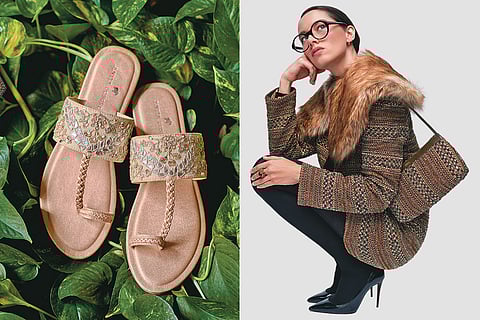
Photo courtesy: Websites of Anita Dongre, Ritu Kumar, Tarun Tahiliani, Manish Malhotra & Sabyasachi
Shelf Space
At couture labels such as Anita Dongre, prices for accessories are as low as ₹1,406 for pocket squares, while scarves and clutches start at around ₹25,000. This broad pricing spectrum for accessories is a perfect pitch for aspirational buyers.
Advertisement
Anita Dongre, founder and chief creative officer, House of Anita Dongre, says that the customers desire to wear the brand beyond big occasions such as weddings. “We have a ready-to-wear line of aspirational luxury, offering our customers the same craft and design in a more fluid, versatile setting,” she says.
The accessory category was built as a natural extension, adds Dongre.
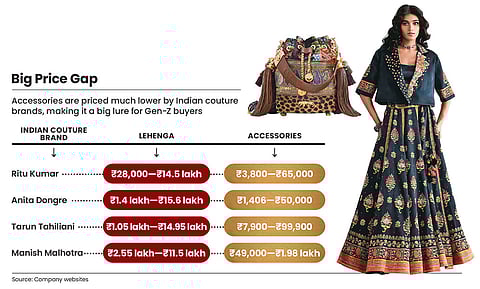
India's luxury brands are offering accessories at more affordable rates
At Ritu Kumar, too, though lehengas are significantly costlier, accessories like bags and shawls are priced much lower, starting from ₹3,800, offering entry-level options for a wider set of buyers.
And as younger millennials and Gen-Z buyers prefer accessories with daily-use quotient, broad pricing range by couture houses is too much of a bonus to skip. The older generation, on the other hand, tends to invest more in one-time, long-lasting purchases.
Kumar says accessories contribute in two key ways. First, they expand the consumer funnel by attracting customers who may not initially invest in core apparel categories but resonate with the brand’s design philosophy and aesthetic. Second, they give consumers more touchpoints with the brand beyond occasional wardrobe purchases.
Advertisement
“From a business perspective, their impact is seen less in immediate topline contribution and more in customer acquisition and repeat behaviour. Accessories serve as a compounding lever in strengthening consumer relationships,” explains Kumar.
Having a less expensive product range is also an international phenomenon. In 2020, French luxury goods brand Hermès, famous for its iconic and expensive leather bags, ventured into the beauty market to cater to aspirational buyers. Now, it has a product range starting at just $47 (₹4,252).
But what is behind this consumption shift back home and how are the youth being made aware of the price and design variety that swadesi luxury brands offer?

The fashion accessory market in India is taking off in a big way
Consumption Shift
Accessories are increasingly becoming part of a complete fashion statement, says Advita Bihani, co-founder of Indulge Global Concierge, a luxury lifestyle services brand that curates bespoke experiences for the ultra-wealthy.
“Today, consumers don’t buy in isolation; they buy the whole look,” Bihani says, adding that Gen Z, as the most fashion-forward and experimental cohort, is driving this consumption shift. In fact, brands like Anita Dongre introduced a bucket bag just to cater to this demand.
Advertisement
Most of this consumption is driven by social media and brands know it. Pallavi Singh was reeled in to buy the Sabyasachi belt as the suggestions kept popping on her Instagram.
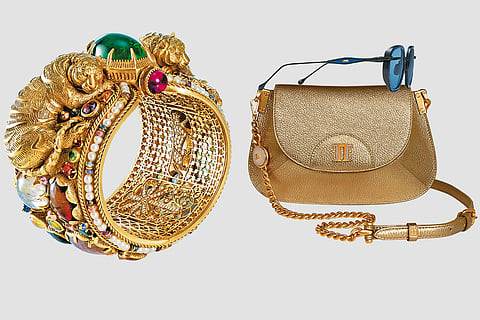
Entry-level accessories include belts, purses and jewellery
Global accounting firm Deloitte alludes to this phenomenon in a report, which mentions social-media creators and engaging in-store experiences are becoming key drivers of product discovery and influence.
With easier access to brands and products, this interest is increasingly turning into purchases. At the same time, changing preferences with millennials leaning toward premium options and Gen Z following trends closely are creating strong growth opportunities across both premium and fast-fashion segments in the coming years.
Creators are driving around 63% of the total product discovery across categories, with Gen Zs relying on them the most, points out the Deloitte report.
Brands are now introducing new styles at a rapid pace, transitioning from seasonal collections to weekly drops. “For Gen Z and young millennials, freshness is more about social visibility, fuelling a culture to replace SKUs [stock keeping units] more frequently,” the report adds.
Behind the craze for designer accessories is also those pieces, statement or otherwise, turning into high-end collectibles, says Bihani from Indulge Concierge, which also has a luxury retail extension called Indulge Shops.
An entirely new demand for the premium middle has been created, driven by a base of consumers who want to keep it premium but accessible
Even at Indulge Shop, while higher-value categories like bags and luxury pieces remain strong sellers, it’s often the quirkier, more distinctive accessories that draw attention, adds Bihani.
Experts believe there lies a large space yet to be tapped in the luxury accessor market. Craftmanship from the Northeast is one such example, offering a significant scope for fresh design and storytelling.
Praveen Govindu, partner, Deloitte India, believes the opportunity for homegrown luxury accessories is undeniable as Indian luxury doesn’t need validation from the West to succeed.
But scaling could be a problem for most of the Indian fashion luxury brands. It’s not as straightforward as it seems.
Scaling Challenges
Majority stakes of luxury brand houses like Manish Malhotra, Tarun Tahiliani and Sabyasachi are owned by corporates such as Reliance Brands and Aditya Birla Fashion and Retail. But even with corporate backing and access to funding, scaling a luxury label isn’t a simple process.
“You can’t expect an Indian label to become a Hermès or Louis Vuitton overnight. The very essence of luxury is exclusivity and that naturally slows the journey. So, it’s not entirely fair to compare homegrown players with them,” says Govindu.
For major couture brands moving into the accessories market, the biggest challenge is scaling without losing the brand’s signature experience. Running one or two stores is manageable, but consistency is tough when the number grows.
Traditional touch is playing well for the designer Indian accessory brands which international luxury labels such as Hermès or Dior are unable to cater to. This is where couture brands like Sabyasachi come in.
A recent Deloitte’s India fashion report points out that young customers today are building small collections to swap frequently, instead of buying only for weddings or festivals. And value no longer means the lowest price.
This mindset, highlights the report, has created an entirely new demand for the premium middle, driven by a base of consumers who want to keep it premium, classy, but accessible.
For Indian luxury labels navigating a young, digital-first India, the future playbook in the country may hinge not only on bridal grandeur, but on designing small, collectible pieces that travel with consumers.