For decades, the distinct hum of a 100cc engine has served as the morning alarm for millions of Indian households.
Growth Gamble, Decentralisation And The Quest To Remain No.1: Inside The Remaking Of Hero MotoCorp
Harshavardhan Chitale spearheads two-wheeler king Hero MotoCorp’s quest to conquer new territories and defend its market leadership

Harshavardhan Chitale, CEO, Hero MotoCorp | Photo: Vikram Sharma
Advertisement
Long before the sun was high in the sky, a familiar rumble of motorcycles would fill the roads.
At the centre of this daily ritual was Hero, a two-wheeler manufacturer. It is the silver Splendor that a father polished every Sunday morning. It is the pillion seat where a young graduate sat on the way to his first job interview.
Be it a kid wedged between his parents for an evening grocery run or a farmer getting to his fields in the morning; Hero motorcycles became the go-to ride for India’s middle class, much like the company’s campaign Desh Ki Dhadkan (heartbeat of the nation) at the turn of the millennium.
Generations have changed, and modern scooters and premium bikes rolling off the assembly lines today look very different from the models of the 1990s.
Yet, Hero MotoCorp has remained relevant through different eras.
The strength of the brand showed up in numbers too. Hero was the largest two-wheeler maker with a mighty 40% total market share in 2015—not a single company was giving it a fight for the pole position. The next biggest player was a distant second at 27%. But that was more than a decade ago.
Advertisement
What’s noteworthy is that in Hero’s export markets, 40% of what it sells is already premium, unburdened by its affordable image
Between then and now, Indian riders have evolved. The demand for basic transportation has given way to new desires: automatic gearboxes for congested commutes, bigger engines for weekend escapes and batteries replacing fuel tanks.
Although it remains at the top with a 28% market share, its position doesn’t look as unassailable as it did in middle of the last decade. The gap between Hero MotoCorp and the next player, Honda Motorcycle & Scooter India, which holds a 25% share, has narrowed substantially. Meanwhile, TVS is breathing down their necks as it has galloped to nearly 20% share from just 13% over the past decade.
Hero has been compelled to shift gears to defend its turf and meet a changing consumer appetite.

Hero still at top but rivals are catching up
Step onto a Hero showroom floor today, and the evolution is visible: the iconic Splendor is still there, but now it is flanked by clutchless, gearless and vibrant scooters from Vida, Hero’s homegrown electric vehicle (EV) brand.
Advertisement
Down the road, at the company’s new upscale Premia outlets, a burly 440cc motorcycle proudly bears a co-developed Harley-Davidson badge.
In effect, Hero is remaking the brand. While the outside world might see this as a company sprinting to keep pace with changing times, the reality is that it has no choice if it wants to remain the undisputed leader.
For Harshavardhan Chitale, who took the helm as chief executive in January, the roadmap ahead is clear: to protect the market leader’s crown. To this end, Hero has accelerated into high-growth segments like scooters, premium motorcycles and EVs.
“We want to be a market leader that defines the future of mobility. And the first part of that sentence is—be the market leader,” notes Chitale.
He has his task cut out.
When it comes to its bedrock commuter bike segment, Hero is indomitable still with an 85% grip on the entry-level, sub-110cc space, which is growing still.
Advertisement
The nature of the challenge is more structural: the entry-level segment, which once made up nearly 65% of all Indian motorcycle sales, has shrunk to just around 44%. Now Chitale has to make sure that the core segment does not suffer as Hero goes full throttle in high-growth segments. The market leader has to keep strengthening the commuter segment by continuing to deliver refreshes to keep customers excited.
While it sounds like a daunting challenge, Hero managed to pull off a similar stunt with elan not too long ago. When it split from Japanese auto giant Honda in 2010-11, many thought it was game over for Hero.
Yet it survived and thrived. It stayed at the top with a 45% grip on the market in 2011–12.
“It’s not always the strongest species that survive, but the ones who are the most receptive to change,” wrote Pawan Munjal, then managing director (MD) and CEO, in the 2011–12 annual report.
Advertisement
Fifteen years later, those words have become a strategic blueprint for the company.
Can it do the impossible again?

Leadership overhaul in the last year-and-a-half
Horses for Courses
Even at the peak of its market leadership, Hero could sense that the sands were shifting. For that reason, the company’s leadership was already using buzzwords like sustainable mobility and future-ready mobility as early as a decade-and-a-half ago.
But foraying into a new segment, which can potentially cannibalise existing business, is never easy. When a company has to do this in multiple segments simultaneously, the complexity increases exponentially.
Over a period of time, the biggest management lever the company has pulled to solve this issue has been to decentralise.
Taken together, these high-growth segments were too broad a portfolio to be managed by a single team or unit chief. More than anything else, each required a different strategy.
So, Hero broke its monolithic empire into four independent “mini companies”—EVs, premium, scooters and global. Each with new leaders and equipped with their own product roadmaps, R&D labs and dedicated factory lines. “You cannot have one person going after all of it,” says Chitale. “There are just too many balls [juggling] in the air.”
By ending internal multitasking, Hero ensured that the lightning-fast agility needed to battle nimble high-growth areas wouldn’t get buried under the weight of running the core motorcycle business.

Hero's journey from setting shop to overtaking Bajaj
“The restructuring appears both timely and logical,” says Deepraditya Datta, MD at talent-acquisition firm Venator Search Partners. “It is critical to create an organisational structure that gives each business dedicated focus, accountability and independence.”
Decentralisation wasn’t an overnight phenomenon. For instance, Hero was keeping a close watch on how the world was rearranging itself around green transition.
Anticipating that green wave, Hero created the Emerging Mobility Business Unit in 2019. At the time, Hero wasn’t even present in the electric market, but it did see the need to make a move.
Three years later, in March 2022, this unit stepped into the light with the launch of Vida.
Last year, Kausalya Nandakumar was brought in from Mahindra Electric Automobile to run the EV show. “Being independent created an environment where our teams could think differently, move quickly and execute swiftly,” she says.
“The Vida Dirt.E K3 perfectly illustrates this approach. We created an electric off-roader specifically for young riders. This reflects our willingness to experiment with new vehicle categories,” she adds.
Hero made a similar play in the premium segment, where it had a negligible presence.
The world was changing and so were the consumers. Segment rivals like Royal Enfield were selling to riders who wanted more from their motorcycles and would not let price be a deterring factor.
Hero realised it had to do more. It created a dedicated premium unit in August 2026 and tapped one of its own as it elevated Anuj Dua to lead the charge. Besides being a Hero veteran, Dua also has had a nine-year stint at Royal Enfield under his belt.
Meanwhile, the mainstay commuter business (entry-level bikes and scooters) has been entrusted to Ashutosh Varma, a 15-year Hero veteran who took over in May 2025.
Exports fall under Sanjay Bhan, and the strategy behind the global unit has changed too. Instead of one product for every market, Hero now builds what each country actually needs—premium bikes, scooters or EVs, depending on local demand. “This approach is working for us. We grew more than 60% year on year on exports this past quarter,” says Bhan.
Hiring choices at Hero also reflect that the company’s horses-for-courses approach didn’t stop at decentralisation. It has aggressively recruited specialised talent from outside to match the speed required in new growth areas.
In May 2026, Sachin Agrawal was cherrypicked from VE Commercial Vehicles to bolster Hero’s R&D team as chief technology officer. Few months later, the company’s digital team found its new leader in Suresh Kumar P, who has led technology transformation at Reckitt, Pernod Ricard and Asian Paints in the past.
Most of this new leadership team are outsiders. In fact, many like Chitale are from entirely outside the automotive ecosystem. “External hires can bring fresh perspectives, challenge conventional thinking and inject new energy into an organisation,” Venator’s Datta points out.

Hero is trying to catch up with its EV rivals
The Electric Dream
When India’s electric two-wheeler market surged in early 2020, Hero MotoCorp was conspicuously missing from the scene. Bajaj had just resurrected the iconic Chetak as an EV and TVS had unveiled the iQube.
Quarter after quarter, analysts grilled Hero on earnings calls. The company remained firm in its response: a brand built on legendary reliability could not rush onto an unproven platform. Besides, Hero had less to lose. Unlike its rivals, it had a meagre internal combustion engine (ICE) scooter business and was not at risk of disruption.
But behind the scenes, an unusual roadblock caused further delay. A bitter family feud over the ‘Hero’ trademark restricted the Pawan Munjal-led company from using the family name on EVs.
By the time Hero finally launched Vida, the space was crowded with EV-only start-ups like Ola and a few legacy players. Turning the delay into a marketing weapon, Hero dropped a punchline while Ola was battling headlines over battery fires: “We’d rather be right than be first.”
Eight months after two IIT Madras graduates—Tarun Mehta and Swapnil Jain—unveiled a sharp, connected prototype called the Ather S340 in Bengaluru, Hero had committed ₹205cr to the venture. That was in 2016.
To prevent internal friction, Hero deliberately walls off Ather products from its own. But there are still some synergies between them
“When Hero first invested in Ather Energy, EVs were not the rage they are today,” says Harsha Tadikonda, assistant professor of strategy at Indian School of Business. “It recognised that it could potentially disrupt its own ICE vehicles and wanted to stay close to that disruption.”
To prevent internal friction, Hero deliberately walls off Ather’s product pipeline from its own. But there are still some synergies between them, particularly around charging infrastructure. Together, they built India’s open fast-charging connector standard (LEAF), deploying a combined network of 6,000 chargers.
“People report number three Ather, number four Vida,” Chitale points out. “But they forget there is one common group company involved in both.”
Today, Ather and Vida together hold over 27% market share while TVS and Bajaj command 26% and roughly 24%, respectively.
Though Vida is aggressively scaling up, its current sales hover around 25,000 a month, which is below its current monthly production capacity of 30,000 units. The plan is to ramp it up to 45,000 units, driven by growth expectations by end of this year.
Vida and Ather each gained roughly 600 basis points of the EV market share over the past year, points out Chitale. “Both were able to grow and have their own play without really cannibalising each other.”
Hero didn’t just enter electric through in-house brand Vida and bets in Ather, it approached the segment from different angles.
“Our approach has been that no single company, focused on just one product, can drive that transition quickly enough,” says Chitale. “So, we’ve taken a multi-vector approach—multiple brands, each focused on different product propositions and go-to-market strategies.”
This multi-vector strategy was also evident in its $60mn electric motorcycle partnership with California-based Zero Motorcycles in 2022-2023 and around ₹525cr bet in Euler Motors in 2025 for diversification into commercial EVs.

Hero seeks a stronger footing in ICE scooters
As Euler targets a completely different commercial segment, Hero has already opened Euler outlets alongside 30 of its traditional dealerships.
However, when it comes to revenues, Hero’s full EV bet is not yet captured. Vida accounted for just about 5%, or roughly ₹660cr, of the total ₹12,999cr revenues in first quarter of 2026–27. Ather and Euler aren’t even consolidated into Hero’s numbers.
Nevertheless, the fact remains that Hero has more financial muscle than most of its rivals to take risks in new categories. But experts say that the scale of its commuter motorcycle business is both its biggest advantage and, potentially, its biggest risk.
If the shift to electric happens faster than expected, Hero also has more of its existing business to protect. Its core commuter motorcycles business remains its biggest source of volumes and cash, while EVs are still a relatively small part of the business.
The risk is no longer hypothetical. Facing an air quality crisis severe enough to rank it among the world’s most polluted cities, Delhi released a policy earlier this year banning new petrol and diesel two-wheeler registrations from April 2028—the first such deadline proposed by any Indian state/UT.
Delhi itself is a small market, under 3% of India’s two-wheeler sales, but rating agency Crisil estimates the ban could put almost 6,00,000 electric two-wheelers on the road by 2028–29 in place of ICE ones.
The bigger fear is precedent: with 66 of the world’s 100 most-polluted cities in the country, other states following Delhi’s lead could push the shift faster than any manufacturer has planned for.
“The industry is only at about 10% penetration overall—roughly 25% in scooters and less than 1% in motorcycles. So, there’s much more to explore,” points out Chitale.
A secondary risk looms close to home at Hero, according to an August 2026 note from Nomura, a brokerage. Rising demand for Vida and other traditional players’ EVs could come at Ather’s expense. For Hero, that could create a difficult trade-off to navigate: its own EV brand gaining ground while the value of its investment in Ather comes under pressure.
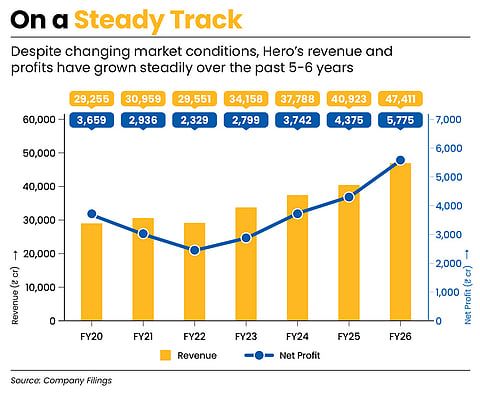
Profits and revenue have been steady
Back to Scooters
In the early 1980s, the Indian two-wheeler market belonged entirely to Bajaj scooters. The iconic Chetak was the ultimate middle-class family vehicle. Motorcycles, by contrast, were associated with young urban male riders rather than the everyday family commute.
Then came Hero Honda. In 1985, the CD100 debuted as a family motorcycle with a larger frame and more comfortable seat built to carry two adults. With a fuel economy to match, 40,000 units were sold in the first year itself.
Riding on this momentum, Hero Honda dethroned Bajaj to become India’s largest two-wheeler manufacturer by the turn of the millennium.
However, the very JV that threatened to put the scooter market out of fashion proved to be an entry barrier for Hero MotoCorp.
For two decades, the focus of the JV was on motorcycles and scooters weren’t even in the picture. The JV finally launched its scooter, the Pleasure, in 2006. But by that time, the landscape had shifted.
Honda’s wholly owned subsidiary, HMSI, had already unleashed the Activa—a powerhouse that would come to define the Indian scooter market. Later, TVS built the Jupiter into a formidable rival.
Hero was left on the periphery, capturing just 7–10% of the scooter market over the subsequent decade.
Now, Hero MotoCorp is staging a fierce counter-offensive to build a standalone scooter empire.
“We want to be the market leader,” says Chitale. “So, we need to have a high share in scooters as well.”
The scale is massive. Scooters make up roughly 30% of India’s over 20mn unit annual two-wheeler market, translating to 6–7mn units every year. Furthermore, the segment is aggressively outgrowing motorcycles, with scooter sales surging 30.8% year on year in the quarter ended June 2026.
While that ICE-EV ratio will inevitably change, the sheer volume of buyers looking for affordable ICE scooters remains immense
“The boy of the family, the girl of the family, husband, wife, they all want to be able to ride one vehicle. A scooter lends itself well to that. Plus, it’s gearless, which makes it easier,” explains Chitale.
The appeal of the scooter, then, is its versatility: one vehicle can be shared across a family, even as different families may want different things from their scooter. Hero’s answer has been to build out the portfolio accordingly. Varma, who heads the segment, says “We have covered the key portfolio white spaces with the widest portfolio.”
The Pleasure, he says, stands out as a lightweight scooter, the Destini focuses on comfort with its suspension, floorboard and seat length, and the Xoom brings a strong proposition around performance and speed.
Hero scooters range from ₹69,000 to ₹1.44 lakh (ex-showroom in Delhi).
To support this targeted approach, Hero is doubling down on production. Factory lines currently running at 65,000 units a month are on track to more than double.
However, Ravi Bhatia, president of automotive-business intelligence platform JATO Dynamics, notes that the response needs to be broader than just adding models. “Hero’s network is a major advantage, but success in scooters requires the products and brand to generate their own category-specific consumer pull.”
Because the two-wheeler maker has already expanded into premium 125cc options with the Xoom and Destini, Bhatia observes this is not a standing-start story.
The ultimate test will be creating an independent scooter brand outside of its legacy motorcycle reputation.
On the retail front, affordability is already paying dividends. Farid Ansari, manager at Vishwakarma Motors in Vasant Kunj, notes that long-time customers are easily swayed by Hero’s low cost of ownership. A typical first-service bill for a Hero scooter runs between ₹300 and ₹400 (including an oil change), which is roughly 50-65% lower than what major competitors charge for the same maintenance.
This retail push is visible in numbers. While Hero’s ICE scooter market share held flat at about 7% through 2025–26, sales volumes skyrocketed 87% year-on-year in the first quarter of 2026–27.
But why expand the fossil-fuel scooter capacity in the exact decade the industry expects scooters to electrify first?
Chitale’s playbook relies on scenario planning rather than picking a single winner. “Both will continue to grow,” he asserts, noting that certain usage profiles like adventure and off-roading remain unviable for electrification.
Market analysts agree there is still a long runway for ICE vehicles. “The cost of acquisition is lower compared to EVs, and some customers are looking at the shorter term—the down payment, not the running cost,” says Ashwin Patil, head of fundamental research at financial-services provider LKP Securities.
With EV penetration currently hovering around 11%, the remaining 89% of the market belongs firmly to ICE. While that ratio will inevitably shrink, the sheer volume of buyers looking for reliable, affordable ICE scooters remains immense.
Hero has no intention of leaving that opportunity untapped. “Our approach is to work on all the powertrains that could emerge,” says Chitale.

The commuter segment is losing ground
The Premium Play
“Fill it, shut it, forget it.” For decades, these words defined Hero as a brand. This marketing campaign from 1985 was a declaration of affordability, mileage and utilitarian reliability.
For generations of Indians, the Hero badge meant the Splendor or Passion. Even today, when modern Indian riders look at a Hero motorcycle, they see value for money.
For a company attempting to capture the lucrative premium market, this deeply ingrained consumer perception has become a significant psychological barrier.
“Sometimes your huge success in one segment overshadows the brand in the other,” admits Chitale. “How do we make sure our premium brands get seen for things like technology, coolness and riding comfort? It’s a work in progress.”
The urgency to pivot became clear with the surge in premium demand. According to research outfit Crisil Intelligence, premium motorcycles accounted for just 14% of the Indian market in 2018–19. By 2026, data from JATO Dynamics reveals that demand is expected to expand to a massive 29% of all motorcycle sales.
At Hero, premium bikes (over 150cc) still accounted for a low single-digit share of the company’s sales volume. So, the country’s largest two-wheeler manufacturer was practically invisible.
Opportunity knocked in September 2020 when Harley-Davidson abruptly announced it was shutting its solo operations in India, leaving many devastated.
The lack of premium appeal and intense rivalry from Royal Enfield and Triumph offerings led to the Mavrick 440 discontinuation in India
Hero moved swiftly. Within 30 days, it absorbed Harley’s domestic sales and service network, and signed a crucial pact to co-develop mid-capacity motorcycles. The first offspring of this marriage, the Harley-Davidson X440, debuted in July 2023 at ₹2.29 lakh, and instantly captured over 25,000 bookings in the first month itself. This strategic move was about capability sourcing. Hero used the partnership to decode how global giants command a 15-20% price premium on brand pull and community ethos.
But the learning curve proved steep. When Hero launched the Mavrick 440, which was built on the exact same engine and similar architecture as the X440, it failed to connect with buyers. Its lack of premium appeal and intense rivalry from Royal Enfield and Triumph offerings led to its discontinuation in India, say industry experts.
Undeterred, Chitale confirms more co-developed Harley motorcycles are slated for release this financial year, and hints that another Hero-badged iteration isn’t off the table.
What’s noteworthy is that in Hero’s export markets, 40% of what it sells is already premium, unburdened by the cost-conscious reputation it struggles to shake at home.
To bridge this perception gap at home, Hero is leading a complete ecosystem reset. On a budget bike, a microscopic paint blemish or uneven weld passes unnoticed; on a premium machine priced to fight Royal Enfield, Triumph, or TVS, it destroys a customer’s trust before they even turn the key.
Consequently, Hero cleared out its Neemrana facility, entirely relocating its mass-market commuter lines to isolate the factory for premium production alone. The facility now features advanced paint systems for high-gloss finishes and AI-driven vision tech designed to catch structural panel gaps that escape human eyes.
Hero’s strategy recognises that engineering alone cannot sustain a premium brand; it requires a culture.
While Harley relies on Harley Owners Group (H.O.G.), its official riding club and community, and Royal Enfield leans on its global Riders Club, Hero is aggressively nurturing the XClan—organising sunrise breakfast runs, weekend expeditions and specialised off-road clinics to convert owners into a lifestyle community.
Early indicators suggest the strategy is beginning to chip away at the old stereotypes. The XPulse, engineered with insights from Hero’s global team leading Dakar Rally, one of the most popular off-road motorsport events in the world, and its German R&D centre, now commands nearly 40% of the niche adventure motorcycle category.
Pop culture is also adding to Hero’s premium play. After the X440 appeared in the Hindi film Saiyaara, showroom dealers reported that customers were specifically asking for the “Saiyaara bike” rather than asking about fuel economy.
“Hero has never had a forte in the premium segment,” observes Patil of LKP Securities. He notes that going toe-to-toe with deeply entrenched rivals will remain an uphill climb.
Today, the monumental challenge for the company is convincing a new generation of lifestyle riders to feel a sense of pride when they look down at a badge that reads Hero.
Premium boss Dua is confident that the ride ahead is going to be smooth. “With a strong product pipeline, continued investments in technology and design, and a sharper focus on premium customer engagement, we are well positioned.”
The New Avatar
For any large company, the risk associated with making future-defining gambits is unquestionably big. The fear of financial burden may keep many out of the race to enter new categories. But Hero has no such concern. Financially, it is fighting from a position of strength. It closed 2025–26 with an operating cash flow of around ₹8,300cr. It is also debt-free.
This strength gives Hero the room to make new bets by anticipating the areas it must chase or gaps it must plug. It’s ingrained in the company’s DNA. It has done so in the past when it built its R&D capability from scratch, immediately after the split from Honda in 2011.
However, the two-wheeler market leader’s true moat is the loyalty of its distribution network. That loyalty shone through when most dealers chose to stay with Hero when they had every reason to hedge their bets and join Honda’s India operation in 2010.
“The trust these brands have built over decades doesn’t go anywhere. And the reach they have—their dealer network and servicing—no new player can replicate that,” says Puneet Gupta, director at automotive-data provider Mobility Global.
Still, the challenge for Hero is two-fold: protect its absolute dominance in the mass-market commuter motorcycle segment, while simultaneously forcing its way into premium and electric categories. Chitale sees this as an opportunity: “I see four growth areas, each with a lot of high growth ahead for many quarters to come.”
The fact remains that Hero has leveraged its legacy name and financial might to tackle challenges in the past and did so with panache. However, those at the company’s helm don’t want to rest on the laurels of the past. As far back as 2014, Hero patriarch Pawan Munjal made this much clear.
“The past is like using a rear-view mirror while driving. It is good to glance back and see how far you have travelled. But if we stare too long, we will miss what is right in front of us,” he had said.