In August 1998, a dropsy epidemic struck North India. About 30 people lost their lives, and over 3,000 fell ill within the first couple of weeks of the outbreak. The government responded by banning the sale of mustard oil in Uttar Pradesh (UP), Delhi, Haryana and other neighbouring states, as the epidemic was caused by toxic adulteration in it.
From Mustard Oil To Cattle Genomics: How BL Agro Is Moving Beyond Kitchen Staples
BL Agro, which began with mustard oil before expanding into kitchen staples, is now entering cattle-genomics research as it diversifies into agri technology

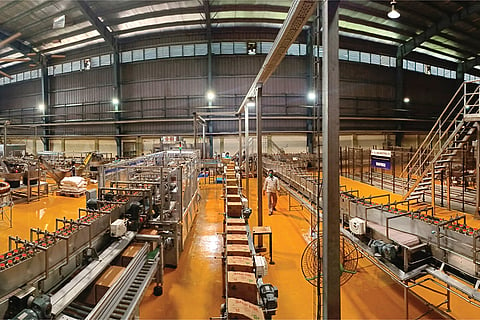
BL Agro's main plant in Bareilly
Advertisement
About 250km from Delhi, the government order struck Ghanshyam Khandelwal in Bareilly like a thunderbolt. The BL Agro Industries chairman was just beginning to expand his only business: selling mustard oil. A ban meant downing the shutters.
Little did Khandelwal know that it would be the pivotal moment that would make his flagship brand, Bail Kolhu, the biggest oil brand in UP. A month later, the government issued a follow-up order and lifted the ban; however, it mandated the sale of only packaged edible oil.
The new order was the proverbial tailwind that the company needed. Four years earlier, before the dropsy epidemic, BL Agro had started selling mustard oil in sealed plastic bottles, ranging from 200ml to 5l, the first mustard-oil brand in Uttar Pradesh to do so, according to the company.
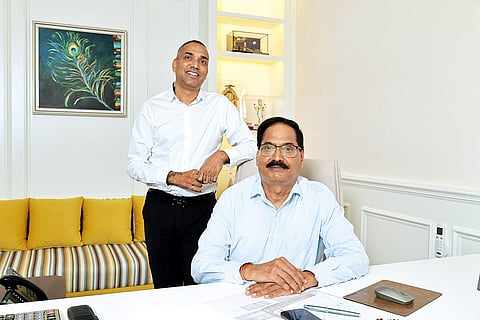
Ashish Khandelwal (left), MD with Ghanshyam Khandelwal, chairman, BL Agro
Press Rewind
BL Agro began as a modest oil-trading business in 1940. Lal Taap and Kishan Lal, Khandelwal’s father and uncle, respectively, would go to oil manufacturers in Rajasthan to buy mustard oil in bulk, which they would then sell in Bareilly and neighbouring districts. By the time the 19-year-old Khandelwal joined the family business in 1975, it had grown into a company with an annual turnover of ₹1 crore.
Advertisement
Khandelwal inherited a stable and operationally efficient family business. Things were looking good, the company was profitable. But the young businessman was not satisfied with it.
He recalls that the prevalent adulteration and black marketing had given oil traders a bad reputation. “At that time, there was no such thing as lab testing. Oil’s smell, frothiness and live pakoda-frying demonstration were the prevailing methods to test purity,” he says.
Discontented with the prevailing norms, the young science graduate established a small laboratory to test the company’s incoming and outgoing oil. He realised that making a good product was not enough to gain customer trust; distinguishing his oil from others was necessary. In 1984, he started selling his mustard oil under the brand name Bail Kolhu (a play on the Hindi phrase kolhu ka bail, meaning hardworking).
“The reaction was overwhelmingly negative. People smirked and said, 'At the end of the day, oil is just oil, what’s the use of giving it a name?’ Branding was a new thing at that time,” he recalls.
Advertisement
For the next 20 years, Khandelwal would go on to create a strong distributor and retailer network and scale the Bail Kolhu brand. “There is not a single city or town in UP where I haven’t pitched the product,” he says. During the same period, BL Agro’s marketing evolved from banners at local fairs and jagrans to placing ads in local Hindi newspapers.
The Prime-Time Show
In 1998, Khandelwal’s son Ashish joined the company, and the young blood brought new aspirations and ideas to the table. He wanted to try something as radical as his father had earlier done.
By the turn of the century, satellite TV was the hottest new medium, and serials were the biggest eyeball grabber. Dinner-table conversations revolved around these soap operas. Ashish wanted to make Bail Kolhu part of those conversations.
Marketing a mustard-oil brand on national TV was a bold and risky move for its time, particularly for a regional player. The novel marketing bet paid off. If the 1998 government order placed Bail Kolhu on kirana store shelves, the TV spots brought it to kitchens.
Advertisement
For the next 15 years, BL Agro continued to grow in UP and the neighbouring region, upgrading a semi-automatic packaging plant to a fully automatic one as production capacity increased from 300 to 1,100 tonne per day.
During these years, BL Agro’s competition had also grown from regional companies to large fast-moving consumer goods (FMCG) companies. Khandelwal says that over the years, the emphasis on quality and a robust distribution network are the secret behind its nearly 70% market share in Uttar Pradesh's mustard-oil market.
Rajesh Verma, head of Mittal Business School at Lovely Professional University, says that large FMCG brands typically compete by leveraging economies of scale, extensive advertising, strong distribution capabilities and attractive trade schemes for retailers; however, regional players often possess a different set of strengths.
“They [regional players] usually have a deeper understanding of local consumer preferences, stronger retailer relationships and the agility to respond quickly to changing market needs,” he says.
Advertisement
Stocking the Shelves
Traditionally, companies expand operations into new territories as they grow; they go from regional to national. However, Khandelwal says they have no desire to expand beyond their traditional region of UP, Delhi-NCR and neighbouring markets.
He says that mustard oil is a high-volume, low-margin business and transportation costs beyond a certain distance eat up margins. Rather, the company has chosen a different growth path: expanding into new categories in the region where it already has a strong distribution network.
In 2025, the company entered cattle-genomics research with an investment of ₹1,000 crore
In 2018, BL Agro entered the staples category with a brand called Nourish. The brand started with 18 products, including pulses, flour, pasta, rice and dried fruits. Today, it has grown into a 50-product business and accounts for 26% of BL Agro’s ₹5,413 crore revenue in 2025–26.
“The demand first came from distributors. They said that your distribution is strong, personal relations are good, the company name has a loyal customer base, so why don't you sell other products also?” says Khandelwal. While the expansion of an edible oil company into staples looks like an obvious extension, BL Agro’s most recent venture is as far from obvious as it could be.
Planting a New Seed
In 2025, the company entered cattle-genomics research under a subsidiary named Leads Genetics with an investment of ₹1,000 crore.
Using its distribution and brand recall BL Agro wants to build an integrated dairy value chain. The company is working on developing large-scale embryos of high milk-yielding cow breeds. It has bought about 1,000 embryos of the Gir breed from Brazil, which are implanted into cows at its 28-acre research facility in Bareilly. The resultant embryos will be sold to governments and farmers.
The new venture began with a humanitarian cause. According to Khandelwal, his mother wanted to set up a cow shelter. During their efforts to set it up, the Khandelwals met with Parshottam Rupala, Union agriculture minister and later of fisheries, animal husbandry and dairying between 2019 and 2024, who introduced them to the concept of cow-embryo transplantation. The minister suggested that if they could invest in this field, there is an unlocked business opportunity.
The 71-year-old mustard-oil baron is once more filled with entrepreneurial zeal, betting on a novelty that not many people understand and see scale in. But he is determined to be ahead of the curve just as before.