As Russian troops crossed into Ukraine and missiles began targeting critical infrastructure like power grid, another battle was unfolding. On February 24, 2022, the very day the invasion began, Kyiv made an extraordinary request to synchronise with Europe’s power network.
Can India Build a South Asian Power Pool Like Europe?
How Europe-style regional electricity grid links in South Asia can ease India’s power pangs. But factors ranging from geography and national politics to technology and geopolitics need to be dealt with

The challenges and geopolitics of cross-border power trade in South Asia
Advertisement
That decision proved lifesaving. As Russian attacks battered Ukraine’s energy infrastructure, destroying or occupying nearly 70% of its thermal-power generation capacity by May 2024, the country’s lights stayed on in large part because electricity could flow across borders. Through interconnectors with Europe, Ukraine imported as much as 2.4GW of power, equivalent to about one-fifth of its peak demand.
Three years later, on April 28, 2025, a massive blackout swept across Spain and Portugal, leaving 60mn people without electricity. But the recovery began almost immediately. Within 10 minutes, electricity started flowing into Spain through power links with France, followed by support from Morocco.
For many countries around the world, Europe’s interconnected power network has served as a model for regional energy cooperation.
India, too, has long aspired to deepen electricity links with its neighbours. In times of crisis, the resilience of a power system may depend not only on domestic generation capacity but also on the strength of regional connections.
Advertisement
Alok Kumar, former secretary to the ministry of power, government of India, has been a strong proponent of forging regional power networks. “Europe’s experience demonstrates that integrating electricity markets across countries and leveraging differing demand patterns lowers system costs and enhances reliability,” he points out.
As South Asia grapples with rising electricity demand, geopolitical tensions and ambitious renewable energy goals, the question is whether India can help build a synchronised regional power pool that strengthens energy security across the region?
The benefits of international power networks extend beyond the need to ensure resilience against one-off events. Countries are looking to forge power links with each other for a variety of other reasons, including rising demand for power and the rapid expansion of renewable power generation. Regional connections help countries with high power generation potential, such as Nepal and Bhutan, tap rising demand in countries such as India.
Similarly, the rise of renewable power sources, such as wind and solar—whose generation potential is skewed towards certain times of the day or seasons of the year—makes it important for a country to have complementary sources of power to offset such natural fluctuations. Regional electricity integration can provide this flexibility by allowing India to draw on hydropower resources from neighbouring countries when renewable output is low.
Advertisement
India has already taken the initial steps. A major breakthrough came when India opened its power exchanges to neighbouring countries.
India has already taken the initial steps. A major breakthrough came when India opened its power exchanges to neighbouring countries. Nepal became the first country allowed to participate in the day-ahead market of the Indian Energy Exchange (IEX), India’s electricity-exchange-trading platform, in 2021, enabling it to sell surplus hydropower directly into India’s competitive electricity market.
Bhutan followed later, allowing its generators to access Indian power exchanges as well. In 2024, India also signed a tripartite agreement with Nepal and Bangladesh to facilitate cross-border electricity trade.
“These countries have distinct electricity demand patterns that create opportunities for cross-border energy trade,” says Kumar.
Early results have been encouraging. In recent years, India’s cross-border electricity trade has grown significantly, particularly in the Bangladesh–Bhutan–India–Nepal (BBIN) region, where it has risen from 7.8TWh in 2013 to 21TWh in 2024, though it still falls well short of its full potential.
Advertisement
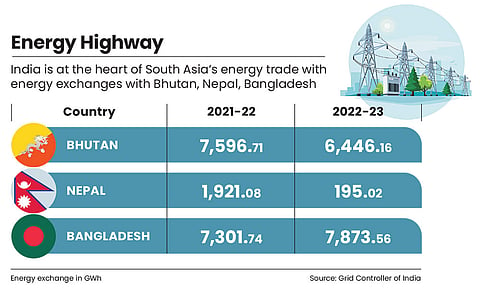
India's energy trade with South Asian peers
How it Began
The impetus for these interconnection agreements can be traced back to India’s economic reforms of the 1990s. The reforms generated sustained economic growth, which in turn strengthened its financial and institutional capacity to pursue deeper economic partnerships with its neighbours, especially when it comes to the energy sector.
Between 2005 and 2023, India extended loans, investments and lines of credit worth a total of $7.15bn to Bangladesh, Bhutan and Nepal to support energy cooperation, funding a range of regional connectivity projects such as cross-border transmission lines, hydropower plants, oil and gas pipelines and grid interconnections.
The country also led the formation of several structures, such as the South Asian Association for Regional Cooperation (Saarc) Framework Agreement on Energy Cooperation (2014), the Bay of Bengal Initiative for Multi-Sectoral Technical and Eco-nomic Cooperation (Bimstec) grid interconnection pact (2018) and the Guidelines for Cross-Border Import and Export of Electricity of 2018.
Advertisement
The original vision for regional cooperation in South Asia was centred around Saarc. However, in the wake of military conflicts with Pakistan, it hasn’t progressed effectively.
Recognising these limitations, India shifted its focus towards sub-regional cooperation through platforms like Bimstec. This aligns closely with its “Neighbourhood First” and “Act East” policies, bringing together countries from South Asia and Southeast Asia, including Myanmar and Thailand.
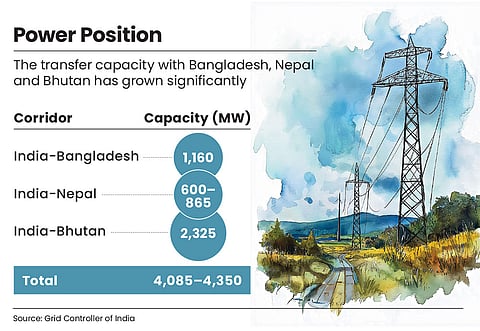
The growing power transfer capacity
Lessons from Europe
Yet, the integration achieved by South Asia is nowhere close to what has been accomplished in places like Europe, and it may be instructive to study what Europe did right, and how the learnings can be incorporated into the South Asian situation.
The success in Europe was not achieved overnight: it evolved gradually through decades of political cooperation, investment in cross-border infrastructure, regulatory coordination and a shared recognition that energy security is strengthened when countries are connected rather than isolated.
Countries first interconnected their national power systems after World War II, adopting common technical standards and synchronising their grids to operate at the same frequency of 50Hz.
This allowed electricity to flow seamlessly across borders and improved system reliability.
The unfavourable situation in South Asia can be attributed to geography, technology and geopolitics
The process was supported by major investments in cross-border transmission infrastructure.
Today, most of continental Europe functions as a single synchronous electricity system, allowing countries to share resources, improve energy security, and balance supply and demand more efficiently.
The experience demonstrates that successful regional power integration requires a combination of physical interconnections, common technical standards, supportive regulations and sustained political cooperation.
The support provided through European interconnectors during Ukraine’s energy crisis, as well as the rapid restoration of power following the Iberian blackout, underscore the resilience that regional integration can provide.
The Roadblocks
At the same time, the unfavourable situation in South Asia can be attributed to a host of reasons, ranging from geography and national politics to technology and geopolitics.
To begin with, South Asia suffers from a poorly developed transmission network, both across borders and within. Weak domestic transmission networks create bottlenecks that make it difficult to transport electricity efficiently to border interconnection points.
For example, the total interconnection between Nepal and India currently stands at around 700MW (0.7GW). In comparison, France and Spain are linked by interconnections of around 6.3GW.
The infrastructure roadblock owes partly to the region’s challenging geography, which makes transmission lines difficult to construct. Many of these projects are in the fragile Himalayan region, which complicates construction and increase costs. Extensive environmental assessments and regulatory approvals further lengthen project timelines. “This has resulted in keeping cross-border energy projects in the discussion stage for years,” says Kumar.
One example of this is Bhutan’s Punatsangchhu-I hydropower project, which has been repeatedly delayed because of severe geological instability and slope stabilisation issues. “The pace of expansion has been slower than it should be, as the government-to-government model has limitations in terms of scalability,” Kumar notes.
Other factors include concerns over grid stability, differences in technical standards, the lack of coordinated regional planning, complex financial negotiations, bureaucratic procedures and shifting political priorities.
Domestic politics adds another layer of complexity. For example, when turmoil in Bangladesh led to the ouster of Sheikh Hasina in 2024, one of the projects that quickly found itself at the centre of public debate was the Adani-Bangladesh power deal, which was signed in 2017.
The change in political leadership brought renewed scrutiny of the agreement’s costs and terms. Although the project ultimately survived the upheaval, the episode highlights how domestic political shifts can have major influence.
Similarly, geopolitics has also played its part. Over the past decade, China has emerged as a major investor in South Asia’s energy sector. It has funded and built a wide range of energy projects across the region. “China affects India’s regional power vision by giving neighbours alternative sources of finance, infrastructure and political leverage,” says foreign-affairs expert Robinder Sachdev.
Despite this, experts believe that India will continue to be the preeminent player in the South Asian energy market. “Even if Chinese companies invest in generating electricity, the most economically viable market for that power remains India,” says Anil Kumar Trigunayat, a former Indian diplomat.
“Without access to Indian markets and transmission networks, it becomes difficult to fully realise the commercial potential of many such projects,” he adds.
The final factor is funding, particularly given the long-term nature of such projects. Given that the assets have useful lives stretching to 50 or 60 years, the returns can also be slower.
“Such projects require patient, long-term capital, which institutions like the World Bank and ADB [Asian Development Bank] are well-positioned to provide,” says Kumar.
The Way Forward
All this is not to say that South Asia cannot have a functional and well-integrated regional grid. However, making this dream a reality will require sustained political commitment.
While the economic and technical rationale for greater electricity trade is increasingly clear, progress often slows when governments shift their attention to more immediate domestic and geopolitical priorities.
Long-term policy support and consistent political engagement are therefore critical to overcoming bottlenecks and advancing regional connectivity projects.
As the region’s leading power, experts say, India may have to approach the effort in the spirit of building confidence and goodwill, rather than looking at it from a commercial viewpoint. “Balancing commercial interests with flexibility and goodwill can help build trust among neighbouring countries and create a stronger foundation for long-term cooperation,” says Trigunayat.
Sachdev highlights the need to institutionalise such projects and investments, instead of looking at them as one-off diplomatic achievements.
“Grid-to-grid arrangements, transparent pricing, competitive procurement, multiple suppliers, multiple buyers, payment security and treaty-level anchoring are more durable than a single-plant, single-buyer model,” he says.
Establishing robust regional institutions and market mechanisms can help shield energy cooperation from political changes and commercial disputes.
Today, South Asia remains far from achieving a European-style power pool, but the foundations are already taking shape through growing electricity trade between India, Bangladesh, Bhutan and Nepal.
The region possesses complementary energy resources, diverse demand patterns and expanding renewable energy ambitions that make deeper integration both economically attractive and strategically valuable.
Ultimately, the future of regional power integration in South Asia depends less on technology or financing than on political vision, trust and a shared commitment to long-term cooperation.