When diplomats from the expanded BRICS grouping met in New Delhi in May, there were expectations, however low, that they would come up with a joint declaration despite internal contradictions.
Can BRICS Survive Geopolitical Rifts, Rivalries Among Member Countries?
Geopolitical turbulences like the Iran war and internal rifts between the member nations are charting out an uncertain future for BRICS as a multilateral forum

External affairs minister S Jaishankar (right) with his Iranian counterpart Abbas Araghchi
Advertisement
Instead, the BRICS Foreign Ministers Meeting ended without a joint declaration, with India only issuing a chair’s statement, reflecting the dominance of internal rift.
The immediate trigger was the disagreement over the ongoing West Asia conflict. Iran pressed for the condemnation of the US, Israel and the United Arab Emirates (UAE). There was a heated exchange between the leaders of Tehran and Abu Dhabi.
Iranian foreign minister Abbas Araghchi called on the bloc members and other countries to “take practical steps to stop warmongering”. “It is necessary for all of us to intensify our efforts to end this sense of superiority and impunity on the part of the US—a notion that has no place in today’s world,” he said.
Experts say the failure to conclude the meeting without a joint statement signals more challenges in the future. “With rising geopolitical tensions across regions, the BRICS’s agenda is increasingly being shaped and at times overshadowed by global conflicts and strategic rivalries,” says Harsh V Pant, vice-president at Observer Research Foundation, a think tank.
Advertisement
“As these turbulences deepen, it is likely to face greater challenges in maintaining consensus and cohesion in the future,” he adds.
Over the past two decades, BRICS member nations have significantly increased their share in global GDP, trade, energy production and diplomatic influence.
The expanded BRICS grouping represents around 49.5% of the world’s population, about 40% of global GDP and nearly 26% of global trade, cementing its strong status as a major geopolitical and economic force.
When BRICS officially came into existence in mid-2000s with the first summit in Russia in 2009, the core agenda was economic cooperation and global governance reforms. Now, its agenda is being marred by geopolitical factors and internal rifts.
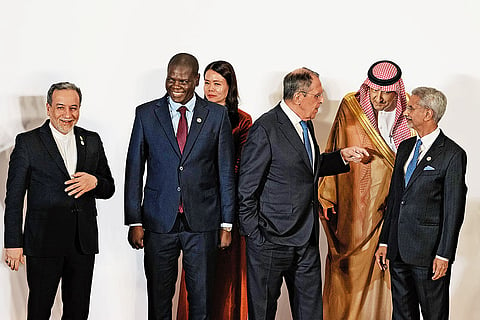
Jaishankar with foreign ministers from BRICS member countries at the New Delhi summit last month that ended without a joint declaration
Rifts and Rivalries
One of the most significant contradictions is the uneasy existence of India and China along with Iran, Saudi Arabia and the UAE.
While both India and China publicly advocate multi-polarity but their bilateral ties have deteriorated over the past decade in the backdrop of rising tensions at the Line of Actual Control. China’s economic dominance in the grouping has also complicated internal trade balance.
Advertisement
The expanded BRICS grouping represents about 40% of global GDP and nearly 26% of global trade, making it a major economic force
“China is the largest exporter and importer within intra-BRICS trade. But its dependence is the lowest among the 10 members,” as per the UN Trade and Development.
“China’s dominance is a structural reality. It remains the largest economy in BRICS, with the highest levels of exports, imports and financial capacity,” says Swaran Singh of the School of International Studies, Jwaharlal Nehru University.
“Naturally, this gives Beijing a disproportionately strong influence, and that imbalance is unlikely to change in the near future given the scale of China’s economy,” adds Singh.
Similarly, Russian invasion of Ukraine has also transformed BRICS’s internal dynamics with Moscow increasingly seeing this grouping as a counter to Western sanctions.
Brazil, Russia and Indonesia are the most reliant on BRICS markets. Their intra-grouping exports accounted for over 30% of their total exports in 2024. Iran, Ethiopia, Russia and India source over 40% of their total imports from BRICS members.
Advertisement
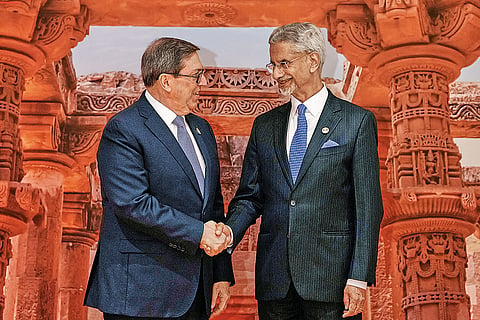
Jaishankar with Cuban counterpart Bruno Rodriguez Parrilla
Utility of BRICS
Still, BRICS has achieved far more than many early sceptics expected. Over the years, it has expanded its intra-member trade, economic cooperation and created institutions such as New Development Bank. Intra-BRICS trade has expanded over 13 fold since 2003. Trade between the member countries reached $1.17trn in 2024.
“Unlike institutions like the IMF [International Monetary Fund], where major reforms are difficult without Washington’s approval, BRICS has demonstrated greater flexibility in introducing alternative financial mechanisms and reforms,” says Singh. “In many ways, BRICS represents an evolving alternative template in global economic governance,” he adds.
Notably, BRICS members have also sought to reduce the dollar’s primacy in global trade with the likes of China, India and Russia settling their payments in local currencies. But its future appears uncertain as it lacks a unified vision.
“Internal divisions are bound to grow. With more members come more fault lines and competing interests,” says Pant.
Advertisement
For now, BRICS continues to matter as it reflects a broader transition in the global order, with a focus on the Global South. But the meeting in New Delhi has shown that geopolitical turbulences along with internal divisions would create problems for the grouping’s unity, which could hurt BRICS’s influence.