Industrial thermal energy is a major blind spot in India’s decarbonisation push.
Khushboo Bhatia highlights 80% of industrial energy demand is thermal, not electricity.
Biomass and alternative fuels offer viable solutions, but aggregation remains a key challenge.
Outlook Planet C3: India’s Energy Transition's Blind Spot Lies in Industrial Thermal Demand, Says TOESL CEO
Bhatia pointed out that old conversation around energy among industry leaders was purely about securing the lowest possible cost but things have changed now

Outlook Planet C3: India’s Energy Transition's Blind Spot Lies in Industrial Thermal Demand, Says TOESL CEO
Summary
Advertisement
India's decarbonisation story has a blind spot. While the policy debate mostly focuses on electricity and renewables, the thermal energy that runs the country's factories has barely registered. That, according to Khushboo Bhatia, CEO of TOESL — the energy services arm of the Thermax group, is where the real transition challenge lies.
"If you look at India's energy demand, roughly 50% comes from industrial consumption. And within that, nearly 80% is thermal energy, while only about 20% is electricity," Bhatia shared in-conversation with Sudipto Dey, Outlook Planet Editor at the Outlook Planet C3 – Climate Circularity Community - Summit & Awards today.
The implication is significant. A country that imports nearly 85% of its crude oil, and is increasingly exposed to price swings driven by geopolitical disruption, cannot complete an industrial energy transition by electrifying a fifth of the problem.
Bhatia pointed out that old conversation around energy among industry leaders was purely about securing the lowest possible cost. But things have changed. "Sustainability is no longer just about compliance. It has become a question of competitiveness," she said, pointing to export pressures, carbon border adjustment mechanisms, and evolving policy frameworks as the forces reshaping boardroom priorities.
Advertisement
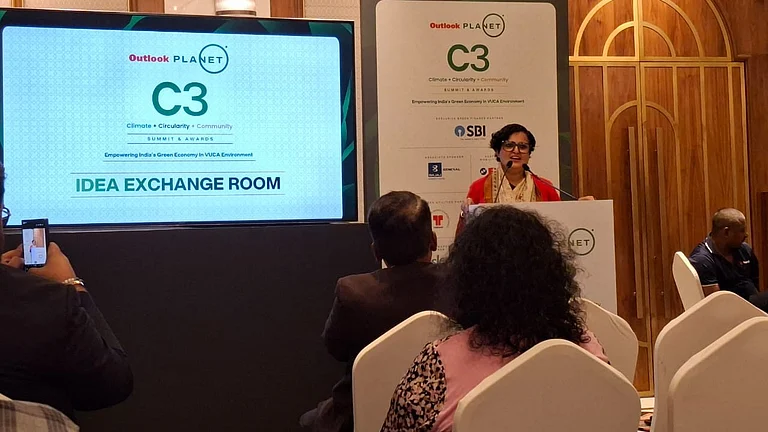
TOESL began anticipating this shift as early as 2009, building what Bhatia described as an end-to-end model spanning technology selection, fuel supply risk management, and lifecycle operations and delivered under a Build, Own, Operate structure that transfers both capital and operational risk to the service provider.
She further stressed on moving from volatility to predictability as it reduces dependence on external factors and stabilises manufacturing operations.
On asked about biomass, which India generates around 125 million tonnes of surplus annually, yet only a small fraction is currently put to productive use, Bhatia said that the bottleneck is not availability but aggregation. "TOESL itself handles roughly 3,000 tonnes daily, a capability she said has taken years to build," she added.
For industries substituting imported fuels such as furnace oil or natural gas, the economics are compelling. In many cases payback periods can fall within a year.
Advertisement
On sectors like steel, Bhatia acknowledged a real cost — but argued the direction of travel is clear. With global carbon markets maturing and companies such as Microsoft and Google already exploring Indian carbon credits for their international operations, the ecosystem is forming.
Bhatia urged the industry to treat transition as a strategic choice now, before it arrives as a regulatory obligation.