India’s traffic crisis stems less from ignorance and more from a dangerous illusion of invincibility
Objective crash risks are high, yet drivers scroll phones, speed and overtake recklessly, assuming low odds of being caught or harmed
Only consistent digital enforcement, stricter compliance, and pedestrian-friendly, well-marked roads can realign behaviour with genuine risk aversion
How Risk Perceptions Influence Traffic Accidents on India’s Roads
Penalties were sharply increased under the Motor Vehicles (Amendment) Act but enforcement is in the hands of state-level institutions and the stringent provisions under the MVA have been consciously diluted, leaving the citizens responsible for their destiny

How Risk Perceptions Influence Traffic Accidents on India’s Roads
Summary
Advertisement
Standard economic theory models individuals as risk averse when outcomes involve significant uncertainty. This is why people buy insurance, diversify investments, and often choose stable jobs over uncertain income – they are willing to pay a “risk premium” to avoid risk.
The greater the potential loss, the stronger the instinct should be to avoid the risk. Yet something unsettling is happening on India’s roads - everyday driving behaviour suggests not risk aversion but risk indifference. Motorists scroll through reels while navigating traffic. Drivers slip into the wrong lane to save a few seconds, fully aware of oncoming traffic. The gain is trivial: a notification checked, a minute saved, a queue avoided. The potential loss is catastrophic. And often, it is their own life at stake.
In 2024, data from the National Crime Records Bureau (NCRB) show that India recorded 4,67,967 road accidents claiming 1,75,142 lives and leaving over 4.4 lakh people injured. The rate of deaths per thousand vehicles rose to 0.54 in 2024 – a significant loss socially.
Advertisement
Nearly half of all road fatalities in 2024 – 84,599 deaths – involved two-wheelers. Pedestrians accounted for another 15%, while cars and SUVs contributed 14%, while over-speeding alone accounted for 61% of all road accidents in India. Dangerous or careless driving and reckless overtaking contributed another 26% of accidents. Sadly, most crashes are not acts of nature but acts of human impatience.
If risk aversion is central to economic theory, what explains the recklessness we see on our roads?
Risk Aversion Vs Risk Perception
One answer lies in how people perceive risk. Economics distinguishes between objective probability and subjective probability. Objectively, the risk of a road accident is measurable and significant. Yet subjectively, most drivers assign that probability close to zero – at least for themselves.
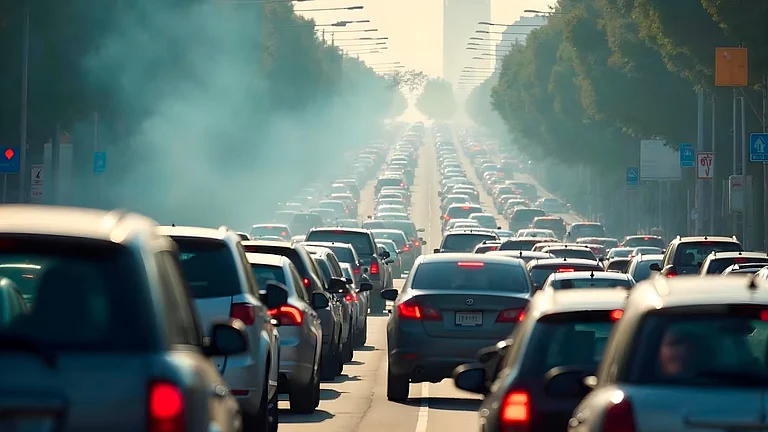
The accident is always someone else’s tragedy. Studies on driver behaviour have long shown that motorists typically believe they are safer and more skilled than the average driver, and therefore less likely to be involved in a crash.
Advertisement
Indian road-safety research echoes this behavioural dimension: the India Status Report on Road Safety 2023 by IIT Delhi notes that enforcement effectiveness depends heavily on the perceived likelihood of being caught, and that education campaigns alone rarely change behaviour without visible enforcement. When drivers systematically underestimate their own vulnerability, the result is a dangerous illusion: ‘It won’t happen to me’.
As Gary Becker’s economic theory shows, behaviour responds not to statutory penalties alone but to the expected penalty – the product of the fine and the probability of detection. Where enforcement is weak, even high fines generate limited compliance because the perceived cost of violation remains low.
Penalties were sharply increased under the Motor Vehicles (Amendment) Act, 2019 – for example, fines for drunken driving rose sharply (up to ₹10,000) and for driving without a licence from ₹500 to ₹5,000 – with an objective to enhance deterrence. Yet enforcement is in the hands of state-level institutions and the stringent provisions under the MVA have been consciously diluted, leaving the citizens responsible for their destiny.
Advertisement
In 2024, India issued ₹12,000 crore worth of traffic fines, but ₹9,000 crore – about 75% – remained unpaid, showing that penalties alone did not ensure compliance. Survey evidence from The Great Indian Challan Crisis (2025) report by CARS24 shows that 31% drivers adjust behaviour only after checking for police presence. When drivers see traffic police, 51% check their speed and ensure compliance, and 35% slow down instinctively.

The Road Ahead
India has already created a nationwide digital enforcement backbone through platforms such as VAHAN, SARATHI, iRAD and the e-Challan system, enabling electronic detection and violation tracking. Corridor-based enforcement should be introduced on national highways through speed cameras, ANPR systems and Intelligent Traffic Management Systems.
India can scale average-speed enforcement on highways using FASTag and ANPR systems and deploy iRAD-based heat maps to guide district-level enforcement. Further, a dedicated Road Safety Enforcement Fund should channel penalty revenues, like a ring-fenced system, into trauma care, blackspot removal and enforcement expansion to improve safety and public trust.
Advertisement
Reducing digital distraction will hinge not on new technologies but on enforcing existing AI-based detection of mobile phone use and making “Do Not Disturb While Driving” features functionally unavoidable.
Finally, over 25,000 pedestrians dying in a year can no longer be discussed only as a matter of driver behaviour – when roads are poorly designed or inconsistently marked, even well-intentioned behaviour breaks down. Work on pothole-free roads, scientifically designed roads, dedicated and unobstructed right of way, proper road and lane markings, and signages. The onus of lowering fatalities and injuries is not only on the motorists, but also on the authorities. Unlike in financial markets, there is no way to diversify the loss of a life.
(Sharif Qamar is Fellow and Associate Director, and Shreya Gupta is Research Associate at The Energy and Resources Institute (TERI). Views expressed are personal.)