Advertisement
X

Beyond Mumbai and Delhi: Why Lucknow, Jaipur and Kochi Now Lead Ticket Sales

Ticket sales in cities like Lucknow and Chandigarh surged 225% in 2023, and industry leaders say the non-metro audience is no longer aspirational about metros. It is setting its own terms

Beyond Mumbai and Delhi: Why Lucknow, Jaipur and Kochi Now Lead Ticket Sales

When India’s Economic Survey 2025-26 confirmed that the country’s live entertainment sector had officially crossed the ₹10,000 crore mark, the announcement was received as validation of what the industry had long sensed on the ground. 

Advertisement

According to a FICCI-EY report, India’s concert economy is projected to create nearly 12 million temporary jobs by 2030-32, with an estimated 10-15% of those roles already converting into full-time positions in areas like audio engineering, production management and digital strategy. A Ministry of Information & Broadcasting whitepaper on India’s Live Events Economy released last year pegged the number of ticketed events in India in 2024 at more than 30,000, across 319 cities and up 15% over the previous year. 

But the more compelling detail wasn’t the growth, it was where it was coming from. Not Mumbai. Not Delhi. Not Bengaluru. It was coming from Lucknow, Kochi, Jaipur, Guwahati, and dozens of other cities that the industry once treated as afterthoughts.

India is on course to become a $5 trillion economy, and while steel, software and services will drive much of that journey, a quieter revolution is underway in a sector that runs on creativity, culture and human connection. The Orange Economy — a term now officially recognised in the Union Budget 2026 — encompasses industries built on creativity, intellectual property and cultural heritage: film, music, fashion, gaming, live events and digital content.

Advertisement

For the first time, culture is being counted as an economic force, not a decorative one. And the people building this economy are finding their most surprising markets far from the metros.

Tier-2 and Tier-3 Inflection Point

Walk into a live event in Indore, Kochi, or Jaipur today and something immediately feels different from the equivalent experience in Mumbai. The crowd is more invested. The energy is less jaded. The connection between audience and performer is almost electric.

Raj Mishra, MD and CEO of influencer marketing and live experience platform Chtrbox, kept it plain and simple: "In Lucknow or Kochi, the event is a civic moment. People are not just buying a ticket. They are making a statement about their city, their taste, their identity. There is a sense of pride and ownership in the audience that you rarely get in Mumbai or Delhi, where entertainment is almost background noise because there is so much of it."

Advertisement

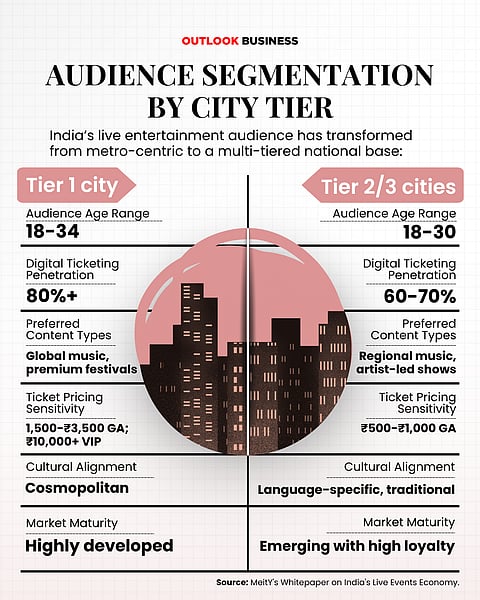
The MIB whitepaper puts hard numbers to this observation. Cities such as Chandigarh, Lucknow, and Gandhinagar, rarely associated with large concerts until recently, saw ticket sales surge 225% in 2023. The whitepaper specifically names Chandigarh, Lucknow, Gandhinagar, Vadodara, Shillong, Jamshedpur, and Bidadi as markets that experienced that lift.

Cities like Jaipur, Lucknow, and Kochi are matching metros in per capita spending on niche cultural experiences.

Sheetal Birla, General Manager, India, at live experience company Live Your City, said this aligns with what she is seeing on the ground. "In several Tier-2 cities, while absolute volumes may still trail metros, per capita spending and conversion rates are often comparable or even higher. Audiences in these cities tend to be more intentional in their choices, leading to stronger engagement and repeat attendance."

Over 70% of young urban Indians attended at least one ticketed live event in 2024, with Gen Z and millennials accounting for 88% of all live event attendees.

Advertisement

Nauman Mulla, co-founder and COO of creator and gaming community platform STAN, agreed that audiences in smaller towns come across as qualitatively different from those in metros. "Users in these markets are more decisive and willing to spend on experiences where they get to witness the creators they are deeply connected to." For STAN, which has built its business on creator-led live events and gaming communities, the non-metro surge has been both a validation and a strategic accelerator. "Earlier, scale was largely metro-led. Today, it is about distributed growth across multiple emerging markets," Mulla adds.

Mazher Ramzanali, Chief Creative Officer at live events company Scara Live, attributed the difference to the relative rarity of such events in smaller towns. "Metros have a problem of excess. Too much to compete with. When a big band comes to Indore or Kochi, the whole city starts anticipating it. In many cases, smaller towns, especially college towns like Pune and Manipal, outperform metros on energy."

Advertisement

Decoding the Demand: Data, AI and Science of Expansion

The rush into non-metro markets is not being guided by gut feel alone. Behind the scenes, companies are building sophisticated data infrastructures to spot cultural clusters before they become commercially obvious.

Nishant Patel, SVP at NODWIN Gaming, the company behind Comic Con India, NH7 Weekender, and a string of esports properties, described a multi-layered approach. "We combine multiple layers of insight. At the core is our in-house data analytics function, which looks at platform behaviour, game-wise engagement patterns, and audience movement across formats. This is complemented by primary research on the ground at our events, where we capture real-time feedback."

The result has been a dramatic expansion of NODWIN’s footprint. When the company acquired Comic Con India in January 2024, it was a five-city event. By the 2025-26 season, it had expanded to include Jaipur, Guwahati, and Kochi, the last of which hosted its first-ever Comic Con edition in February to March 2026.

Patel described the Kochi decision as a textbook example of data-led confidence. "Kerala has a deeply rooted comics tradition. The same state that grew up on Mayavi and Luttappi is now home to thriving cosplay circles, anime communities, and gaming cafes. That cultural substrate was always there. Our data helped us see it."

STAN has gone further, integrating Google’s Gemini AI across multiple parts of its user journey. "We track deep behavioural signals like how communities are forming and the creator-audience relationship," said Mulla. The company also leverages tools such as Google’s video generation engine Veo 3 to generate marketing material. AI also plays a role in content moderation across regional languages, a critical function for building trust with users in smaller cities.

Authenticity Is the New Currency

If data is driving where companies go, authenticity is determining what they do when they get there. The days of rolling out a Mumbai template in Nagpur are over, not just because audiences have grown too discerning, but because the business case for doing so has collapsed.

"The assumption baked into a lot of programming is, ‘Bring them what Mumbai already loves and they will be grateful.’ That is fundamentally wrong," said Mishra of Chtrbox. "Non-metro audiences are not looking up to metros for cultural validation, not anymore. They are building their own references, their own taste, their own definition of what a great experience feels like."

"Stop asking ‘What can we bring to these cities?’ and start asking ‘What are these cities already creating, and how do we amplify it?’ That is not just the ethical approach. It is the commercially smarter one," he added.

Protecting that local identity while scaling quickly is a tension Mishra acknowledged directly. "The easiest thing to do, and the most damaging, is to treat every city as a new pin on the same map, roll out the same template, and call it expansion. You end up homogenising culture."

His solution is to build with people from the city, not just people who fly in. "Kochi has its own relationship with music, with art, with public gathering. It does not need to be told what a ‘world-class experience’ looks like by someone from outside. It needs a collaborator."

Patel of NODWIN took a similar view when describing the difference between designing an esports event for Delhi versus Guwahati. "A Delhi audience often comes for spectacle. They want the production scale, the big screens, the influencer appearances. A Guwahati or Shillong audience comes for legitimacy, the feeling that their gaming identity is being taken seriously on a national platform for the first time."

Emotional Economy: Why People Are Spending More on Meaning

Amid global economic uncertainty, one of the more counterintuitive trends in India’s entertainment market has been the resilience of consumer spending on live experiences.

An important indicator from the MIB whitepaper is that premium ticketing categories, VIP experiences, curated access, and luxury hospitality, more than doubled year-on-year. Nearly half a million fans travelled between cities specifically to attend live music events in the past year.

"Live experiences have become a form of social currency. They are shareable, identity-defining, and offer experiences that feel scarce in an otherwise digital world," said Mulla of STAN. He pointed to what he calls an "intimacy premium", which is consumers paying not just for access, but for proximity to the creators and communities they already feel part of online.

Ramzanali of Scara Live linked the spending boom to something more elemental. "People want to meet old friends and colleagues every few months and relive moments, listening to the Backstreet Boys or Michael Learns to Rock, like they did in college. You often see quick friend groups forming the moment an event is announced, with people buying 6 to 10 tickets together to go as a group."

Birla framed the shift in structural terms: "People are placing more value on time, connection, and memory-making, and live events deliver a sense of presence and emotional engagement that digital formats cannot replicate." Crucially, she believes this is not a cyclical trend. "This underlying shift towards experience-driven consumption feels structural and, therefore, sustainable in the long term."

This is where the concept of "emotional ROI" enters the conversation. Emotional ROI is the idea that the return audiences are seeking from a live event is not just entertainment but meaning. For Patel, the NH7 Weekender, billed as "India's happiest music festival", is an attempt to articulate this. "The 'happiest' is not a marketing tag. It is an operating principle. Every production decision, from stage design to artist sequencing to food programming, gets interrogated against whether it increases or decreases the ambient joy in the space." He measures success not through post-event surveys, but through something harder to quantify. "An audience that says ‘I needed that’ is a different outcome from an audience that says ‘that was fun.’ We are designing for the former."

Investors, Policymakers, and Road Ahead

Until recently, telling a policymaker or institutional investor that you organise live entertainment was a conversation-stopper. That is changing.

"Two or three years ago, when you said ‘live entertainment’ in a policy room, people heard ‘concerts and parties’," recalled Mishra of Chtrbox. "Today, there is a growing appreciation that this is infrastructure, for culture, for tourism, for employment, for city identity. The Orange Economy framing has helped because it gives policymakers a vocabulary to work with."

On the investor side, Mishra notes a healthier composition of capital. "I am seeing more patient capital come in, people who understand that this is not a quick-flip business, that building trust with audiences in a city takes time."

Patel of NODWIN sees the ecosystem catching up to what early movers already knew. "Revenue streams like media rights, ticketing, and brand partnerships have matured, making the business model more predictable and scalable. There is still work to be done around standardising metrics and building common benchmarks, but the direction is clear. This is no longer an emerging category seeking validation. It is an established one that is now scaling with stronger institutional support."

India’s concert economy, in other words, has stopped asking for permission. It is too busy filling rooms in cities the industry forgot to pay attention to.