European Parliament set to suspend EU–US trade deal amid escalating Greenland tensions
Trump threatens tariffs as EU leaders warn of sovereignty and trade stability risks
Move could revive trade uncertainty between the world’s largest economic partners
European Parliament to Suspend US Trade Deal Amid Greenland Dispute: Here’s What’s Been Brewing
EU-US trade pact hangs in balance as Greenland dispute spills into friction. Greenland dispute triggers renewed concerns over global trade as market braces for volatility

European Union
Summary
Advertisement
The 27-member European Union is set to announce the suspension of already-agreed EU–US trade deal on Wednesday, amid rising geopolitical tensions over control of Greenland. The European Parliament is expected to move toward suspending the deal today, the BBC reported, citing sources.
The move comes at a time when global markets and trade are facing heightened uncertainty, especially as US President Donald Trump has threatened additional tariffs on the bloc if it chooses to retaliate against Washington.
The US and the EU are each other’s single largest trading partners, with goods and services exchange standing at $1.4 trillion as of 2024 — nearly a third of total global trade. Uncertainty around Trump’s oscillating trade and tariff policies has also increased as the US Supreme Court is yet to rule on the legality of the so-called “Trump tariffs” and whether they overstepped presidential authority.
The EU–US Trade Deal
The trade deal between Brussels and Washington was agreed in July 2025 and was among the most significant agreements secured so far, as it de-escalated tensions between the bloc and the US.
Advertisement
The deal halved US tariffs on European goods to 15%, with the EU agreeing to increase investments in the US and tweak policies to boost American exports. However, the agreement still required formal ratification by the European Parliament — approval that now appears unlikely.
The EU–US trade deal also secured zero or near-zero tariffs for several products, including unavailable natural resources, all aircraft and aircraft parts, generic pharmaceuticals, and chemical precursors. Both sides also agreed to work toward extending the agreement to additional product categories.
The deal included joint protections for the steel and aluminium sectors against unfair and distortive competition, aimed at addressing global overcapacity threatening both economies.
Washington and Brussels also agreed to reduce non-tariff barriers — particularly in the automobile sector — and cut red tape in trade and investment relations. Other commitments included strengthening supply-chain resilience and improving access to critical energy supplies from the US, which was expected to reduce Europe’s reliance on Russian gas and oil.
Advertisement
Why Is the Deal Being Suspended?
Trump has vowed to “100%” follow through on his threat to impose tariffs on EU countries that strongly oppose his demand to “overtake” and “own” Greenland, a semi-autonomous region under Denmark.
On Saturday, Trump announced fresh tariffs on eight European countries over the Greenland issue. Following the move, German Member of the European Parliament Manfred Weber said approval of the EU–US trade deal was “not possible at this stage.”
Bernd Lange, chair of the European Parliament’s trade committee, said there was “no alternative” but to suspend the deal. Importantly, Lange’s committee must sign off on the agreement before it can be tabled in Parliament for a final vote.
“By threatening the territorial integrity and sovereignty of an EU member state and by using tariffs as a coercive instrument, the US undermines the stability and predictability of EU–US trade relations,” media reports quoted Lange as saying.
Advertisement
Greenland, the world’s largest island, holds autonomous status under Denmark. Its strategic geographic location makes it significant for US national security, particularly in early missile warning systems, space surveillance, and Arctic defence.
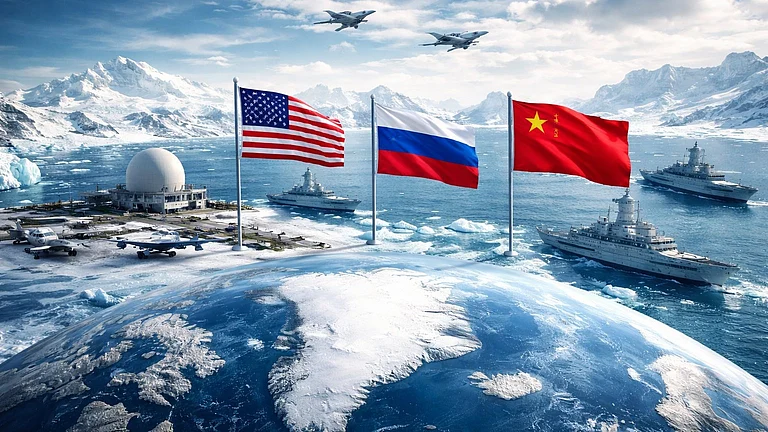
Trump has argued that if the US does not control Greenland, Russia or China could eventually do so, posing a national security risk — a position repeatedly cited by his administration.
US interest in Greenland is not new. Washington attempted to acquire the territory from Denmark in 1946, a proposal that was rejected. However, China’s growing diplomatic presence and Russia’s expanding military footprint in the Arctic have renewed US strategic interest in the region.
How Has the US Responded?
Speaking at the World Economic Forum summit in Davos, US Treasury Secretary Scott Bessent on Tuesday warned European leaders against retaliation, urging them to keep an “open mind.”
Advertisement
“I tell everyone, sit back. Take a deep breath. Do not retaliate. The president will be here tomorrow, and he will get his message across,” Bessent said. Trump is scheduled to arrive in Davos on Wednesday.
US Commerce Secretary Howard Lutnick and US Trade Representative Jamieson Greer have also cautioned that Washington would respond firmly to any retaliation, reports said.
The comments have heightened concerns over how an escalating tariff conflict could shape the global economy in 2026, as markets brace for increased volatility and uncertainty across regions.