Anthropic introduced 'observed exposure' to measure AI automation vs theoretical capability
Computer Programmers and Customer Service Reps are most exposed to displacement
Highly exposed workers are disproportionately female, older and highly educated
What Jobs Will AI Replace? Anthropic's New Metric Exposes Roles Most At-Risk
Anthropic’s 2026 labor report introduces "Observed Exposure," a metric tracking real-world AI automation

What Jobs Will AI Replace?
Summary
Advertisement
Anthropic in its recently released research report introduced a new metric called ‘observed exposure,’ for understanding AI’s potential impact on the labour market. In its report titled ‘Labor Market Impacts of AI: A New Measure and Early Evidence,’ the company describes observed exposure as a metric that combines the theoretical capabilities of large language models (LLMs) with real-world usage data.
The measure gives greater weight to cases where AI is used for automation rather than augmentation, and where the usage occurs in work-related or professional contexts.
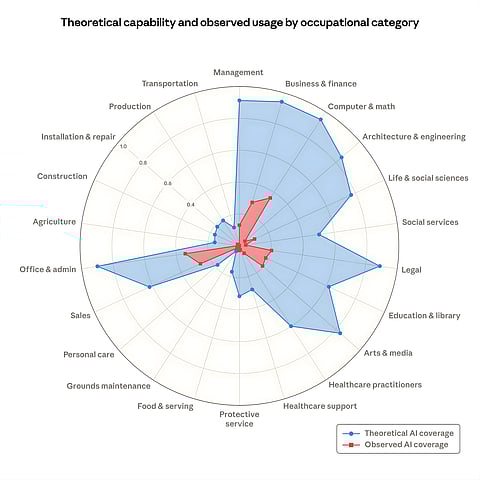
Explaining the metric in the report Anthropic stated, “Our new measure, observed exposure, is meant to quantify: of those tasks that LLMs could theoretically speed up, which are actually seeing automated usage in professional settings? Theoretical capability encompasses a much broader range of tasks. By tracking how that gap narrows, observed exposure provides insight into economic changes as they emerge.”

Advertisement
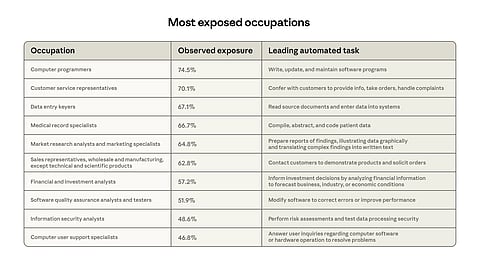
Most Exposed Occupations
Anthropic noted that the observed probability of a job being replaced by AI is much lower than the theoretical exposure estimates.
However, some occupations are still largely exposed to the AI displacement risks. As per the report, Computer Programmers are most exposed to the observed exposure measure with around 75% coverage. It was followed by Customer Service Representatives, whose main tasks we increasingly see in first-party API traffic.
Finally, Data Entry Keyers, whose primary task of reading source documents and entering data sees significant automation, are 67% covered.
At the bottom end, 30% of workers have zero coverage, as their tasks appeared too infrequently in our data to meet the minimum threshold. This group includes, for example, Cooks, Motorcycle Mechanics, Lifeguards, Bartenders, Dishwashers, and Dressing Room Attendants.
In the research, the concept was tested against early labour-market data and found limited evidence so far that AI has significantly affected overall employment levels.
Advertisement
The report also argues that many existing studies predicting widespread job displacement due to AI may be overstating the risks. It points to several examples where occupations previously labelled as highly vulnerable to AI disruption have continued to record steady or healthy employment growth, suggesting that the real-world impact of AI adoption on jobs may be more gradual and complex than earlier projections indicated.
Most Exposed Occupations Anthropic
How is Observed Exposure Determined
The observed exposure is designed to measure several qualitative aspects of AI use.
A job scores higher on exposure when: its tasks are theoretically possible to automate with AI; when those tasks show substantial usage in the Anthropic Economic Index; when tasks are performed in work-related contexts; when the job exhibits a larger share of automated use patterns or API implementations; and when the tasks likely affected by AI constitute a greater portion of the overall role.
To produce a single exposure value for each occupation, the report first aggregates task-level measures to the occupation level by averaging with weights based on our time-fraction measure. It then aggregates from occupations to occupation categories by averaging with weights proportional to total employment, producing the occupation-category exposure estimates used in our analyses.
Advertisement
Anthropic’s approach to measuring observed exposure combines data from three complementary sources. First, they draw on the O*NET database, which enumerates the tasks associated with roughly 800 US occupations. Second, they use their own usage data as captured by the Anthropic Economic Index. Third, they incorporate task-level exposure estimates from Eloundou et al. (2023), which evaluate whether a large language model could, in principle, make a task at least twice as fast.
Most Exposed Occupations Anthropic
Most Vulnerable Demographics
The report also highlights how certain demographic groups may be more exposed to the potential impacts of AI than others. Workers in occupations with the highest AI exposure differ noticeably from those in roles with little or no exposure.
The analysis measures these differences by comparing the characteristics of workers in the top quartile of exposure with the 30% of workers who had zero exposure during the three months before the public release of ChatGPT, specifically from August to October 2022. The data used for this comparison comes from the Current Population Survey.
Advertisement
The findings show that women are more represented in highly exposed occupations. About 54.4% of workers in the most AI-exposed group are female, compared to 38.8% in the unexposed group. Education levels also differ significantly. Workers with higher educational qualifications, particularly those holding a bachelor’s degree or higher, are disproportionately represented in high-exposure roles. In fact, individuals with graduate degrees are nearly four times more likely to fall within the most exposed quartile compared with those in the unexposed category.

The demographic composition also varies by race and ethnicity. White workers account for 65.1% of the highly exposed group, compared to 54.5% among workers in unexposed roles. Asian workers are also significantly more represented in high-exposure occupations, being nearly twice as likely to appear in this category. In contrast, Hispanic and Black workers are less represented in jobs with high levels of AI exposure.
Age differences are also evident, though more modest. The average age of workers in highly exposed occupations is slightly higher, at 42.9 years, compared with workers in roles that show no exposure to AI. Together, these patterns suggest that the workforce segments most affected by AI adoption tend to be more educated, somewhat older, and more likely to include women and certain racial groups.